In brief
At a glance
Quick Facts
- Status
- Transgressed
- Control variable
- Number of transgressed planetary boundaries
- Proposed boundary
- Zero boundaries transgressed
- Current value
- Six of nine boundaries transgressed (2023 assessment)
- Pre-industrial baseline
- Holocene epoch with no boundaries transgressed
Current status
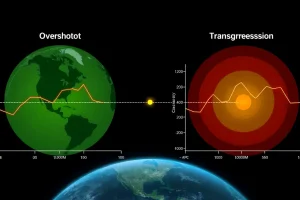
From the perspective of intergenerational justice, the planetary boundaries framework is currently in a state of transgression. As of the 2023 update by Richardson et al., six of the nine quantified planetary boundaries have been exceeded, indicating that humanity is operating outside the safe operating space that has characterized the Holocene—the stable Earth-system state that enabled human civilizations to develop. This transgression represents a profound failure of intergenerational equity, as the actions of the present generation are systematically eroding the environmental conditions necessary for the well-being of future generations.
Control variable
Unlike individual planetary boundaries that have specific control variables (e.g., atmospheric CO₂ concentration for climate change), the intergenerational justice dimension is assessed through a composite indicator: the number of planetary boundaries currently transgressed. This metric captures the overall pressure humanity exerts on Earth-system processes and serves as a proxy for the legacy being left to future generations. A safe intergenerational state is defined as zero transgressed boundaries, maintaining all Earth-system processes within the Holocene-like range that has supported human development for the past 11,700 years.
Proposed boundary or threshold
The proposed safe boundary for intergenerational justice is that all nine planetary boundaries remain within their safe operating space, i.e., zero transgressions. This threshold is derived from the ethical principle that current generations should not compromise the Earth-system stability upon which future generations depend. The danger zone is entered when any single boundary is transgressed, as this increases the risk of triggering irreversible tipping points and undermining the resilience of the Earth system. With six boundaries already transgressed, the world is currently in a high-risk zone for intergenerational equity.
Current measured value
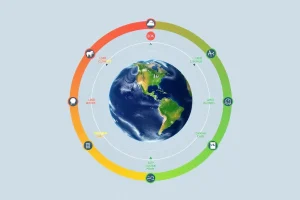
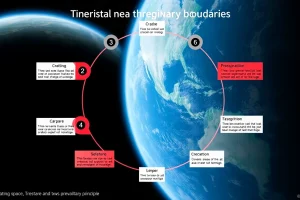
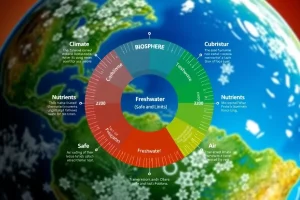
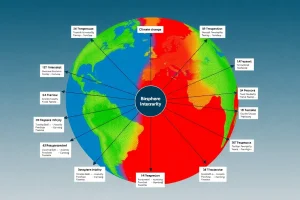
According to the 2023 assessment by Richardson et al., six of the nine planetary boundaries are transgressed: climate change, biosphere integrity (genetic diversity and functional integrity), land-system change, freshwater change, biogeochemical flows (nitrogen and phosphorus), and novel entities (including plastics and synthetic chemicals). Only stratospheric ozone depletion, atmospheric aerosol loading, and ocean acidification remain within the safe operating space, though ocean acidification is approaching the boundary. This means the current measured value is six boundaries transgressed, far exceeding the safe threshold of zero.
How the boundary is calculated
The intergenerational justice dimension is not calculated through a single Earth-system model but rather by aggregating the status of all nine planetary boundaries as defined by the scientific community. Each boundary has its own control variable, safe limit, and assessment methodology (e.g., ice-core data for climate, species extinction rates for biosphere integrity). The overall state is determined by counting how many boundaries are in the zone of increasing risk or high-risk zone. This composite approach reflects the precautionary principle: because uncertainties and interactions among boundaries can amplify risks, maintaining all boundaries within safe limits is the most robust way to protect future generations.
Historical trend
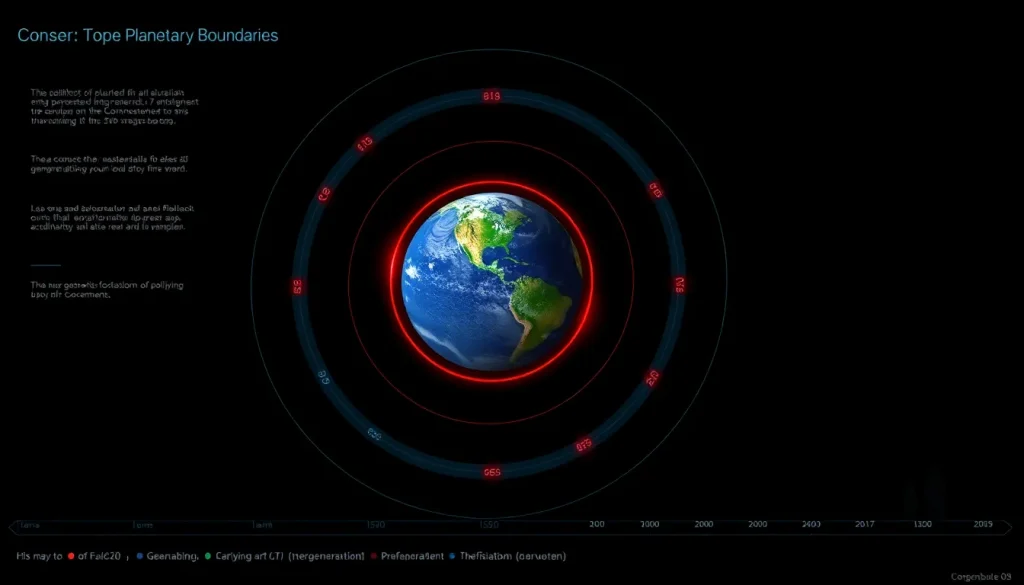
During the Holocene epoch (the last ~11,700 years), all planetary boundaries remained within safe limits, providing a stable environment for human civilizations to develop. The Industrial Revolution marked the beginning of significant anthropogenic pressure, with transgressions accelerating during the Great Acceleration of the mid-20th century. The first planetary boundary assessment in 2009 identified three transgressed boundaries (climate change, biosphere integrity, and nitrogen cycle). By 2015, four boundaries were transgressed (adding land-system change). The 2023 update found six boundaries transgressed, with freshwater change and novel entities newly exceeded. This trend shows a rapid erosion of the safe operating space, directly undermining the environmental inheritance of future generations.
What is driving the change
The primary drivers of boundary transgression are human activities linked to population growth, consumption patterns, and technological systems. These include fossil fuel combustion (climate change, ocean acidification), agricultural expansion and intensification (biosphere integrity, land-system change, biogeochemical flows, freshwater change), and industrial production of synthetic chemicals and waste (novel entities). Underlying these proximate drivers are economic systems that prioritize short-term growth over long-term sustainability, discount the future, and fail to account for the full social and environmental costs of resource use. This creates a systemic bias against the interests of future generations.
What crossing the boundary means
Crossing the intergenerational justice boundary—i.e., transgressing one or more planetary boundaries—means that the current generation is imposing irreversible changes on the Earth system that will harm future generations. Transgression increases the risk of crossing critical tipping points, such as the collapse of the West Antarctic Ice Sheet, dieback of the Amazon rainforest, or disruption of ocean circulation, which could lead to a qualitatively different and less hospitable Earth state. Once triggered, these changes cannot be undone on human timescales, effectively locking in consequences like sea-level rise, extreme weather, and biodiversity loss for centuries to millennia. This represents a fundamental injustice: future people will bear the costs of decisions they had no part in making.
Regional variations
While planetary boundaries are global in scope, the responsibility for transgressing them and the vulnerability to their impacts are highly uneven across regions. Historically, industrialized nations in the Global North have contributed disproportionately to boundary transgression through high per-capita resource consumption and emissions. In contrast, many regions in the Global South, which have contributed least to the problem, are often the most vulnerable to the consequences—such as sea-level rise threatening small island states, droughts affecting sub-Saharan Africa, and floods impacting South Asia. This spatial disconnect between cause and effect exacerbates intergenerational injustice, as the regions least responsible for environmental degradation will bear the heaviest burdens, and future generations in those regions will inherit the most severe challenges.
Interaction with other boundaries
Intergenerational justice is not a separate Earth-system boundary but a cross-cutting ethical principle that is affected by interactions among all boundaries. Transgressing one boundary can amplify pressures on others, creating cascading risks that compound the injustice for future generations. For example, climate change exacerbates biodiversity loss, which in turn reduces ecosystem resilience and the capacity to sequester carbon, further accelerating climate change. Similarly, land-system change and freshwater overuse can combine to degrade soil fertility and water availability, undermining food security for future populations. These interactions mean that the overall risk to future generations is greater than the sum of individual boundary transgressions.
Impacts on people and ecosystems
The transgression of planetary boundaries directly threatens the well-being of current and future human societies by undermining the ecosystem services upon which we depend. These include provisioning services (food, water, timber), regulating services (climate regulation, flood control, pollination), and cultural services (recreation, spiritual values). For future generations, the loss of biodiversity, stable climate, and fertile soils will constrain their ability to meet basic needs and pursue meaningful lives. The impacts are likely to be regressive, disproportionately affecting the poor, marginalized, and those in vulnerable regions, thereby widening inequalities both within and across generations.
Possible pathways back toward the safe zone
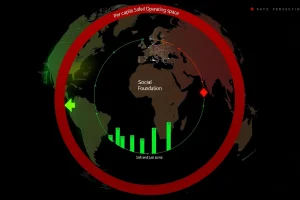
Returning to a safe intergenerational state requires reducing humanity’s pressure on all transgressed boundaries to within safe limits. This involves transformative changes across multiple sectors: rapid decarbonization of energy systems, sustainable food production (e.g., agroecology, reduced meat consumption), circular economy models to minimize waste and novel entities, and nature-based solutions to restore ecosystems. Governance innovations are equally critical, including the incorporation of long-term thinking into policy-making (e.g., future generations commissioners, constitutional environmental rights), reform of economic metrics beyond GDP, and international cooperation to manage global commons. The concept of ‘doughnut economics’ explicitly combines planetary boundaries with social foundations, offering a framework for achieving intergenerational justice.
Scientific uncertainty
Significant uncertainties surround the precise position of individual planetary boundaries, the interactions between them, and the timing of potential tipping points. The safe limits for some boundaries (e.g., novel entities, atmospheric aerosol loading) are poorly quantified due to data gaps and complex dynamics. Additionally, the Earth system’s response to multiple simultaneous transgressions is not fully understood, and there may be unknown feedbacks that could accelerate change. These uncertainties do not weaken the case for intergenerational justice; rather, they strengthen the argument for a precautionary approach that maintains a generous safe operating space to protect future generations against unforeseen risks.
Criticism and alternative frameworks
Critics of the planetary boundaries framework argue that it oversimplifies complex Earth-system dynamics, relies on arbitrary thresholds, and may not adequately capture regional heterogeneity. Some scholars contend that the framework’s global focus can obscure local environmental injustices and that it does not sufficiently address the distribution of responsibilities and impacts within the current generation. Alternative frameworks include ‘doughnut economics’ (Raworth, 2012), which integrates planetary boundaries with social foundations, and the ‘safe and just operating space’ concept, which explicitly incorporates intragenerational equity. Others advocate for rights-based approaches, such as the proposed crime of ‘ecocide’ or the recognition of legal rights for nature and future generations. These alternatives complement rather than replace the planetary boundaries framework in the context of intergenerational justice.
FAQ
How does the planetary boundaries framework relate to intergenerational justice?
The framework defines a safe operating space that must be maintained to ensure Earth-system stability for future generations. Transgressing boundaries imposes risks and harms on people who have no say in current decisions, violating the principle of intergenerational equity.
Is intergenerational justice a separate planetary boundary?
No, it is not a separate Earth-system process but an ethical lens through which the entire framework is evaluated. The number of transgressed boundaries serves as a proxy for the legacy being left to future generations.
What can be done to restore intergenerational justice within planetary boundaries?
Transformative changes in energy, food, and economic systems are needed to bring all boundaries back within safe limits. Governance reforms that prioritize long-term thinking, such as future generations commissioners and constitutional environmental rights, are also essential.
References
- Rockström, J., et al. (2009). A safe operating space for humanity. Nature, 461, 472–475.
- Steffen, W., et al. (2015). Planetary boundaries: Guiding human development on a changing planet. Science, 347(6223), 1259855.
- Richardson, K., et al. (2023). Earth beyond six of nine planetary boundaries. Science Advances, 9(37), eadh2458.
- Raworth, K. (2012). A safe and just space for humanity: Can we live within the doughnut? Oxfam Discussion Paper.
- Biermann, F., & Kim, R. E. (2020). The boundaries of the planetary boundary framework: A critical appraisal of approaches to define a 'safe operating space' for humanity. Annual Review of Environment and Resources, 45, 497–521.