In brief
At a glance
Quick Facts
- Status
- Six of nine boundaries transgressed as of 2023
- Control variable
- Multiple, process-specific indicators (e.g., CO₂ concentration, extinction rate, nitrogen fixation)
- Proposed boundary
- Varies by process; e.g., climate: 350 ppm CO₂, biosphere: <10 extinctions per million species-years
- Current value
- Climate: ~420 ppm CO₂; biosphere: >100 E/MSY; nitrogen fixation: ~150 Tg N/yr (2023 assessment)
- Pre-industrial baseline
- Holocene conditions (e.g., 280 ppm CO₂, background extinction rate ~0.1-1 E/MSY)
Current status
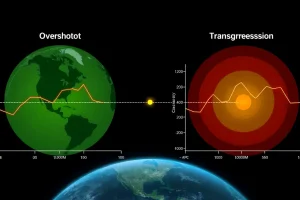
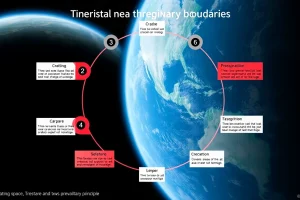
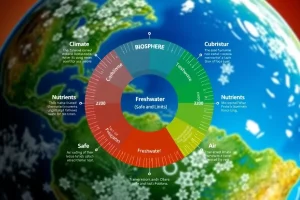
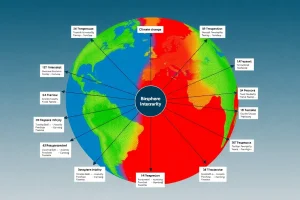
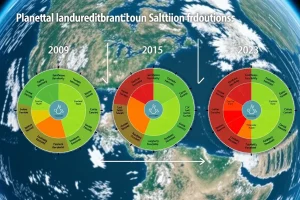
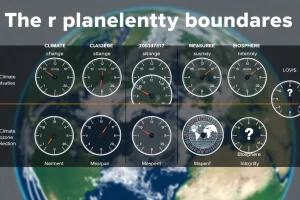
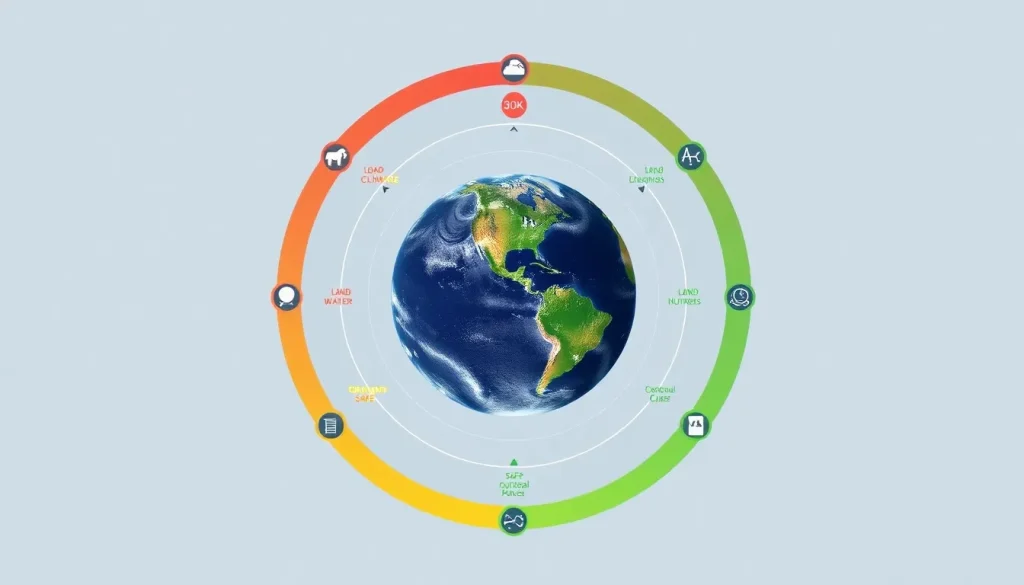
The planetary boundaries framework, first proposed in 2009 and updated in 2015 and 2023, assesses the state of nine Earth-system processes critical for maintaining a Holocene-like state. As of the 2023 update, six of the nine boundaries are assessed as transgressed: climate change, biosphere integrity (genetic diversity and functional integrity), land-system change, freshwater change, biogeochemical flows (nitrogen and phosphorus), and novel entities (chemical pollution). Ocean acidification is approaching the boundary, while stratospheric ozone depletion remains within the safe operating space (largely due to the Montreal Protocol). Atmospheric aerosol loading is not yet globally quantified. The framework thus signals that humanity is operating outside the safe space for multiple Earth-system processes, increasing the risk of large-scale, irreversible environmental changes.
Control variable
The planetary boundaries framework does not have a single control variable; rather, it defines one or more control variables for each of the nine Earth-system processes. A control variable is a measurable indicator that captures the state of the process relative to a Holocene baseline. Examples include atmospheric CO₂ concentration for climate change, genetic diversity (extinction rate) and functional integrity (e.g., human appropriation of net primary production) for biosphere integrity, and phosphorus flow to the ocean for biogeochemical flows. The choice of control variables is based on their ability to reflect the stability and resilience of the Earth system, their relevance to human pressures, and the availability of data. The framework’s strength lies in translating complex Earth-system dynamics into a limited set of actionable metrics, but the selection of control variables involves scientific judgment and is subject to revision as understanding improves.
Proposed boundary or threshold
The planetary boundaries framework proposes a “safe operating space” defined by a boundary value for each control variable. This boundary is not a single tipping point but a zone of increasing risk. For most boundaries, the framework sets a lower boundary (the limit of the safe operating space) and, where possible, an upper boundary (the threshold of high risk). For example, the climate change boundary is set at 350 ppm CO₂ (safe) and 450 ppm CO₂ (high risk), while the current value exceeds 420 ppm. For novel entities, no global boundary has yet been quantified. The boundaries are based on Earth-system science, paleo-records, and modeling, but they are inherently uncertain and represent expert judgment about acceptable risk levels. Policymakers can use these boundaries as reference points for setting targets, but the framework does not prescribe specific national or sectoral limits.
Current measured value
As of the 2023 assessment, six of the nine boundaries are transgressed. The control variables and their current values include: climate change (CO₂ concentration ~420 ppm, radiative forcing ~2.9 W/m²), biosphere integrity (extinction rate >100 extinctions per million species-years; functional integrity metrics declining), land-system change (global forest cover ~60% of original, below the 75% boundary), freshwater change (blue water consumption and streamflow deviations beyond regional boundaries), biogeochemical flows (industrial nitrogen fixation ~150 Tg N/yr, phosphorus flow to ocean ~22 Tg P/yr), and novel entities (production and release of synthetic chemicals and plastics exceed assessment capacity). Ocean acidification (saturation state of aragonite) remains just within the boundary but is declining. The framework thus provides a snapshot of global risk, but the aggregated global numbers mask significant regional heterogeneity.
How the boundary is calculated
The planetary boundaries framework is not a single model but a synthesis of Earth-system science. For each boundary, scientists review the literature to identify a control variable, a Holocene baseline range, and a threshold beyond which the risk of destabilizing the Earth system increases. The boundary is set at a distance from the threshold to account for uncertainty and to provide a safety margin. For example, the climate boundary uses CO₂ concentration and radiative forcing as proxies for the risk of triggering ice-sheet disintegration, permafrost thaw, and other feedbacks. The biosphere integrity boundary uses genetic diversity (extinction rate) and functional diversity (e.g., human appropriation of net primary production, Biodiversity Intactness Index). The methodology relies on Earth-system models, paleo-data, and expert elicitation. The framework does not calculate boundaries dynamically; they are periodically reassessed as science advances. Policymakers should understand that boundaries are not precise tipping points but risk indicators, and that the underlying science is continually evolving.
Historical trend
The planetary boundaries framework itself has evolved since its first publication in 2009. Initially, seven boundaries were proposed; later updates added two more (novel entities and atmospheric aerosol loading) and refined the control variables and boundary positions. The historical trend of the control variables shows a clear pattern: most have moved from the safe operating space toward or beyond the boundary since the Industrial Revolution. For example, atmospheric CO₂ has risen from ~280 ppm (pre-industrial) to over 420 ppm, crossing the 350 ppm boundary in the late 1980s. Human-induced nitrogen fixation has increased from near zero to over 150 Tg N/yr, far exceeding the boundary of ~62 Tg N/yr. The framework’s repeated assessments show that the number of transgressed boundaries has increased from three in 2009 to six in 2023, indicating accelerating human pressure on the Earth system. This trend underscores the urgency of policy action, but the framework does not provide a timeline for when critical thresholds might be crossed.
What is driving the change
The transgression of planetary boundaries is driven primarily by human activities: fossil fuel combustion, industrial agriculture, deforestation, freshwater extraction, and the production and release of synthetic chemicals and plastics. These activities are in turn driven by population growth, economic expansion, and consumption patterns. The framework highlights the interconnectedness of these drivers—for example, agricultural expansion contributes to climate change, biodiversity loss, land-system change, and nutrient pollution simultaneously. However, the framework does not attribute responsibility to specific countries, sectors, or actors, nor does it analyze the socioeconomic drivers in detail. It thus signals the need for systemic change but cannot tell policymakers which specific economic or social levers to pull.
What crossing the boundary means
Crossing a planetary boundary does not imply an immediate catastrophe but rather a shift from a safe operating space to a zone of increasing risk. In this zone, the likelihood of triggering non-linear, abrupt, or irreversible changes in Earth-system processes rises. For example, transgressing the climate boundary increases the risk of crossing tipping points such as the collapse of the Greenland ice sheet, dieback of the Amazon rainforest, or disruption of the Atlantic Meridional Overturning Circulation. Transgressing the biosphere integrity boundary undermines the resilience of ecosystems, reducing their capacity to provide essential services like carbon sequestration, pollination, and water purification. The framework emphasizes that boundaries interact, so crossing one can amplify the risk of crossing others. However, the framework cannot predict exactly when or where a tipping point will be crossed, nor can it quantify the precise consequences for specific regions or sectors.
Regional variations
Several planetary boundaries are inherently global (e.g., climate change, ocean acidification, stratospheric ozone depletion), but others have strong regional dimensions. The freshwater change boundary, for instance, is assessed at the river-basin scale, and many basins are already transgressed while others remain within safe limits. Biogeochemical flows also exhibit regional heterogeneity, with excessive nitrogen and phosphorus loading concentrated in agricultural regions. Land-system change is assessed globally but manifests as deforestation in tropical regions and boreal zones. The framework acknowledges that some boundaries must be defined at sub-global scales to be meaningful, and it provides regional assessments where data allow. However, the global aggregation of boundaries can obscure local risks and may not directly inform national or local policymaking. Policymakers need to complement the global boundaries with regional assessments to understand local vulnerabilities and responsibilities.
Interaction with other boundaries
A key insight of the planetary boundaries framework is that the nine boundaries are interconnected. Transgressing one boundary can increase the risk of transgressing others. For example, climate change exacerbates biosphere integrity loss through habitat shifts and extreme events, while land-system change contributes to climate change via carbon emissions and alters freshwater flows. Biogeochemical flows (nitrogen and phosphorus) can lead to freshwater eutrophication and marine dead zones, harming biosphere integrity. The introduction of novel entities (e.g., plastics, synthetic chemicals) can affect biosphere integrity and freshwater quality. The framework highlights these interactions conceptually but does not provide a dynamic, coupled model of all boundaries. Policymakers should be aware that addressing one boundary in isolation may have unintended consequences for others, and that integrated, cross-sectoral approaches are needed.
Impacts on people and ecosystems
Transgressing planetary boundaries poses systemic risks to human well-being and ecosystem services. Climate change beyond the boundary increases the frequency and intensity of extreme weather events, sea-level rise, and disruptions to food and water security. Biosphere integrity loss reduces nature’s contributions to people, including pollination, pest control, and carbon storage. Freshwater overuse leads to water scarcity, affecting agriculture, industry, and drinking water supplies. Nutrient pollution causes harmful algal blooms, dead zones, and health impacts from contaminated water. Novel entities can have toxic effects on wildlife and humans, with long-term, poorly understood consequences. The framework underscores that these impacts are not merely environmental but have profound economic and social dimensions. However, it does not provide a detailed impact assessment for specific regions or populations, nor does it quantify economic costs.
Possible pathways back toward the safe zone
The planetary boundaries framework suggests that returning to the safe operating space requires transformative changes in human systems. For climate change, this means rapid decarbonization and possibly carbon dioxide removal. For biosphere integrity, it requires halting habitat loss, restoring ecosystems, and reducing exploitation. For biogeochemical flows, it entails improving nutrient use efficiency, reducing fertilizer overuse, and managing livestock waste. For freshwater, it involves sustainable water management and reducing withdrawals. The framework can inform target-setting (e.g., net-zero emissions, 30% protected areas) but does not prescribe specific policies. It highlights the need for a precautionary approach, given the uncertainties and the risk of irreversible changes. Policymakers can use the boundaries as a dashboard to guide integrated strategies, but the framework does not provide a roadmap for the political, economic, and social transformations required.
Scientific uncertainty
The planetary boundaries framework is subject to significant scientific uncertainties. The position of each boundary is based on incomplete knowledge of Earth-system dynamics, threshold behavior, and feedbacks. For some boundaries (e.g., novel entities, atmospheric aerosol loading), the lack of data prevents quantification of a global boundary. Even for well-studied boundaries like climate change, the exact threshold for triggering irreversible ice-sheet loss is uncertain. The interactions among boundaries are poorly understood and not fully modeled. The framework uses a precautionary approach, setting boundaries at the lower end of the uncertainty range, but this choice is normative. Additionally, the global aggregation of some boundaries may mask regional tipping points. Policymakers should treat the boundaries as indicative risk levels, not precise guardrails, and should support ongoing research to reduce uncertainties.
Criticism and alternative frameworks
The planetary boundaries framework has been criticized on several grounds. Some scientists argue that the concept of a single global boundary for processes like biodiversity loss or land-system change is overly simplistic and ignores regional heterogeneity. Others question the choice of control variables and the evidence for global thresholds. The framework has also been critiqued for its potential to be misinterpreted as a license to pollute up to the boundary, or for shifting focus away from local environmental issues. Alternative or complementary frameworks include the “doughnut economics” model, which combines planetary boundaries with social foundations; the “safe and just Earth system boundaries” approach, which adds justice considerations; and the “Earth-system impact” metrics used in life-cycle assessment. Some researchers advocate for a more dynamic, process-based approach that models Earth-system interactions explicitly. Despite these criticisms, the framework remains influential as a high-level communication tool and a starting point for global sustainability governance.
FAQ
What is the planetary boundaries framework?
It is a scientific framework that identifies nine Earth-system processes critical for maintaining a stable and resilient planet, and proposes quantitative boundaries for each to define a safe operating space for humanity.
How can policymakers use the planetary boundaries framework?
Policymakers can use it as a high-level dashboard to understand global environmental risks, set long-term sustainability targets, and guide integrated policy development. However, it does not prescribe specific national policies or allocate responsibilities.
What are the main limitations of the framework for policymaking?
The framework does not provide local or regional guidance, cannot predict exact tipping points, does not account for socioeconomic dynamics, and involves significant scientific uncertainties. It is a risk-assessment tool, not a policy blueprint.
References
- Rockström, J., et al. (2009). A safe operating space for humanity. Nature, 461, 472–475.
- Steffen, W., et al. (2015). Planetary boundaries: Guiding human development on a changing planet. Science, 347(6223), 1259855.
- Richardson, K., et al. (2023). Earth beyond six of nine planetary boundaries. Science Advances, 9(37), eadh2458.
- Lenton, T. M., et al. (2019). Climate tipping points — too risky to bet against. Nature, 575, 592–595.
- Persson, L., et al. (2022). Outside the safe operating space of the planetary boundary for novel entities. Environmental Science & Technology, 56(3), 1510–1521.