In brief
At a glance
Quick Facts
- Also known as
- Warming in the pipeline or unavoidable warming.
- Primary driver
- Thermal inertia of the oceans, which absorb over 90% of excess heat.
- Constant concentration commitment
- Additional warming of 0.3–0.8°C by 2100 if CO₂ levels were stabilized at year 2000 values.
- Zero emissions commitment
- Surface warming may stabilize within decades if all emissions cease, but sea level rise continues for centuries.
- Ocean heat uptake
- The ocean has absorbed enough heat to raise its temperature by about 0.1°C per decade since the 1970s.
- Distinction from committed emissions
- Committed emissions refer to future CO₂ from existing infrastructure; committed warming is the temperature response to past emissions.
- IPCC estimate
- The IPCC AR5 estimated committed warming of about 0.6°C over the 21st century from past emissions alone.
- Regional variation
- Land areas warm faster than oceans, and the Arctic warms at roughly twice the global average rate.
- Slow feedbacks
- Permafrost thaw and ice sheet melt could increase committed warming beyond current model estimates.
- Policy relevance
- Committed warming defines the minimum adaptation needed and highlights the urgency of emission cuts to avoid greater warming.
Key Takeaways
- Committed warming is the future global temperature increase that is already locked in due to past greenhouse gas emissions, even if all emissions were to stop immediately.
- It is primarily driven by the thermal inertia of the oceans, which continue to absorb and redistribute heat over decades to centuries, delaying the full surface temperature response.
- Two distinct definitions exist: warming committed under constant atmospheric concentrations and warming committed under zero future emissions, with the latter being smaller because natural carbon sinks remove CO₂ from the atmosphere.
- Understanding committed warming is essential for climate adaptation planning and for recognizing that immediate emission reductions are necessary to avoid even greater warming beyond what is already unavoidable.
What Is Committed Warming?
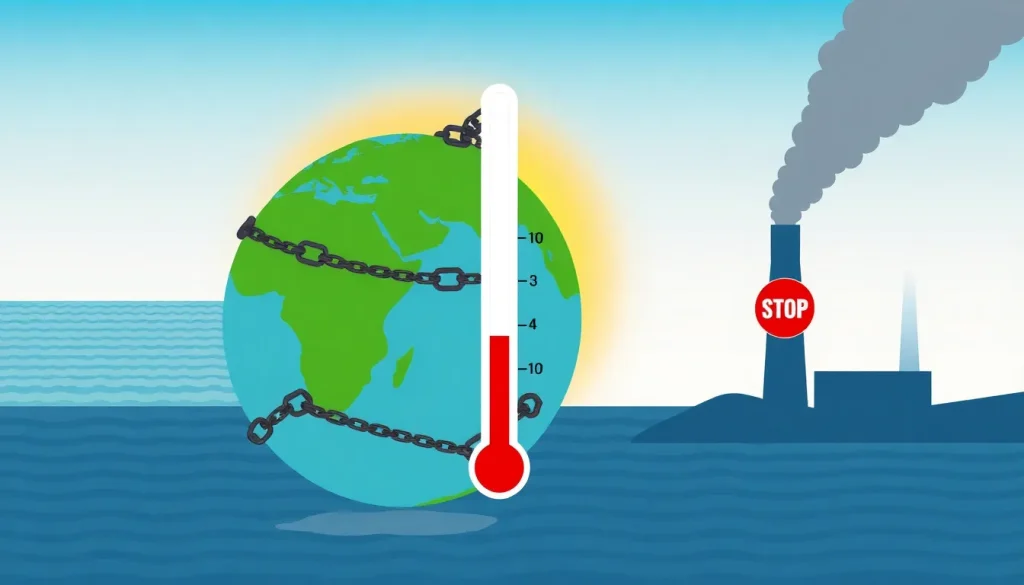
Committed warming is the amount of future global surface temperature increase that is already unavoidable due to past and present greenhouse gas emissions, even if all human-caused emissions were to cease immediately. It represents the warming that is “in the pipeline” and cannot be prevented by any future mitigation actions. This concept is central to climate science because it quantifies the minimum climate change that societies must prepare for, regardless of how quickly emissions are reduced.
The term encompasses two related but distinct ideas. The first, often called “constant concentration commitment,” refers to the warming that would still occur if atmospheric greenhouse gas concentrations were stabilized at current levels. Because the climate system responds slowly, the planet would continue to warm for decades or longer until it reaches equilibrium with those fixed concentrations. The second, known as “zero emissions commitment,” describes the warming that would follow an abrupt and complete cessation of all human-caused emissions. In this scenario, natural carbon sinks gradually draw down atmospheric CO₂, so the committed warming is typically smaller than under constant concentrations. Both interpretations highlight the inertia of the climate system and the long-lasting consequences of emissions already released.
Overview
Committed warming is a fundamental concept in climate projections, helping to separate the warming that is already locked in from the additional warming that depends on future emission pathways. It is sometimes referred to as “warming in the pipeline” or “unavoidable warming.” The idea emerged from early climate model experiments that showed even if greenhouse gas concentrations were stabilized, global temperatures would continue to rise for centuries due to the slow response of the oceans. This lag is a result of the large heat capacity of the ocean, which absorbs over 90% of the excess energy trapped by greenhouse gases, delaying the full surface warming.
In policy discussions, committed warming is often contrasted with “committed emissions” — the future emissions that will come from existing fossil fuel infrastructure if it operates for its full lifetime. While committed emissions can be reduced by retiring or retrofitting power plants and industrial facilities, committed warming is already baked into the system and can only be addressed through adaptation and, potentially, large-scale carbon dioxide removal. The concept underscores the urgency of early action: the longer emissions remain high, the greater the committed warming becomes, locking in more severe impacts for future generations.
How It Works
The physical basis for committed warming lies in the thermal inertia of the climate system, primarily the oceans. When greenhouse gases trap heat in the atmosphere, most of that excess energy is absorbed by the upper layers of the ocean, which warm slowly. This ocean heat uptake delays the full equilibrium warming that would occur if the atmosphere and ocean were instantly in balance. As the ocean continues to absorb heat, it gradually warms, and some of that heat is later released back to the atmosphere, causing surface temperatures to rise further even if greenhouse gas concentrations stop increasing.
Under a scenario where atmospheric CO₂ concentrations are stabilized at current levels, the planet would continue to warm for centuries until the ocean reaches thermal equilibrium. This is because the ocean’s immense heat capacity means it takes a long time to warm up fully. In contrast, if emissions are abruptly cut to zero, natural carbon sinks — such as the ocean and terrestrial biosphere — begin to remove CO₂ from the atmosphere. This drawdown reduces the greenhouse effect over time, partially offsetting the delayed warming from ocean heat release. As a result, the zero emissions commitment is typically smaller and may even be near zero for CO₂, though warming from other greenhouse gases and aerosols complicates the picture.
Several feedback mechanisms also influence committed warming. For example, as the planet warms, ice sheets and snow cover retreat, reducing the Earth’s reflectivity (albedo) and causing additional warming. Thawing permafrost can release methane and CO₂, further amplifying the greenhouse effect. These slow feedbacks are not fully accounted for in many models, meaning that actual committed warming could be higher than current estimates. Additionally, the spatial pattern of warming is not uniform: land areas warm faster than oceans, and the Arctic warms several times faster than the global average, so committed warming has regionally distinct impacts.
What the Evidence Shows
Climate models have consistently demonstrated the existence of committed warming. Early simulations with coupled atmosphere-ocean general circulation models showed that even if CO₂ concentrations were stabilized at year 2000 levels, global mean surface temperature would rise by an additional 0.3–0.8°C by the end of the 21st century. The Intergovernmental Panel on Climate Change (IPCC) Fifth Assessment Report estimated that the committed warming from past emissions alone, without any future emissions, is about 0.6°C over the 21st century relative to the pre-industrial period.
More recent research has refined these estimates, particularly for the zero emissions scenario. A landmark study published in 2020 found that if all human-caused emissions were suddenly halted, global surface temperatures would likely stabilize within a couple of decades, with little additional warming. This finding suggests that the zero emissions commitment for CO₂ may be close to zero, because the cooling effect of declining atmospheric CO₂ roughly balances the delayed warming from the oceans. However, this does not mean that all warming stops immediately; rather, the temperature plateaus near the level reached when emissions cease. It is important to note that this applies primarily to CO₂; other greenhouse gases like methane have different lifetimes, and aerosols have a cooling effect that would diminish quickly if emissions stopped, potentially causing a temporary warming spike.
Observational evidence also supports the concept. The Earth’s energy imbalance — the difference between incoming solar radiation and outgoing longwave radiation — has been positive for decades, indicating that the planet is still accumulating heat. Ocean heat content continues to rise, and sea levels are increasing due to thermal expansion and ice melt, both of which will persist for centuries even if surface warming stabilizes. These observations confirm that the climate system is not yet in equilibrium and that further changes are already committed.
Importance and Impact
Committed warming has profound implications for climate policy and adaptation. It defines the minimum level of climate change that societies must prepare for, regardless of mitigation efforts. This unavoidable warming will lead to a range of impacts, including more frequent and intense heatwaves, changes in precipitation patterns, sea level rise, and ecosystem disruptions. Understanding the magnitude of committed warming helps governments and communities plan infrastructure, agriculture, and disaster response for a world that is already certain to be warmer than today.
For mitigation, the concept underscores the urgency of reducing emissions as quickly as possible. Every additional ton of greenhouse gases emitted increases the committed warming, locking in more severe and potentially irreversible changes. While some warming is already unavoidable, the worst-case scenarios can still be avoided by rapid decarbonization. Committed warming also highlights the potential role of carbon dioxide removal technologies, which could theoretically reduce atmospheric concentrations and thus lower the committed warming from past emissions, though such approaches face significant technical, economic, and environmental challenges.
On a human level, committed warming means that vulnerable populations, particularly in low-lying coastal areas and regions dependent on climate-sensitive resources, will face increasing risks. Adaptation measures such as sea walls, drought-resistant crops, and improved early warning systems become essential. The concept also carries ethical dimensions, as the warming committed by historical emissions from industrialized nations disproportionately affects developing countries that have contributed least to the problem.
Common Misconceptions
One common misconception is that committed warming means further warming is inevitable no matter what we do, implying that mitigation efforts are futile. In reality, committed warming represents only the minimum unavoidable warming; the total amount of future warming depends heavily on emission choices made today and in the coming decades. Rapid and sustained emission reductions can prevent additional warming beyond the committed amount.
Another misunderstanding is equating committed warming with projected warming under business-as-usual scenarios. Projected warming includes both committed warming and the warming from future emissions. If emissions continue to rise, the actual warming will far exceed the committed warming. Conversely, confusing committed warming with the warming that would occur if concentrations were stabilized can lead to overestimates of the zero emissions commitment. As research has shown, if emissions go to zero, the warming commitment is much smaller than if concentrations are held constant.
Some also mistakenly believe that committed warming means temperatures will continue to rise for centuries even after emissions stop. While this is true for the constant concentration scenario, the zero emissions scenario suggests that surface warming may level off relatively quickly. However, other aspects of climate change, such as sea level rise and ice sheet melt, will continue for centuries due to the slow response of the cryosphere and deep ocean, representing a different kind of commitment.
Data Limitations and Uncertainties
Estimates of committed warming are subject to several uncertainties. Climate models differ in their representation of ocean heat uptake, cloud feedbacks, and carbon cycle processes, leading to a range of committed warming values. The treatment of aerosols is particularly challenging: aerosols have a cooling effect that masks some of the greenhouse warming, and if emissions were to cease, the rapid decline of aerosols could unmask additional warming, complicating the zero emissions commitment.
Another uncertainty involves slow feedbacks such as permafrost thaw and methane hydrate destabilization, which are not fully included in most models. These processes could add to committed warming over longer timescales. Additionally, the response of natural carbon sinks to future climate change is not perfectly known; if sinks weaken, atmospheric CO₂ would decline more slowly, increasing the zero emissions commitment. Ongoing research and improved Earth system models continue to refine these estimates, but the fundamental conclusion remains: past emissions have already committed the planet to some additional warming, and the magnitude of that commitment depends on the complex interplay of physical and biogeochemical processes.
FAQ
What is committed warming?
Committed warming is the future increase in global average temperature that is already unavoidable due to past and present greenhouse gas emissions, even if all human-caused emissions were to stop immediately. It represents the minimum warming that societies must adapt to.
How does committed warming differ from projected warming?
Projected warming includes both committed warming (from past emissions) and additional warming from future emissions. Committed warming is the locked-in portion, while projected warming depends on emission scenarios and can be much higher if emissions continue to rise.
Why does committed warming matter for climate policy?
It defines the unavoidable climate impacts that require adaptation, and it underscores the urgency of reducing emissions quickly. Every delay increases the committed warming, locking in more severe consequences for future generations.
References
- IPCC, 2013: Climate Change 2013: The Physical Science Basis. Contribution of Working Group I to the Fifth Assessment Report of the Intergovernmental Panel on Climate Change.
- MacDougall, A. H., et al. (2020). Is there warming in the pipeline? A multi-model analysis of the Zero Emissions Commitment from CO2. Biogeosciences, 17, 2987–3016.
- Mauritsen, T., & Pincus, R. (2017). Committed warming inferred from observations. Nature Climate Change, 7, 652–655.
- NASA Global Climate Change: Vital Signs of the Planet – 'Committed Warming' (https://climate.nasa.gov/).