In brief
At a glance
Quick Facts
- Definition
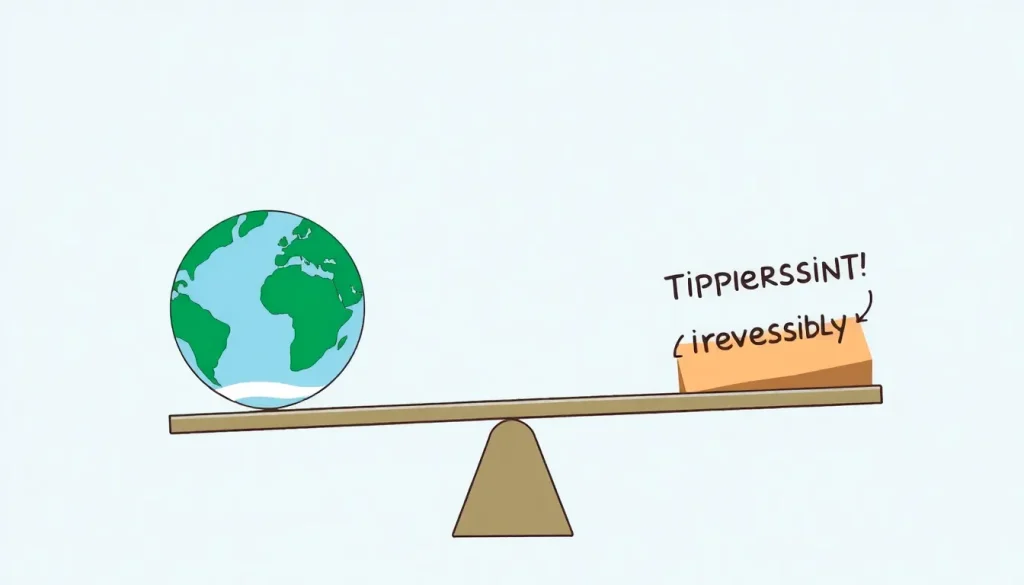
- A climate tipping point is a critical threshold beyond which a system reorganizes, often abruptly and/or irreversibly.
- Key Examples
- Ice sheet collapse, Amazon rainforest dieback, permafrost thaw, and Atlantic Ocean circulation slowdown are major tipping elements.
- Irreversibility Timescale
- Some tipping points, like ice sheet loss, are effectively irreversible for centuries to millennia once triggered.
- Hysteresis
- Many climate systems exhibit hysteresis, meaning the forcing must be reduced far below the tipping point to reverse the change.
- Policy Threshold
- The Paris Agreement's 1.5–2°C target is designed in part to avoid crossing irreversible tipping points.
- Cascading Risks
- Tipping points can interact, where crossing one increases the likelihood of crossing others, complicating reversal.
- Uncertainty
- Exact thresholds and reversibility of many tipping points remain uncertain, but risk increases with warming.
- Paleoclimate Evidence
- Past climate shifts show that ice sheets and ecosystems have undergone abrupt, long-lasting changes.
Key Takeaways
- Climate tipping points are critical thresholds where a small perturbation can trigger a large, often self-perpetuating change in a component of the Earth system.
- Some tipping points, such as the collapse of major ice sheets, are considered effectively irreversible on human timescales due to long recovery periods and self-reinforcing feedbacks.
- Other tipping points, like shifts in ecosystems or ocean circulation, may be reversible if the underlying forcing is reduced, but the path to recovery often involves hysteresis—requiring a much larger reduction in forcing than the initial trigger.
- The potential irreversibility of many tipping points makes their avoidance a central goal of climate policy, as crossing them could lock in severe and long-lasting impacts.
What Is Can Climate Tipping Points Be Reversed?
The question “Can climate tipping points be reversed?” refers to the scientific inquiry into whether large-scale, potentially abrupt changes in the Earth’s climate system—once triggered—can be undone by reducing the forcing that caused them, such as lowering greenhouse gas concentrations. A climate tipping point is a threshold beyond which a component of the climate system (a “tipping element”) undergoes a qualitative change in state, often driven by self-reinforcing feedbacks. The reversibility of such a shift depends on the nature of the system, the strength of the feedbacks, and the timescale considered. In many cases, even if reversal is theoretically possible, it may require a much larger reduction in forcing than what triggered the change, and the recovery could take centuries to millennia.
This concept is not about a single event but rather a property of multiple critical Earth system components, including ice sheets, ocean circulation patterns, ecosystems, and biogeochemical cycles. The question of reversibility is central to climate risk assessment because it determines whether crossing a tipping point leads to permanent damage or a state from which recovery is feasible. Understanding the reversibility of these thresholds helps policymakers and scientists evaluate the long-term consequences of current emissions and the urgency of mitigation efforts.
Overview
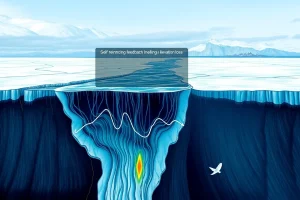
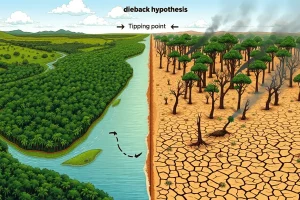
The Earth’s climate system contains several large-scale components that could exhibit tipping behavior. These include the Greenland and Antarctic ice sheets, the Atlantic Meridional Overturning Circulation (AMOC), the Amazon rainforest, coral reefs, permafrost carbon stores, and monsoon systems. Each of these tipping elements has a critical threshold—often expressed as a level of global warming—beyond which it may shift into a new state. For example, the Greenland ice sheet could commit to irreversible melting if global temperatures exceed a certain level, leading to meters of sea-level rise over centuries. The Amazon rainforest might transition from a moist, carbon-absorbing forest to a drier, fire-prone savanna if deforestation and warming pass a critical point.
The reversibility of these tipping points varies widely. Some, like the loss of Arctic summer sea ice, are considered reversible on relatively short timescales if temperatures are lowered, because the ice can regrow. Others, like the collapse of the West Antarctic Ice Sheet, involve processes that are effectively irreversible once initiated, because the ice sheet’s grounding line retreats into deeper basins, leading to unstoppable ice discharge. The concept of “irreversibility” here is often defined on human timescales—meaning that even if the original forcing is removed, the system will not return to its original state for many centuries or millennia. This distinction is crucial for understanding the long-term commitment of current emissions.
How It Works
The dynamics of tipping points and their reversibility are governed by feedback mechanisms and the shape of the system’s potential landscape. A tipping point occurs when a system, initially in a stable state, is pushed by a forcing (such as rising temperature) past a critical threshold. At this point, positive feedbacks—processes that amplify the initial change—dominate, driving the system toward a new, often very different stable state. For example, as Arctic sea ice melts, the darker ocean surface absorbs more sunlight, causing further warming and more ice melt. This self-reinforcing loop can make the transition abrupt and difficult to stop once initiated.
Reversibility depends on whether the system exhibits hysteresis. In a system with hysteresis, the forcing must be reduced well below the level that triggered the initial shift to return to the original state. This is because the feedbacks that pushed the system into the new state now work to keep it there. For instance, if the Amazon rainforest tips to a savanna state, the drier local climate and altered soil conditions may prevent forest regrowth even if temperatures are later reduced. The system may have two stable states for the same external conditions, and a large perturbation is needed to flip it back. In contrast, some tipping points may be more symmetric, where reducing the forcing back below the threshold allows a gradual recovery. However, many climate tipping elements are thought to exhibit strong hysteresis, making reversal difficult or impossible on policy-relevant timescales.
What the Evidence Shows
Scientific understanding of tipping point reversibility comes from a combination of paleoclimate records, observational data, and model simulations. Paleoclimate evidence reveals that Earth’s climate has undergone abrupt shifts in the past, such as the rapid warming events during the last ice age and the collapse of ice sheets. These events provide natural experiments for studying irreversibility. For example, during the last interglacial period, sea levels were 6–9 meters higher than today, likely due to partial loss of the Greenland and West Antarctic ice sheets, indicating that these ice sheets can tip and remain in a reduced state for millennia.
Modeling studies suggest that many tipping elements have critical thresholds between 1.5°C and 2°C of global warming above pre-industrial levels. For the Greenland ice sheet, the threshold may be as low as 0.8–3°C, with a likely range around 1.5°C. Once crossed, the ice sheet would eventually melt almost completely, raising sea levels by about 7 meters over thousands of years. Even if temperatures were later reduced, the ice sheet would not regrow unless temperatures dropped significantly below pre-industrial levels—a state that is not naturally achievable in the current interglacial. Similarly, the West Antarctic Ice Sheet may have already passed a tipping point in some regions, with irreversible retreat underway. For the AMOC, models indicate a collapse could be triggered by freshwater input from melting ice, and recovery might require a cooling far below present temperatures, making it effectively irreversible for centuries. Ecosystem tipping points, like coral reef bleaching, show that while individual corals can recover if heat stress is removed, repeated bleaching events can lead to permanent ecosystem shifts.
Importance and Impact
The question of reversibility has profound implications for climate policy and risk management. If a tipping point is irreversible, crossing it commits future generations to permanent changes such as multi-meter sea-level rise, altered weather patterns, and loss of biodiversity. This creates a strong argument for precautionary action: the cost of preventing a tipping point is far lower than the cost of adapting to an irreversible change. The potential for cascading tipping points—where one event triggers others—further amplifies the risk. For example, Greenland ice melt could slow the AMOC, which in turn could shift tropical rainfall patterns and accelerate Amazon dieback.
From an economic and social perspective, irreversible changes impose long-term costs that are difficult to quantify but likely enormous. Coastal cities, agricultural systems, and water resources could be permanently altered. The concept of “committed impacts”—changes that are locked in even if emissions stop—highlights the urgency of early mitigation. Even if some tipping points are technically reversible, the timescales involved (centuries to millennia) mean that for all practical purposes, they are permanent on human planning horizons. This understanding has led to the framing of climate targets, such as the Paris Agreement’s goal to limit warming to well below 2°C, precisely to avoid crossing these irreversible thresholds.
Solutions
The primary strategy for addressing the risk of irreversible tipping points is to prevent them from being crossed in the first place. This requires rapid and sustained reductions in greenhouse gas emissions to keep global warming as low as possible. Strengthening natural carbon sinks, such as forests and wetlands, can also help reduce net forcing. In addition to mitigation, adaptation measures are necessary to cope with changes that may already be unavoidable, such as sea-level rise from ice sheets that have already been destabilized.
Some proposed interventions aim to directly reverse or stabilize tipping elements, though these are largely theoretical and carry significant risks and uncertainties. For example, geoengineering approaches like solar radiation management could temporarily cool the planet, potentially reducing the risk of crossing some tipping points, but they do not address ocean acidification and could have unintended side effects. More targeted interventions, such as building sea walls to slow ice sheet collapse or artificially restoring ecosystems, are in early research stages. However, the scale and complexity of these interventions make them uncertain and potentially infeasible. The most reliable solution remains aggressive emissions reductions, combined with monitoring and early warning systems to detect approaching tipping points.
FAQ
What is a climate tipping point?
A climate tipping point is a critical threshold at which a small additional perturbation can trigger a large, often self-perpetuating change in a component of the Earth system, such as an ice sheet or ecosystem.
Can climate tipping points be reversed?
It depends on the tipping point. Some, like Arctic sea ice loss, may be reversible if temperatures drop. Others, like ice sheet collapse, are effectively irreversible on human timescales due to long recovery periods and strong feedbacks. Many systems exhibit hysteresis, meaning reversal requires a much larger reduction in forcing than what caused the initial change.
Why does the reversibility of tipping points matter?
Irreversible tipping points commit the planet to long-term changes like sea-level rise and altered weather patterns, making adaptation more difficult and costly. Understanding reversibility helps policymakers set climate targets to avoid crossing these thresholds and emphasizes the urgency of reducing emissions.
References
- Lenton, T. M., et al. (2008). Tipping elements in the Earth's climate system. Proceedings of the National Academy of Sciences, 105(6), 1786–1793.
- IPCC (2021). Climate Change 2021: The Physical Science Basis. Contribution of Working Group I to the Sixth Assessment Report. Cambridge University Press.
- Steffen, W., et al. (2018). Trajectories of the Earth System in the Anthropocene. Proceedings of the National Academy of Sciences, 115(33), 8252–8259.