In brief
At a glance
Quick Facts
- What is the AMOC?
- The Atlantic Meridional Overturning Circulation, a system of ocean currents that transports warm water northward and cold water southward in the Atlantic.
- How much could the AMOC weaken?
- Climate models project a 10% to 50% reduction in strength by 2100 under high-emission scenarios.
- Regional cooling
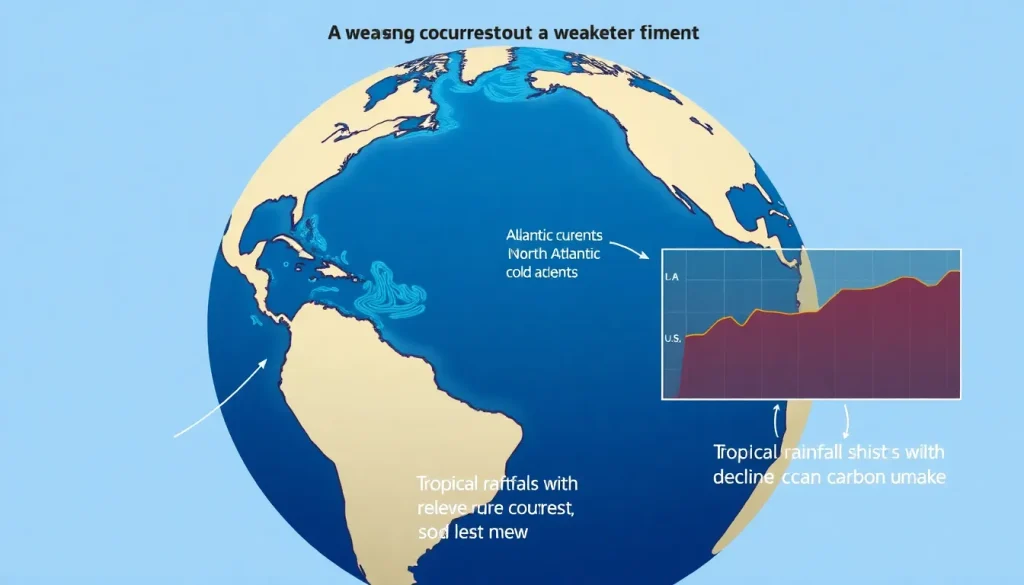
- A weaker AMOC could cause parts of the North Atlantic to cool by several degrees Celsius, even as the rest of the world warms.
- Sea level rise on U.S. East Coast
- An additional 20–50 cm of sea level rise could occur due to circulation changes, beyond the global average.
- Tropical rainfall shift
- The Intertropical Convergence Zone would shift southward, reducing rainfall in the Sahel, South Asia, and the Amazon.
- Carbon uptake decline
- A weaker AMOC would reduce the ocean's ability to absorb CO2, leaving more in the atmosphere and accelerating warming.
- Observation period
- Direct continuous measurements of the AMOC began in 2004 with the RAPID array, providing a relatively short record.
- Past behavior
- Paleoclimate evidence shows the AMOC has weakened or shut down during glacial periods, but current changes are human-driven.
Key Takeaways
- A weaker AMOC would cause significant cooling in the North Atlantic region, partially offsetting global warming there but disrupting weather patterns across Europe and North America.
- Sea levels along the U.S. East Coast could rise by an additional 20–50 cm due to changes in ocean circulation, exacerbating coastal flooding.
- Tropical rainfall belts would shift southward, threatening water and food security in the Sahel, South Asia, and the Amazon basin.
- The ocean’s ability to absorb carbon dioxide would decline, accelerating the pace of global warming.
What Is What Would a Weaker AMOC Mean for Climate?
A weaker AMOC means a reduction in the strength of the Atlantic Meridional Overturning Circulation, a vast system of ocean currents that transports warm surface water northward and cold deep water southward through the Atlantic Ocean. This circulation plays a critical role in regulating Earth’s climate by redistributing heat, influencing weather patterns, and cycling carbon and nutrients. When scientists ask what a weaker AMOC would mean for climate, they are exploring the cascading consequences of a slowdown in this vital planetary “conveyor belt.”
The AMOC is part of the global thermohaline circulation, driven by differences in water density caused by temperature and salinity. A weakening can be triggered by increased freshwater input from melting ice sheets and enhanced precipitation, which reduces the density of surface water in the North Atlantic and slows the sinking that powers the circulation. While a complete shutdown is considered a low-probability, high-impact event, even a moderate weakening would have profound effects on regional and global climate, sea level, and marine ecosystems.
Overview
The AMOC is a key component of Earth’s climate system, moving roughly 15–20 million cubic meters of water per second in its upper limb. It transports heat from the tropics to the North Atlantic, where the water cools, sinks, and returns southward at depth. This process keeps Northern Europe several degrees warmer than it would otherwise be and influences the position of the Intertropical Convergence Zone (ITCZ), a critical rainfall belt. A weaker AMOC would reduce this northward heat transport, leading to a cascade of climate impacts that extend far beyond the Atlantic basin.
Climate models consistently project that the AMOC will weaken over the 21st century under continued greenhouse gas emissions, with estimates ranging from a 10% to 50% reduction in strength. The consequences of such a slowdown are wide-ranging, affecting temperature, precipitation, sea level, and marine ecosystems across the globe. Understanding these potential impacts is essential for assessing the risks of future climate change and informing adaptation strategies.
How It Works
The AMOC operates like a giant oceanic conveyor belt. Warm, salty surface water flows northward from the tropics into the North Atlantic, where it releases heat to the atmosphere—helping to moderate the climate of Western Europe. As the water cools and becomes denser, it sinks to the deep ocean and flows southward, eventually upwelling in the Southern Ocean and other regions. This sinking process, known as deepwater formation, is the engine of the AMOC and occurs primarily in the Nordic and Labrador Seas.
A weaker AMOC means that this overturning circulation slows down. The primary drivers of weakening are increased freshwater input from melting ice sheets (particularly Greenland) and enhanced precipitation in the North Atlantic, both of which reduce surface water density and inhibit sinking. As the circulation weakens, less warm water is transported northward, leading to regional cooling, while the deep ocean absorbs less heat and carbon. The slowdown also alters the distribution of sea surface temperatures, which in turn shifts atmospheric pressure patterns, storm tracks, and precipitation belts around the world.
Importance and Impact
The AMOC is a linchpin of the global climate system, and its weakening would have far-reaching consequences. One of the most immediate impacts would be a cooling of the North Atlantic region, particularly around the Nordic Seas and the British Isles. This “warming hole” could partially counteract global warming in those areas, but it would also disrupt established weather patterns, potentially leading to more extreme winter storms in Europe and altered monsoon systems in Africa and Asia.
Beyond temperature, a weaker AMOC would affect global sea level. The circulation currently pulls water northward, causing a depression in sea level in the North Atlantic. A slowdown would cause this water to “slosh” back, leading to a rapid rise in sea level along the U.S. East Coast—potentially adding tens of centimeters to the global average rise. This would significantly increase the risk of coastal flooding in cities like New York, Boston, and Miami. Additionally, a weaker AMOC would reduce the ocean’s ability to absorb carbon dioxide, leaving more CO2 in the atmosphere and accelerating global warming.
Regional Differences
The impacts of a weaker AMOC would not be uniform; different regions would experience distinct and sometimes opposing effects. In the North Atlantic, cooling would be most pronounced, with parts of the Nordic Seas and the subpolar gyre potentially cooling by several degrees Celsius, even as the rest of the world warms. This cooling could lead to harsher winters in the UK and Scandinavia, and a southward shift in the North Atlantic storm track, bringing more storms to southern Europe.
In the tropics, a weaker AMOC would cause the ITCZ to shift southward, leading to reduced rainfall in the Sahel region of Africa, northern South America, and parts of South Asia. This could exacerbate drought conditions and threaten food security for millions of people. Meanwhile, the Southern Hemisphere might experience warming due to reduced northward heat transport, and the North Atlantic’s reduced heat uptake could lead to a warmer tropical Atlantic, potentially intensifying hurricanes. Sea level rise would be most pronounced along the U.S. East Coast and in the Caribbean, while parts of Europe might see a slight decrease in sea level due to the changed circulation.
Connections to Other Systems
The AMOC does not operate in isolation; it is tightly coupled with other components of the Earth system. A slowdown would affect the global carbon cycle by reducing the ocean’s capacity to absorb atmospheric CO2, as the deepwater formation process is a major pathway for carbon sequestration. This would leave more CO2 in the atmosphere, amplifying the greenhouse effect and accelerating global warming.
Weakening of the AMOC could also destabilize the West Antarctic Ice Sheet by altering ocean heat transport to the Southern Ocean, potentially accelerating sea level rise further. It would impact marine ecosystems by reducing nutrient upwelling in the North Atlantic, affecting fisheries and biodiversity. Changes in the Atlantic’s heat distribution could also influence the El Niño–Southern Oscillation (ENSO) and the Indian monsoon, with consequences for weather patterns across the globe. These interconnections highlight the AMOC’s role as a critical node in the climate system, where a slowdown could trigger a cascade of environmental changes.
Common Misconceptions
One common misconception is that a weaker AMOC would cause a new ice age or a Day After Tomorrow-style abrupt climate catastrophe. While a slowdown would bring significant cooling to the North Atlantic region, it would not trigger a global ice age; the ongoing warming from greenhouse gases would still dominate the global average temperature. The cooling would be regional, not global, and the transition would likely occur over decades to centuries, not days.
Another misconception is that a weaker AMOC would simply mean a cooler Europe. In reality, the impacts are far more complex and include changes in precipitation, sea level, and storm patterns that could have severe consequences for agriculture, infrastructure, and ecosystems. Additionally, some assume that the AMOC is either “on” or “off,” but in reality, it can exist in a range of strengths, and even a partial weakening can have significant effects. The risk of a complete shutdown is considered low for the 21st century, but the probability increases with higher levels of global warming.
Data Limitations and Uncertainties
While climate models consistently project an AMOC weakening under continued greenhouse gas emissions, the exact magnitude and timing remain uncertain. Direct observations of the AMOC’s strength are limited to a few decades (since 2004 with the RAPID array), making it difficult to distinguish between natural variability and a long-term trend. Paleoclimate records suggest that the AMOC has weakened in the past during glacial periods, but the current rate of change is unprecedented in the context of human civilization.
Uncertainties also arise from the complex interactions between the AMOC and other climate components, such as ice sheet dynamics and atmospheric circulation. Models differ in their sensitivity to freshwater forcing, and the potential for abrupt changes or tipping points is still debated. These limitations underscore the need for continued monitoring and improved modeling to better constrain the risks and inform adaptation planning.
FAQ
What is a weaker AMOC?
A weaker AMOC refers to a slowdown in the Atlantic Meridional Overturning Circulation, a major ocean current system that transports heat from the tropics to the North Atlantic. This weakening reduces the northward flow of warm surface water and the southward flow of cold deep water.
How would a weaker AMOC affect global temperatures?
It would cause regional cooling in the North Atlantic, but globally, temperatures would continue to rise due to greenhouse gases. The cooling effect is localized, while the reduction in ocean carbon uptake would slightly accelerate global warming.
Why does a weaker AMOC matter for sea level?
The AMOC's circulation currently pulls water northward, lowering sea level in the North Atlantic. A slowdown would cause water to redistribute, leading to rapid sea level rise along the U.S. East Coast, potentially adding tens of centimeters to the global average rise.
References
- IPCC Sixth Assessment Report, Working Group I: The Physical Science Basis (2021), Chapter 9: Ocean, Cryosphere and Sea Level Change.
- Srokosz, M. A., & Bryden, H. L. (2015). Observing the Atlantic Meridional Overturning Circulation yields a decade of inevitable surprises. Science, 348(6241), 1255575.
- Caesar, L., Rahmstorf, S., Robinson, A., Feulner, G., & Saba, V. (2018). Observed fingerprint of a weakening Atlantic Ocean overturning circulation. Nature, 556(7700), 191–196.