In brief
At a glance
Quick Facts
- Ice sheet volume
- Contains enough ice to raise global sea level by about 7.4 meters (24 feet) if fully melted.
- Current mass loss rate
- Losing approximately 270 billion metric tons of ice per year on average (2002–2023).
- Tipping point temperature range
- Estimated between 1.5°C and 2.5°C above pre-industrial levels, with some studies suggesting as low as 0.8°C.
- Key feedback mechanism
- Elevation–melt feedback: as the ice sheet thins, its surface sits at lower, warmer altitudes, accelerating melt.
- Albedo effect
- Melting exposes darker ice and impurities, reducing reflectivity and increasing solar absorption.
- Timescale of collapse
- If tipping point is crossed, full melt could take centuries to a millennium, but sea level rise would be irreversible on human timescales.
- Contribution to sea level rise
- Currently contributes about 0.7 mm per year to global mean sea level rise.
- Arctic amplification
- The Arctic warms roughly twice as fast as the global average, intensifying Greenland melt.
Key Takeaways
- The Greenland Ice Sheet has a critical temperature threshold beyond which its melting becomes self-sustaining and irreversible, even if global temperatures later stabilize.
- Positive feedback mechanisms, such as the elevation–melt feedback and albedo loss, accelerate ice loss once a certain warming level is exceeded.
- Current estimates place the tipping point between 1.5°C and 2.5°C of global warming above pre-industrial levels, though the exact threshold remains uncertain.
- Crossing this tipping point would commit the world to multi-meter sea level rise over centuries, reshaping coastlines and displacing millions of people.
What Is the Greenland Ice Sheet Tipping Point?
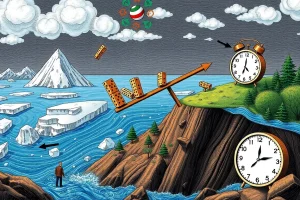
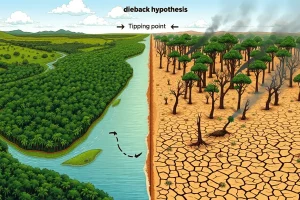
The Greenland Ice Sheet tipping point is a critical threshold of global warming beyond which the ice sheet’s decline becomes self-sustaining and irreversible on human timescales. In climate science, a tipping point refers to a level of change at which a system shifts from one stable state to another, often abruptly and with no easy return. For the Greenland Ice Sheet, this means that once a certain amount of ice loss occurs—driven by rising temperatures—the remaining ice will continue to melt even if the climate stops warming, eventually leading to the near-complete disappearance of the ice sheet.
This concept is rooted in the ice sheet’s mass balance: the difference between snow accumulation (gains) and melting plus iceberg calving (losses). Under stable climate conditions, the ice sheet maintains its size because gains and losses are roughly equal. However, as global temperatures rise, melting increases and the ice sheet loses mass. The tipping point is reached when the ice sheet’s surface lowers so much that it enters a warmer atmospheric layer, causing a self-reinforcing cycle of melting and thinning. Once this feedback loop dominates, the ice sheet is committed to long-term decline, regardless of future emission cuts.
How It Works
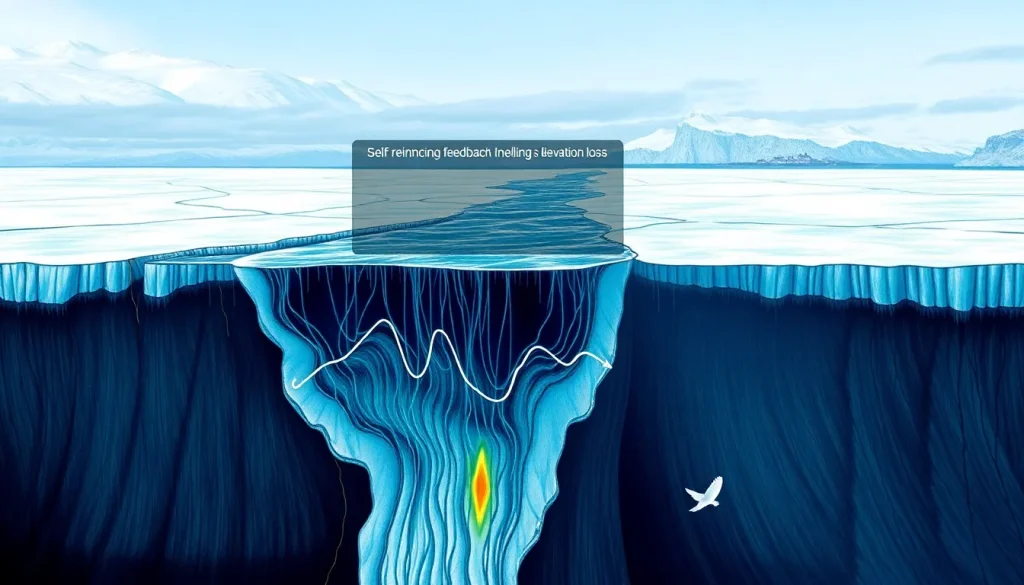
The tipping behavior of the Greenland Ice Sheet is driven by several interconnected feedback mechanisms that amplify initial warming. The most important is the elevation–melt feedback: as the ice sheet melts, its surface elevation decreases. Because temperature in the lower atmosphere decreases with altitude (the lapse rate), a lower surface experiences warmer air, which in turn accelerates melting. This creates a vicious cycle: melting lowers the surface, exposing it to warmer air, which causes more melting.
Another critical feedback is the ice–albedo feedback. Fresh snow and clean ice reflect most of the sun’s energy back into space (high albedo). As the ice melts, darker impurities concentrate on the surface, and meltwater ponds form, both of which absorb more solar radiation. This additional heat further accelerates melting. Additionally, as the ice sheet thins, its surface descends to lower, warmer altitudes, enhancing melt. These feedbacks can push the ice sheet past a point of no return, where even if global temperatures were stabilized, the ice sheet would continue to shrink for centuries until it reaches a new, much smaller equilibrium state.
What the Evidence Shows
Evidence for a tipping point in the Greenland Ice Sheet comes from both paleoclimate records and computer modeling. During the last interglacial period (the Eemian, about 125,000 years ago), global temperatures were roughly 1–2°C warmer than pre-industrial levels, and sea levels were 6–9 meters higher. While part of that sea level rise came from Antarctica, studies of ice cores and marine sediments indicate that the Greenland Ice Sheet was significantly reduced, contributing several meters to global sea level. This suggests that even modest long-term warming can trigger large-scale ice loss.
Modern ice sheet models, which simulate the physics of ice flow and surface mass balance, consistently show that the Greenland Ice Sheet exhibits a threshold behavior. When forced with increasing temperatures, the models predict a critical warming level beyond which the ice sheet’s surface mass balance becomes persistently negative, leading to its eventual complete melting. The exact threshold varies among models, but many place it between 1.5°C and 2.5°C above pre-industrial levels. Observations over the past few decades show accelerating mass loss from Greenland, with the ice sheet now losing about 270 billion tons of ice per year on average, contributing roughly 0.7 mm annually to global sea level rise.
Importance and Impact
The Greenland Ice Sheet contains enough frozen water to raise global sea levels by approximately 7.4 meters (24 feet) if completely melted. While full melting would take centuries to millennia, even a partial collapse would have profound consequences. A tipping point that commits the ice sheet to irreversible loss would lock in multi-meter sea level rise over the coming centuries, forcing coastal communities worldwide to adapt or relocate. Major cities such as New York, London, Shanghai, and Mumbai would face increased flooding, storm surges, and eventual submersion of low-lying areas.
Beyond sea level rise, the melting of the Greenland Ice Sheet can disrupt global climate systems. The influx of cold freshwater into the North Atlantic could weaken the Atlantic Meridional Overturning Circulation (AMOC), a major ocean current that regulates climate in Europe and beyond. A slowdown or collapse of the AMOC would have far-reaching effects, including altered weather patterns, shifts in marine ecosystems, and changes in heat distribution across the planet. Thus, the Greenland tipping point is not just a polar issue—it carries global risks.
Main Causes or Drivers
The primary driver pushing the Greenland Ice Sheet toward its tipping point is rising global temperatures caused by greenhouse gas emissions. Arctic temperatures are warming at roughly twice the global average rate due to Arctic amplification, a phenomenon linked to the loss of sea ice and changes in atmospheric heat transport. This amplified warming directly increases surface melt on the ice sheet. In addition, changes in atmospheric circulation patterns can bring more warm, moist air over Greenland, further accelerating melt.
Other contributing factors include darkening of the ice surface from soot, dust, and biological growth (such as algae), which reduces albedo and enhances melt. Ocean warming also plays a role by melting the ice sheet’s marine-terminating outlet glaciers from below, increasing calving rates and accelerating the flow of ice into the sea. These processes interact with the elevation and albedo feedbacks, making the ice sheet more sensitive to crossing the tipping point.
Data Limitations and Uncertainties
Despite advances in modeling and observations, significant uncertainties remain about the exact location of the Greenland Ice Sheet tipping point. Climate models differ in their representation of ice sheet dynamics, cloud processes, and ocean–ice interactions, leading to a range of threshold estimates. Some studies suggest the tipping point could be as low as 0.8°C above pre-industrial levels, while others indicate it may be closer to 3°C. The timescale of ice loss after crossing the threshold is also uncertain, with estimates ranging from a few hundred to several thousand years for complete melt.
Another challenge is that the tipping point may not be a single, well-defined temperature but rather a range influenced by the rate of warming, the duration of temperature overshoot, and regional climate variability. Additionally, current observations cannot definitively confirm whether the ice sheet has already passed a point of no return, because the system responds slowly. This uncertainty complicates policy decisions but underscores the importance of precautionary measures to limit warming and avoid crossing potential thresholds.
FAQ
What is the Greenland Ice Sheet tipping point?
It is a critical temperature threshold beyond which the ice sheet’s melting becomes self-sustaining and irreversible, leading to its eventual near-complete loss and several meters of sea level rise.
How does the elevation–melt feedback work?
As the ice sheet melts, its surface lowers to warmer altitudes, which increases melt rates. This further lowers the surface, creating a self-reinforcing cycle that can drive irreversible ice loss.
Why does the Greenland Ice Sheet tipping point matter?
Crossing it would commit the world to multi-meter sea level rise over centuries, threatening coastal cities, ecosystems, and global climate stability through freshwater input into the North Atlantic.
References
- IPCC Sixth Assessment Report (AR6), Working Group I: The Physical Science Basis, Chapter 9: Ocean, Cryosphere and Sea Level Change.
- Robinson, A., Calov, R., & Ganopolski, A. (2012). Multistability and critical thresholds of the Greenland ice sheet. Nature Climate Change, 2(6), 429–432.
- Pattyn, F., Ritz, C., Hanna, E., et al. (2018). The Greenland and Antarctic ice sheets under 1.5°C global warming. Nature Climate Change, 8(12), 1053–1061.
- NSIDC (National Snow and Ice Data Center). Greenland Ice Sheet Today. https://nsidc.org/greenland-today/