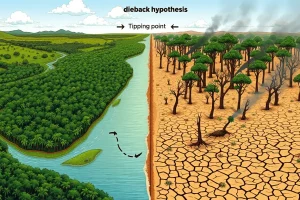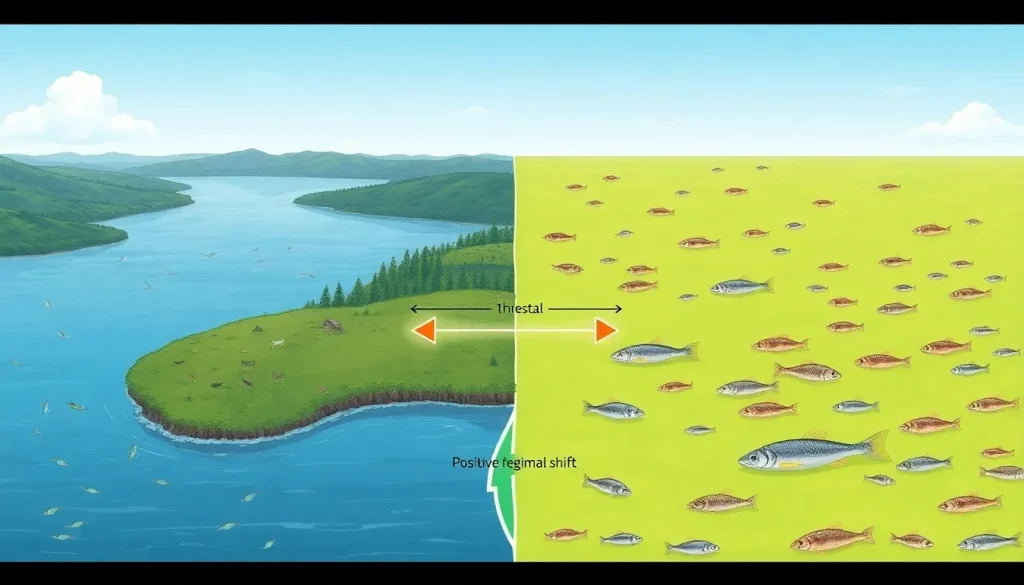
In brief
At a glance
Quick Facts
- Definition
- A regime shift is a large, abrupt, persistent change in the structure and function of an ecosystem.
- Key mechanism
- Positive feedback loops amplify small changes, pushing the system past a tipping point.
- Common triggers
- Climate change, habitat loss, pollution, overexploitation, and invasive species.
- Recovery difficulty
- Hysteresis often makes recovery much harder than prevention; some shifts are irreversible.
- Early warning signs
- Increased variance, slowing recovery from disturbances, and flickering between states.
- Global relevance
- Regime shifts affect systems from coral reefs and forests to lakes and drylands.
- Human impact
- Loss of ecosystem services can threaten food security, water quality, and livelihoods.
Key Takeaways
- Ecosystems can undergo abrupt, large-scale changes known as regime shifts or tipping points, moving from one stable state to another.
- Positive feedback loops and the erosion of resilience are central mechanisms that drive sudden ecosystem change.
- Common triggers include climate change, habitat loss, pollution, overexploitation, and invasive species.
- Once a threshold is crossed, recovery may be difficult, costly, or even impossible, leading to permanent loss of biodiversity and ecosystem services.
- Understanding early warning signals can help predict and prevent catastrophic shifts, but uncertainties remain.
What Is Why Ecosystems Can Change Suddenly?
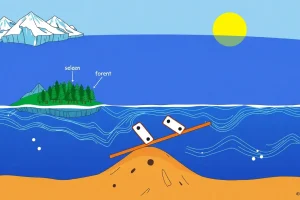
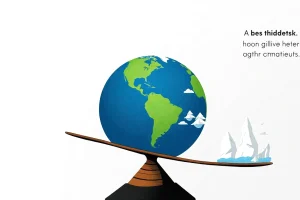
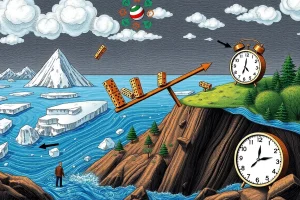
Ecosystems are often perceived as stable, self-regulating systems that respond gradually to environmental pressures. However, research has shown that many ecosystems can undergo sudden, dramatic transformations—shifting from one stable state to another in a matter of years or even months. This phenomenon is known as a regime shift, critical transition, or tipping point. Rather than changing smoothly along with external conditions, an ecosystem may appear resilient until a threshold is crossed, at which point it reorganizes into a fundamentally different state, often with reduced biodiversity and altered functions.
Understanding why ecosystems can change suddenly is crucial because these shifts can have severe consequences for the services that nature provides, such as clean water, food production, and climate regulation. Once a regime shift occurs, returning to the original state may be extremely difficult or impossible due to hysteresis—the system’s tendency to remain in the new state even if the original conditions are restored. This concept challenges traditional linear views of environmental change and highlights the importance of early detection and proactive management.
How It Works
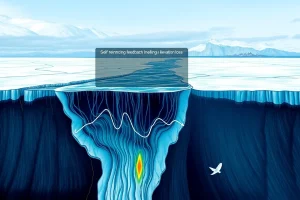
Sudden ecosystem change is driven by the interplay of external pressures and internal feedback mechanisms. Under gradual environmental change, an ecosystem may absorb disturbances without showing obvious signs of stress, a property known as resilience. However, resilience has limits. When a critical threshold is crossed, positive feedback loops can amplify small perturbations, propelling the system into an alternative stable state.
Key mechanisms include:
- Positive feedback loops: Processes that reinforce a change, pushing the system further from its original state. For example, in a clear lake, nutrient runoff can stimulate algal growth. Algae reduce water clarity, which suppresses aquatic plants. Without plants to stabilize sediment and absorb nutrients, more nutrients are released, fueling even more algae. This self-reinforcing cycle can abruptly flip a clear lake to a turbid, algae-dominated state.
- Loss of resilience: External stressors like climate warming, pollution, or overfishing can gradually erode an ecosystem’s ability to recover from disturbances. The system may appear unchanged until a small perturbation—a drought, a disease outbreak—triggers a collapse. This is often compared to a ball in a landscape of valleys (stable states). As resilience declines, the valley becomes shallower, and a small push can send the ball into a different valley.
- Thresholds and hysteresis: The point at which a system flips is a threshold. Once crossed, the new state is stabilized by its own feedback loops, making recovery difficult. Even if the original stressor is removed, the system may not return to its previous state—a phenomenon called hysteresis. For example, a clear lake may require far lower nutrient levels to recover than the levels that caused it to become turbid.
Main Causes or Drivers
Multiple interacting factors can push an ecosystem toward a tipping point. The most common drivers include:
- Climate change: Rising temperatures, altered precipitation patterns, and increased frequency of extreme events can stress species and disrupt ecological relationships. For instance, ocean warming can cause coral bleaching, while prolonged drought can trigger desertification.
- Habitat loss and fragmentation: Deforestation, wetland drainage, and urban expansion reduce the size and connectivity of habitats, making populations more vulnerable to collapse.
- Pollution: Nutrient runoff from agriculture, industrial toxins, and plastic waste can degrade ecosystems, often pushing them past critical thresholds.
- Overexploitation: Overfishing, overhunting, and excessive water extraction can remove key species or resources, destabilizing food webs and ecosystem functions.
- Invasive species: Non-native species can outcompete or prey on native organisms, altering ecosystem structure and function, sometimes irreversibly.
- Natural disturbances: While ecosystems are adapted to some level of disturbance, the increasing frequency and intensity of fires, storms, and floods due to human activities can exceed their capacity to recover.
Examples
Sudden ecosystem changes have been documented across a wide range of environments:
- Coral reef bleaching: When ocean temperatures exceed a critical threshold, corals expel their symbiotic algae, turning white. If heat stress persists, the corals die, and the reef can shift from a diverse, coral-dominated system to an algae-dominated one. This transition can occur within a single season and is often irreversible on human timescales.
- Lake eutrophication: Excess nutrient inputs from agriculture or sewage can cause a clear lake to suddenly become turbid and dominated by toxic algal blooms. Once the shift occurs, reducing nutrient levels may not restore the clear-water state due to internal nutrient recycling from sediments.
- Desertification: In drylands, overgrazing and drought can trigger a rapid shift from grassland to desert. Vegetation loss reduces soil moisture and increases erosion, creating a feedback loop that prevents re-establishment of plants.
- Kelp forest collapse: Overfishing of sea otters or lobsters can lead to explosions of sea urchin populations, which overgraze kelp forests. The result is a barren “urchin desert” that persists even if fishing pressure is reduced.
- Fisheries collapse: The Atlantic cod fishery off Newfoundland collapsed in the early 1990s after decades of overfishing. Despite a moratorium, the cod population has not recovered, as the ecosystem shifted to a new state dominated by shrimp and crab.
Importance and Impact
Sudden ecosystem changes have profound consequences for both nature and people. They can lead to the loss of biodiversity, including the extinction of species that cannot adapt to the new conditions. Ecosystem services—such as water purification, pollination, carbon storage, and fisheries—may be severely diminished or lost entirely, affecting human livelihoods, food security, and health.
Economic impacts can be substantial. For example, the collapse of a fishery can devastate coastal communities, while desertification can force migration and increase poverty. The loss of coral reefs not only reduces marine biodiversity but also eliminates natural coastal protection against storms and erosion. Furthermore, regime shifts can create feedbacks that exacerbate global environmental problems, such as the release of stored carbon from thawing permafrost or burning forests, accelerating climate change.
Common Misconceptions
Several misconceptions surround the idea of sudden ecosystem change:
- “Ecosystems always change gradually.” While some changes are slow, many ecosystems exhibit nonlinear behavior, with long periods of apparent stability punctuated by abrupt shifts.
- “If we remove the stressor, the ecosystem will bounce back.” Hysteresis means that recovery may require much more effort than prevention, and some changes are effectively permanent on human timescales.
- “Tipping points are rare and only affect remote ecosystems.” Regime shifts have been observed in many systems, including agricultural landscapes, urban watersheds, and even the human gut microbiome.
- “We can predict exactly when a shift will occur.” While early warning signals like increased variability and slowing recovery rates exist, precise prediction remains challenging due to complex interactions and stochastic events.
- “Small actions don’t matter.” Because ecosystems near a threshold are highly sensitive, even small reductions in pressure can sometimes prevent a shift, while small additional stress can trigger one.
FAQ
What is a sudden ecosystem change?
A sudden ecosystem change, or regime shift, is an abrupt and persistent reorganization of an ecosystem’s structure and function, often triggered when a critical threshold is crossed.
How do feedback loops cause sudden changes?
Positive feedback loops amplify small disturbances, such as nutrient inputs or temperature increases, creating self-reinforcing cycles that push the ecosystem into a new state. For example, algae growth reduces water clarity, which kills plants, releasing more nutrients and fueling more algae.
Why are sudden ecosystem changes concerning?
They can lead to irreversible loss of biodiversity, collapse of fisheries, degraded water quality, and reduced carbon storage, directly impacting human well-being and economies. Recovery is often slow, costly, or impossible.
References
- Millennium Ecosystem Assessment, 2005. Ecosystems and Human Well-being: Synthesis.
- Scheffer, M., et al. (2001). Catastrophic shifts in ecosystems. Nature, 413, 591–596.
- IPCC Special Report on Climate Change and Land, 2019. Chapter 4: Land Degradation.