In brief
At a glance
Quick Facts
- Definition
- A large, abrupt, and persistent change in ecosystem structure and function.
- Key feature
- Alternative stable states and hysteresis make reversal difficult.
- Common drivers
- Nutrient pollution, overfishing, climate change, habitat loss, invasive species.
- Classic example
- Shallow lakes shifting from clear to turbid water.
- Marine example
- Coral reefs shifting to algae-dominated states.
- Terrestrial example
- Grasslands shifting to shrublands or desert.
- Economic impact
- Fisheries collapse can cost billions and cause job losses.
- Management focus
- Prevention and resilience-building are more effective than restoration.
- Early warning signals
- Increased variance and critical slowing down may precede a shift.
- Related concept
- Tipping point, resilience, hysteresis, alternative stable states.
Key Takeaways
- An ecological regime shift is a large, abrupt, and persistent change in the structure and function of an ecosystem, often triggered by gradual pressures that push the system past a tipping point.
- Regime shifts are characterized by alternative stable states, meaning the ecosystem can exist in two or more different configurations under the same environmental conditions.
- Once a shift occurs, feedback mechanisms reinforce the new state, making reversal difficult and costly—a phenomenon known as hysteresis.
- Common examples include the collapse of fisheries, lake eutrophication, coral reef degradation, and desertification of grasslands.
- Understanding and predicting regime shifts is essential for sustainable resource management and conservation, as prevention is far more effective than restoration.
What Is an Ecological Regime Shift?
An ecological regime shift is a large-scale, abrupt, and persistent change in the structure and function of an ecosystem. Unlike gradual, reversible changes that occur in response to fluctuating conditions, a regime shift represents a fundamental reorganization of the system into a new state that is often undesirable and difficult to reverse. The concept is rooted in the idea that ecosystems can have multiple stable states—alternative regimes—under the same external environmental conditions. A regime shift occurs when a disturbance or a slow change in a key driver pushes the system past a critical threshold, or tipping point, causing it to transition rapidly from one stable state to another.
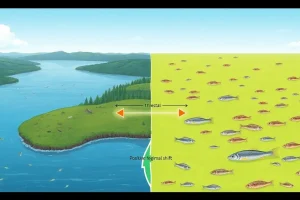
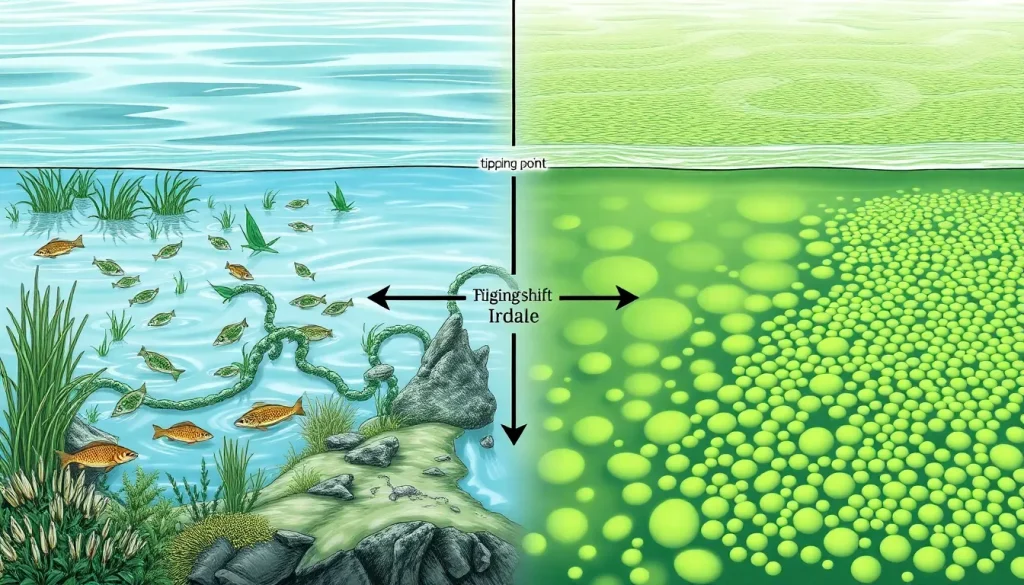
Once the shift happens, the new regime is maintained by different feedback processes than those that sustained the original state. For example, a clear, vegetated lake can suddenly become turbid and algae-dominated after nutrient levels cross a threshold, and even if nutrient inputs are later reduced, the lake may remain turbid due to internal feedbacks like sediment phosphorus release. This persistence, or hysteresis, makes regime shifts particularly challenging for management and restoration. The term is used across many ecosystems—lakes, oceans, forests, grasslands, and even social-ecological systems—to describe non-linear, often surprising changes with significant ecological and societal consequences.
Overview
Ecological regime shifts are a central concept in resilience theory, which studies how systems absorb disturbance and reorganize while undergoing change. The idea emerged from observations that some ecosystems do not respond smoothly to gradual pressures but instead exhibit sudden, dramatic transitions. These shifts can occur at various scales, from small ponds to entire ocean basins, and can be driven by natural forces or human activities. The key feature is that the change is not easily reversed by simply removing the initial pressure; the system has moved into a new basin of attraction, stabilized by different feedback loops.
Regime shifts are often categorized by the type of ecosystem involved—terrestrial, freshwater, or marine—and by the nature of the shift, such as changes in dominant species, productivity, or physical structure. They are distinct from gradual ecological changes like succession because they involve a loss of resilience and a crossing of a critical threshold. The concept has become increasingly important in environmental management, as human activities are accelerating the rate and scale of such shifts globally, with consequences for biodiversity, climate regulation, and human livelihoods.
How It Works
Ecosystems are complex adaptive systems with numerous interacting components. Under normal conditions, negative feedback loops—such as predation, competition, or nutrient cycling—maintain the system in a particular state. However, external pressures like pollution, overexploitation, or climate change can weaken these stabilizing feedbacks, reducing the system’s resilience. As resilience erodes, the system becomes more sensitive to perturbations, and a relatively small trigger—a drought, a disease outbreak, or a pulse of nutrients—can push it past a tipping point into a new regime.
Once the shift occurs, the new state is often maintained by different feedback mechanisms that reinforce the new conditions. For instance, in a clear lake, aquatic plants stabilize sediments and take up nutrients, keeping the water clear. When nutrient loading increases, algae blooms may shade out the plants, causing them to die. The decaying plants release more nutrients, fueling further algal growth, and the lake becomes turbid. Reducing nutrient inputs alone may not restore the clear state because the internal nutrient recycling and lack of plants now stabilize the turbid state. This hysteresis means that the conditions needed to reverse the shift are much stronger than those that caused it. The system’s response curve is not a simple linear path but a fold catastrophe, where the state depends on the history of pressures.
Main Causes or Drivers
Regime shifts are typically caused by a combination of gradual pressures and sudden disturbances. The most common drivers include:
- Nutrient loading: Excessive inputs of nitrogen and phosphorus from agriculture or sewage can trigger eutrophication in lakes and coastal waters, leading to algal blooms and oxygen depletion.
- Overexploitation: Overfishing or overhunting can remove key species, such as top predators or grazers, causing cascading effects that restructure the entire food web.
- Climate change: Rising temperatures, altered precipitation patterns, and increased frequency of extreme events can push ecosystems beyond their tolerance limits, triggering shifts like coral bleaching or forest dieback.
- Habitat fragmentation and loss: Breaking up or destroying habitats reduces the resilience of species and ecosystems, making them more vulnerable to other pressures.
- Invasive species: The introduction of non-native species can disrupt existing interactions and feedbacks, leading to a new, often simplified, ecosystem state.
Often, multiple drivers interact to cause a regime shift. For example, overfishing combined with nutrient pollution and warming waters can synergistically push a coral reef from a coral-dominated to an algae-dominated state. The relative importance of each driver varies by ecosystem and context.
Examples
Regime shifts have been documented in a wide range of ecosystems. Some well-known examples include:
- Shallow lake eutrophication: A clear lake with submerged vegetation shifts to a turbid state dominated by phytoplankton. This is one of the most studied regime shifts, with well-documented cases in Europe and North America.
- Coral reef degradation: Coral-dominated reefs shift to macroalgae-dominated states due to overfishing of herbivores, nutrient pollution, and warming-induced bleaching. The Caribbean has seen widespread shifts of this type.
- Desertification of grasslands: Semi-arid grasslands can shift to shrub-dominated or bare soil states due to overgrazing, drought, and fire suppression. The Sahel region in Africa is a classic example.
- Fisheries collapse: The Northwest Atlantic cod fishery collapsed in the early 1990s due to overfishing, and despite reduced fishing pressure, the cod population has not recovered to its former state, with the ecosystem now dominated by shrimp and other species.
- Forest dieback: Tropical forests can shift to savanna-like states if deforestation and fire frequency cross a threshold, as seen in parts of the Amazon basin.
Importance and Impact
Ecological regime shifts have profound implications for both nature and society. They can lead to the loss of biodiversity, as species adapted to the original state may decline or disappear. Ecosystem services—such as clean water, fisheries, carbon storage, and recreation—are often severely diminished. For example, a turbid lake provides less drinking water quality, fewer recreational opportunities, and reduced fish habitat. The economic costs can be substantial: the collapse of the cod fishery resulted in the loss of tens of thousands of jobs and billions of dollars in revenue.
Moreover, regime shifts can interact with global challenges. The shift of a forest to a savanna releases large amounts of carbon dioxide, exacerbating climate change. The degradation of coral reefs reduces coastal protection from storms, increasing vulnerability of coastal communities. Because reversal is often slow, expensive, or even impossible, the focus of management has shifted toward building resilience and preventing shifts before they occur. Understanding regime shifts is therefore critical for sustainable development, conservation planning, and climate adaptation.
Data Limitations and Uncertainties
Despite advances in theory and modeling, detecting and predicting regime shifts remains challenging. Long-term ecological data are often sparse, making it difficult to distinguish a true regime shift from natural variability or a temporary state change. The identification of tipping points is inherently uncertain because the threshold may change over time and can be influenced by multiple interacting factors. Early warning signals, such as increased variance or critical slowing down, have shown promise in models and some experimental systems, but their reliability in real-world ecosystems is still under investigation.
Additionally, the concept of alternative stable states is sometimes debated, as not all abrupt changes are necessarily regime shifts with hysteresis. Some systems may exhibit rapid but reversible transitions. The complexity of ecosystems means that surprises are common, and our ability to forecast specific shifts is limited. Ongoing research aims to improve monitoring, develop better indicators, and integrate regime shift science into adaptive management frameworks.
FAQ
What is an ecological regime shift?
An ecological regime shift is a large, abrupt, and persistent change in the structure and function of an ecosystem, often caused by gradual pressures that push the system past a tipping point into a new stable state.
How does an ecological regime shift occur?
It occurs when external pressures (like nutrient loading or overfishing) erode the ecosystem's resilience, weakening stabilizing feedbacks. A small disturbance can then trigger a rapid transition to a new state, which is maintained by different feedback loops, making reversal difficult.
Why do ecological regime shifts matter?
They matter because they can cause loss of biodiversity, collapse of fisheries, degradation of water quality, and other declines in ecosystem services that human societies depend on. They are often costly or impossible to reverse, so understanding them is key to sustainable management.
References
- Scheffer, M., Carpenter, S., Foley, J. A., Folke, C., & Walker, B. (2001). Catastrophic shifts in ecosystems. Nature, 413(6856), 591-596.
- Folke, C., Carpenter, S., Walker, B., Scheffer, M., Elmqvist, T., Gunderson, L., & Holling, C. S. (2004). Regime shifts, resilience, and biodiversity in ecosystem management. Annual Review of Ecology, Evolution, and Systematics, 35, 557-581.
- Millennium Ecosystem Assessment (2005). Ecosystems and Human Well-being: Synthesis. Island Press.
- Resilience Alliance. (n.d.). Regime Shifts. Retrieved from https://www.resalliance.org/regime-shifts