In brief
At a glance
Quick Facts
- Primary cause
- Rising atmospheric CO₂ from fossil fuel burning, deforestation, and cement production.
- Ocean pH change since pre-industrial era
- Decreased by about 0.1 pH units, representing a ~30% increase in acidity.
- Heat absorbed by the ocean
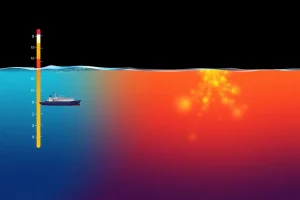
- More than 90% of the excess heat from global warming has been taken up by the ocean since the 1970s.
- Rate of acidification
- The current rate is faster than any known in the past 300 million years.
- Key chemical reaction
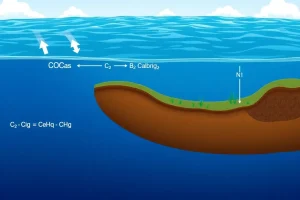
- CO₂ + H₂O → H₂CO₃ → H⁺ + HCO₃⁻, lowering pH and reducing carbonate ions.
- Coral bleaching threshold
- Sustained sea surface temperatures just 1–2°C above the normal summer maximum can trigger bleaching.
- Carbonate ion impact
- Reduced carbonate ions make it harder for calcifying organisms to build shells and skeletons.
- Thermal expansion contribution to sea-level rise
- Ocean warming accounts for about one-third of observed global sea-level rise.
Key Takeaways
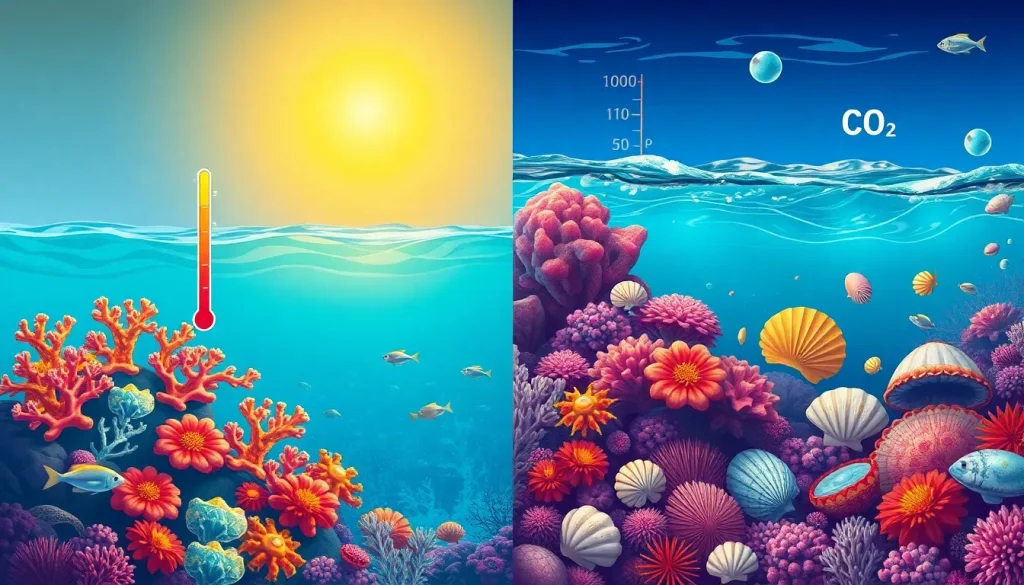
- Ocean acidification and ocean warming are separate phenomena both driven primarily by rising atmospheric CO₂ from human activities.
- Ocean acidification is a chemical change: the ocean absorbs excess CO₂, which reacts with seawater to form carbonic acid, lowering pH and reducing carbonate ion availability.
- Ocean warming is a physical change: the ocean absorbs more than 90% of the excess heat trapped by greenhouse gases, leading to rising sea surface and deep-water temperatures.
- Acidification particularly harms calcifying organisms like corals, shellfish, and plankton, while warming causes coral bleaching, shifts species distributions, and contributes to sea-level rise.
- Both phenomena interact and amplify each other’s impacts, making marine ecosystems more vulnerable than either stressor alone.
- Mitigation requires rapid reductions in CO₂ emissions, alongside local measures to reduce other stressors and enhance ecosystem resilience.
What Is Ocean Acidification vs Ocean Warming?
Ocean acidification and ocean warming are two major, ongoing changes in the marine environment driven by human emissions of carbon dioxide (CO₂) and other greenhouse gases. Although they share a common root cause, they are fundamentally different processes. Ocean acidification refers to the chemical alteration of seawater as it absorbs excess atmospheric CO₂, leading to a decline in pH and a reduction in the concentration of carbonate ions. Ocean warming, on the other hand, is the increase in the heat content of the ocean, resulting in higher sea surface temperatures and thermal expansion of water. Both are global in scale, long-lasting, and have profound consequences for marine life, ecosystems, and the services the ocean provides to humanity.
While ocean warming is a direct result of the greenhouse effect—where the ocean absorbs excess heat from the atmosphere—ocean acidification is sometimes called the “other CO₂ problem” because it stems from the chemical dissolution of CO₂ in seawater, independent of the warming effect. Together, they represent two of the most significant stressors on the ocean, altering its physics, chemistry, and biology in ways that are unprecedented in millions of years.
How It Works
The mechanisms behind ocean acidification and ocean warming are distinct but both originate from the accumulation of CO₂ in the atmosphere. For ocean acidification, when CO₂ dissolves in seawater, it undergoes a series of chemical reactions: CO₂ + H₂O → H₂CO₃ (carbonic acid), which then dissociates into bicarbonate (HCO₃⁻) and hydrogen ions (H⁺). The increase in hydrogen ions lowers the pH, making the water more acidic. Additionally, some of the hydrogen ions react with carbonate ions (CO₃²⁻) to form more bicarbonate, reducing the availability of carbonate—a key building block for many marine organisms that construct shells and skeletons from calcium carbonate.
Ocean warming operates through the physical absorption of heat. The ocean has a high heat capacity and absorbs more than 90% of the extra energy trapped by greenhouse gases. This heat is distributed by ocean currents, but the surface layer warms most rapidly. The warming is not uniform; it varies with depth and region. The process also leads to thermal expansion of seawater, which is a major contributor to global sea-level rise. Unlike acidification, which is a direct chemical response to CO₂, warming is a response to the enhanced greenhouse effect caused by CO₂ and other gases like methane and nitrous oxide.
Main Causes or Drivers
The primary driver of both ocean acidification and ocean warming is the increase in atmospheric CO₂ concentrations due to human activities, mainly the burning of fossil fuels (coal, oil, and natural gas), deforestation, and cement production. Since the Industrial Revolution, atmospheric CO₂ has risen from about 280 parts per million (ppm) to over 420 ppm. The ocean has absorbed roughly 30% of this emitted CO₂, which directly causes acidification. The remaining CO₂, along with other greenhouse gases, traps heat in the atmosphere, and the ocean absorbs the majority of that excess heat, driving warming.
Other factors can influence regional warming, such as changes in ocean circulation patterns (e.g., El Niño events) and local heat fluxes, but the global trend is overwhelmingly tied to greenhouse gas emissions. For acidification, local factors like nutrient runoff and upwelling can exacerbate pH declines in coastal areas, but the global signal is again dominated by atmospheric CO₂. Thus, the root cause of both problems is the same: anthropogenic carbon emissions.
Environmental and Human Impacts
Ocean acidification and warming have wide-ranging and often synergistic impacts on marine ecosystems. Acidification reduces the availability of carbonate ions, making it harder for organisms like corals, mollusks, echinoderms, and some plankton to build and maintain their calcium carbonate shells and skeletons. This can lead to thinner shells, slower growth, and increased mortality. Pteropods, tiny sea snails at the base of many food webs, are particularly vulnerable. Coral reefs, already stressed by warming, face slower calcification and greater dissolution under acidified conditions.
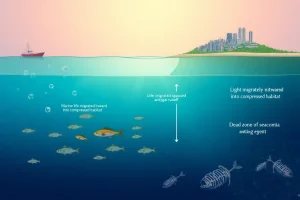
Ocean warming causes coral bleaching, where corals expel their symbiotic algae under heat stress, often leading to death if prolonged. It also shifts the geographic ranges of marine species poleward or to deeper waters, disrupting fisheries and food webs. Warmer waters hold less dissolved oxygen, contributing to deoxygenation and expanding “dead zones.” For humans, these changes threaten fisheries and aquaculture, reduce coastal protection from degraded reefs, and impact tourism. Communities that depend on seafood for protein and livelihoods are especially at risk. Additionally, thermal expansion from warming contributes significantly to sea-level rise, exacerbating coastal flooding and erosion.
Regional Differences
The severity and manifestation of ocean acidification and warming vary across the globe. Polar regions, particularly the Arctic and Southern Oceans, are acidifying faster because cold water absorbs CO₂ more readily. The Arctic is also warming at more than twice the global average rate, leading to rapid sea-ice loss and ecosystem upheaval. In tropical regions, coral reefs face a double threat: intense warming events cause mass bleaching, while acidification slows reef growth and weakens structures.
Coastal zones often experience amplified acidification due to local factors like eutrophication, freshwater input, and upwelling of naturally CO₂-rich deep water. The California Current System, for example, already experiences seasonal low-pH events that stress shellfish hatcheries. In contrast, some upwelling regions may see temporary cooling due to wind-driven upwelling, but the long-term trend is still warming. These regional differences mean that impacts on fisheries and communities are highly localized, requiring tailored adaptation strategies.
Connections to Other Systems
Ocean acidification and warming are tightly linked to other components of the Earth system. Both are direct consequences of the global carbon cycle disruption. Warming reduces the ocean’s capacity to absorb CO₂, as warmer water holds less gas, creating a feedback loop that accelerates atmospheric CO₂ rise. Melting sea ice and glaciers alter salinity and stratification, which can affect how heat and carbon are distributed vertically. Acidification may also alter the production of dimethyl sulfide by plankton, a compound that influences cloud formation and climate, though the net effect remains uncertain.
On land, ocean warming intensifies weather extremes by providing more energy for storms and altering precipitation patterns. Sea-level rise from thermal expansion and ice melt compounds coastal hazards. The combined stressors also interact with pollution, overfishing, and habitat destruction, reducing the resilience of marine ecosystems. Addressing these issues requires an integrated approach that considers the entire climate–ocean–biosphere system.
Solutions
The most effective long-term solution for both ocean acidification and warming is rapid and substantial reduction of global CO₂ emissions. Transitioning to renewable energy sources, improving energy efficiency, and protecting and restoring forests are critical steps. Even with emission cuts, some changes are already locked in due to the long residence time of CO₂ in the atmosphere and the slow response of the ocean. Therefore, adaptation measures are also necessary.
For acidification, local strategies include reducing nutrient runoff to limit coastal acidification, selective breeding of resilient shellfish strains, and monitoring programs to provide early warnings for hatcheries. Marine protected areas can help reduce other stressors, giving ecosystems a better chance to cope. For warming, restoring mangroves and seagrasses can sequester carbon and provide habitat, while artificial upwelling or shading of reefs are experimental ideas. Ultimately, global cooperation under frameworks like the Paris Agreement is essential to limit future warming and acidification.
FAQ
What is the difference between ocean acidification and ocean warming?
Ocean acidification is a chemical change where seawater becomes more acidic due to absorption of CO₂, lowering pH. Ocean warming is a physical change where the ocean absorbs excess heat from the atmosphere, raising water temperatures. Both are caused by greenhouse gas emissions but operate through different mechanisms.
How does ocean acidification affect marine life?
It reduces the availability of carbonate ions, which many organisms need to build shells and skeletons. This can weaken corals, mollusks, and plankton, disrupting food webs and ecosystems.
Why does ocean warming matter?
Warmer oceans cause coral bleaching, shift species distributions, reduce dissolved oxygen, and contribute to sea-level rise through thermal expansion. These changes threaten marine biodiversity and human communities that depend on the ocean.
References
- IPCC Special Report on the Ocean and Cryosphere in a Changing Climate (2019)
- Doney, S. C., et al. (2009). Ocean Acidification: The Other CO₂ Problem. Annual Review of Marine Science.
- NOAA Pacific Marine Environmental Laboratory – Ocean Acidification and Warming overviews