In brief
At a glance
Quick Facts
- Hypoxia threshold
- Dissolved oxygen below 2–3 mg/L; most fish avoid or die below 2 mg/L.
- Anoxia definition
- Complete absence of detectable dissolved oxygen; only anaerobic microbes survive.
- Primary cause
- Excess nitrogen and phosphorus from agriculture, sewage, and fossil fuels.
- Largest dead zone
- Gulf of Mexico, averaging over 13,000 km² in summer, driven by Mississippi River nutrients.
- Global trend
- Number of coastal hypoxic sites has roughly doubled each decade since the 1960s.
- Key process
- Stratification prevents oxygen mixing; decomposition of organic matter consumes bottom oxygen.
- Toxic byproduct
- Anoxic sediments release hydrogen sulfide, which smells like rotten eggs and is toxic.
- Recovery time
- Even with nutrient reductions, full ecosystem recovery can take decades due to legacy pollution.
Key Takeaways
- Hypoxia refers to dissolved oxygen concentrations below 2–3 mg/L, while anoxia means a complete absence of detectable oxygen in water.
- Both conditions are primarily driven by excess nutrient inputs (eutrophication) and water column stratification, which limit oxygen replenishment.
- Hypoxic and anoxic zones cause mass mortality of fish and invertebrates, alter biogeochemical cycles, and can release toxic substances like hydrogen sulfide.
- Management strategies focus on reducing nutrient pollution, restoring wetlands, and improving water circulation, but recovery can take decades.
What Is Hypoxia vs Anoxia in Aquatic Ecosystems?
Hypoxia and anoxia describe states of oxygen deficiency in water, measured by the concentration of dissolved oxygen (DO). Hypoxia is typically defined as DO levels below 2–3 milligrams per liter (mg/L), a threshold at which most fish and other aerobic organisms experience stress or mortality. Anoxia is the extreme condition where DO is undetectable—effectively zero—and only anaerobic microbes can survive. These conditions are not binary; rather, they exist on a continuum of oxygen depletion that profoundly shapes aquatic life and chemistry.
In healthy aquatic ecosystems, oxygen enters water through diffusion from the atmosphere and as a byproduct of photosynthesis by algae and aquatic plants. It is consumed by respiration of all aerobic organisms and by the decomposition of organic matter. When the rate of oxygen consumption exceeds the rate of replenishment, hypoxia develops. If the imbalance persists or intensifies, anoxia can follow. These phenomena occur in both freshwater and marine environments, from small ponds to vast coastal seas, and are often seasonal, linked to temperature, nutrient loads, and water circulation patterns.
Overview
Oxygen is a fundamental regulator of aquatic ecosystem structure and function. Most metazoan life—fish, crustaceans, mollusks, and many insects—requires oxygen to survive. Even sublethal hypoxia can impair growth, reproduction, and immune function, while anoxia leads to rapid death of aerobic organisms and a shift to microbial communities that use alternative electron acceptors like nitrate, iron, and sulfate. The global extent of hypoxic and anoxic zones has increased substantially since the mid-20th century, driven by human activities that accelerate nutrient runoff and climate change, which warms waters and strengthens stratification. These zones are now recognized as a major stressor on marine and freshwater ecosystems, with economic consequences for fisheries and tourism.
Hypoxia and anoxia are not uniform in space or time. They can be episodic (lasting hours to days), seasonal (recurring annually), or persistent (year-round). The most notorious examples are coastal “dead zones,” such as those in the Gulf of Mexico, Baltic Sea, and Chesapeake Bay, but many lakes and reservoirs also experience oxygen depletion in their bottom waters during summer stratification. The severity and duration of these events depend on a complex interplay of physical, chemical, and biological factors.
How It Works
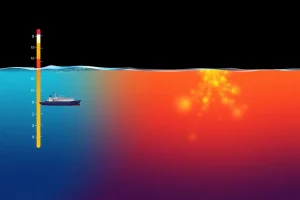
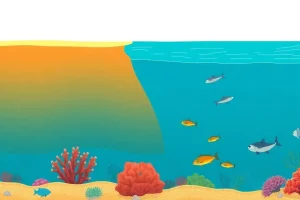
The development of hypoxia and anoxia follows a sequence of physical and biogeochemical processes. In stratified water bodies, a warm, less dense surface layer (epilimnion) sits atop a cooler, denser bottom layer (hypolimnion), preventing vertical mixing. Oxygen from the atmosphere only penetrates the upper layer, while the bottom layer is isolated. Organic matter—from dead algae, fecal pellets, and other debris—sinks into the bottom layer, where microbial decomposition consumes oxygen. Without replenishment, DO concentrations decline. Initially, aerobic bacteria dominate, but as oxygen drops, facultative anaerobes switch to nitrate, then manganese and iron oxides, and finally sulfate. Sulfate reduction produces hydrogen sulfide, which is toxic to most organisms and gives anoxic waters a characteristic rotten-egg smell.
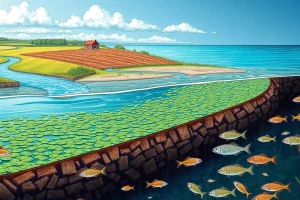
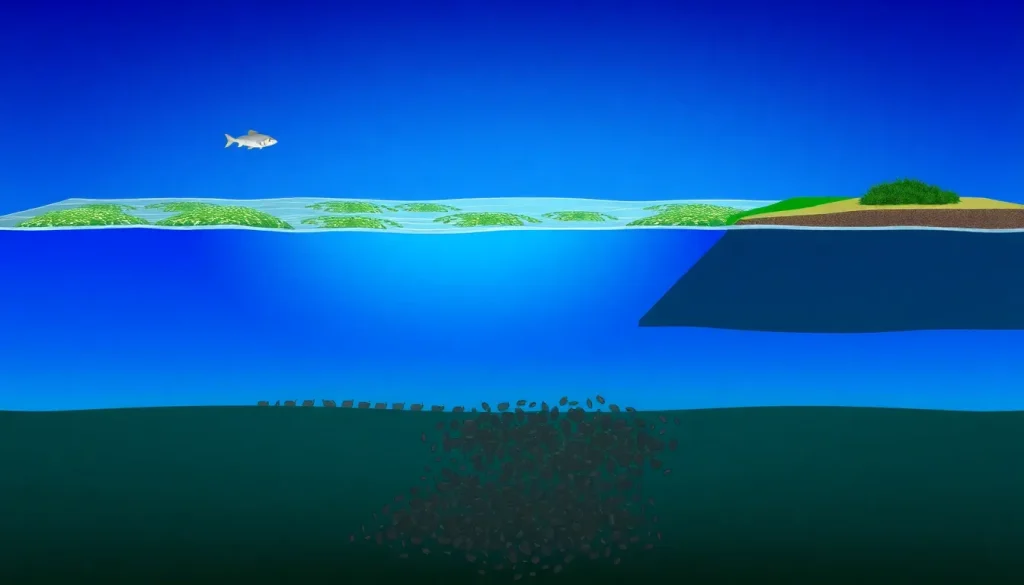
In coastal waters, hypoxia often forms when nutrient-rich freshwater flows from rivers, fueling algal blooms. When the blooms die and sink, their decomposition strips oxygen from the bottom water. Stratification is reinforced by salinity differences (halocline) and temperature (thermocline). In some systems, upwelling of deep, oxygen-poor water can also cause hypoxia near the coast. The spatial extent of hypoxic zones can vary seasonally, expanding in summer when stratification is strongest and shrinking in autumn when storms mix the water column.
Main Causes or Drivers
The primary driver of hypoxia and anoxia in most affected water bodies is cultural eutrophication—the over-enrichment of water with nitrogen and phosphorus from human activities. Key sources include agricultural runoff (fertilizers, manure), sewage discharge, industrial effluents, and atmospheric deposition from fossil fuel combustion. These nutrients stimulate excessive growth of phytoplankton and macroalgae. When this organic matter dies and decomposes, it sinks and fuels oxygen consumption in deeper waters.
Physical factors that promote stratification are equally important. Warm surface waters are less dense than cooler deep waters, creating a thermal barrier to mixing. In estuaries and coastal seas, freshwater inflow from rivers creates a salinity gradient that further stabilizes stratification. Calm weather, weak winds, and long water residence times (e.g., in enclosed bays or deep lakes) exacerbate the problem. Climate change intensifies these drivers by increasing water temperatures, altering precipitation patterns, and extending the duration of stratification. Additionally, natural processes such as upwelling of deep, oxygen-poor water can cause hypoxia, but these events are often amplified by nutrient loading.
Environmental and Human Impacts
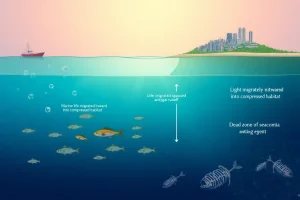
Hypoxia and anoxia have cascading effects on aquatic ecosystems. Mobile organisms like fish and crustaceans may flee affected areas, leading to habitat compression and increased predation risk. Sessile or slow-moving species, such as clams, worms, and some benthic fish, often die. Mass mortality events can drastically reduce biodiversity and alter food webs. Recurring hypoxia eliminates sensitive species, favoring tolerant ones like jellyfish and certain polychaetes, which can dominate degraded ecosystems. Anoxic conditions also disrupt nutrient cycles: phosphorus is released from sediments, potentially fueling further algal blooms, and denitrification removes fixed nitrogen, sometimes leading to nitrogen limitation.
Human communities suffer economic losses from declining fisheries and aquaculture. Hypoxia-induced fish kills and shellfish die-offs reduce commercial and recreational harvests. Tourism and property values can decline when dead zones cause foul odors, fish carcasses on beaches, or toxic algal blooms. In some regions, hypoxia forces fishermen to travel farther, increasing fuel costs and reducing catch per unit effort. The annual economic impact of the Gulf of Mexico dead zone alone has been estimated in the tens of millions of dollars. Additionally, anoxic waters can produce hydrogen sulfide, a gas toxic to humans and corrosive to infrastructure.
Regional Differences
Hypoxic and anoxic zones occur worldwide but vary in size, severity, and driving factors. The Gulf of Mexico’s dead zone, fueled by the Mississippi River’s nutrient load, is one of the largest, covering thousands of square kilometers each summer. The Baltic Sea has a permanent anoxic zone in its deep basins due to limited water exchange and centuries of nutrient accumulation. In East Asia, the Yangtze River plume creates seasonal hypoxia in the East China Sea, while the Black Sea has a massive permanent anoxic layer below about 150 meters, a natural feature exacerbated by pollution. Freshwater systems also suffer: Lake Erie’s central basin experiences seasonal hypoxia, and many reservoirs in agricultural regions develop oxygen-depleted bottom waters.
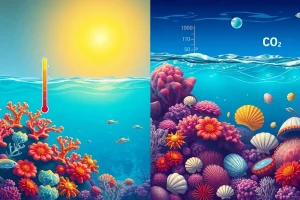
Regional differences arise from variations in nutrient loading, basin morphology, and circulation. Shallow, well-mixed systems may resist hypoxia despite high nutrients because oxygen is constantly replenished. Deep, enclosed basins with long residence times are more vulnerable. In tropical regions, high temperatures accelerate oxygen consumption and reduce oxygen solubility, making waters more susceptible. Some areas, like the oxygen minimum zones in the eastern Pacific and Arabian Sea, are naturally hypoxic at mid-depths, but these are expanding due to climate change and nutrient runoff, a phenomenon known as ocean deoxygenation.
Solutions
Addressing hypoxia and anoxia requires reducing nutrient inputs at their sources. Agricultural best management practices—such as precision fertilizer application, cover crops, buffer strips, and constructed wetlands—can significantly cut nitrogen and phosphorus runoff. Upgrading wastewater treatment plants to remove nutrients, controlling industrial discharges, and reducing atmospheric nitrogen emissions from vehicles and power plants are also critical. In many developed nations, point-source controls have been successful, but non-point sources (especially agriculture) remain challenging.
In-water interventions can provide temporary relief but are not substitutes for nutrient reduction. Artificial aeration or oxygenation systems can be installed in lakes and reservoirs to maintain DO levels. In some estuaries, dredging or altering water flow can reduce stratification. Restoring shellfish populations and seagrass beds helps filter nutrients and stabilize sediments. Policy frameworks, such as the European Union’s Water Framework Directive or the U.S. Clean Water Act, set targets for reducing nutrient loads, but achieving them often requires coordinated action across multiple jurisdictions and sectors. Long-term monitoring and adaptive management are essential, as recovery can lag by decades due to legacy nutrients stored in soils and sediments.
FAQ
What is the difference between hypoxia and anoxia?
Hypoxia is low dissolved oxygen (typically below 2–3 mg/L) that stresses or kills aquatic animals. Anoxia is the complete absence of oxygen, where only anaerobic microbes can survive.
How do hypoxia and anoxia form in water?
They form when oxygen consumption by decomposition of organic matter exceeds oxygen supply from the atmosphere and photosynthesis, often exacerbated by water stratification that prevents mixing.
Why are hypoxia and anoxia important environmental issues?
They create dead zones that kill fish and shellfish, disrupt food webs, release toxic substances, and cause economic losses to fisheries and tourism. They are a major symptom of nutrient pollution and climate change.
References
- Diaz, R. J., & Rosenberg, R. (2008). Spreading dead zones and consequences for marine ecosystems. Science, 321(5891), 926-929.
- Rabalais, N. N., et al. (2010). Dynamics and distribution of natural and human-caused hypoxia. Biogeosciences, 7(2), 585-619.
- Breitburg, D., et al. (2018). Declining oxygen in the global ocean and coastal waters. Science, 359(6371), eaam7240.