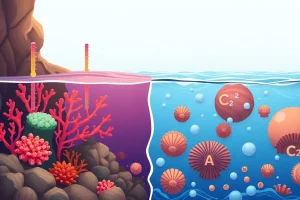
In brief
At a glance
Quick Facts
- Definition
- Aragonite saturation state (Ω_arag) is the ratio of the ion product of calcium and carbonate to the solubility product of aragonite in seawater.
- Critical threshold
- Ω_arag 1 indicates supersaturation, favoring shell formation.
- Primary driver of decline
- Anthropogenic CO2 emissions cause ocean acidification, lowering carbonate ion concentration and thus Ω_arag.
- Most vulnerable regions
- High-latitude oceans (Arctic, Southern Ocean) and upwelling zones are reaching undersaturation first due to colder temperatures and natural CO2-rich waters.
- Key organisms affected
- Reef-building corals, pteropods, foraminifera, and shellfish such as oysters and clams.
- Measurement
- Calculated from seawater chemistry parameters: pH, dissolved inorganic carbon, alkalinity, temperature, salinity, and pressure.
- Global trend
- Surface ocean Ω_arag has declined by approximately 0.3–0.4 units since the pre-industrial era, with further declines projected.
Key Takeaways
- Aragonite saturation state (Ωarag) is a chemical metric that indicates whether seawater will dissolve or precipitate the mineral aragonite, a common form of calcium carbonate used by many marine organisms.
- When Ωarag is greater than 1, seawater is supersaturated and favors shell formation; when it is less than 1, seawater is undersaturated and can dissolve aragonite shells and skeletons.
- Ocean acidification, driven by the absorption of anthropogenic carbon dioxide, is lowering the aragonite saturation state globally, particularly in cold, high-latitude waters.
- Declining aragonite saturation threatens calcifying organisms such as corals, pteropods, and shellfish, with cascading effects on marine food webs, fisheries, and coastal economies.
What Is Aragonite Saturation State?
Aragonite saturation state (Ωarag) is a chemical parameter that describes the thermodynamic potential for the mineral aragonite – a crystal form of calcium carbonate (CaCO3) – to either form or dissolve in seawater. It is defined as the ratio of the ion product of calcium and carbonate ions in seawater to the solubility product of aragonite under the same temperature, salinity, and pressure conditions. In simpler terms, it tells us whether the surrounding water is favorable for shell-building or whether it will tend to corrode existing shells.
Aragonite is one of two common polymorphs of calcium carbonate produced by marine organisms; the other is calcite. Aragonite is more soluble than calcite, meaning it dissolves more easily when the saturation state drops. Because many important marine calcifiers – including reef-building corals, pteropods (sea butterflies), and some mollusks – use aragonite to construct their shells and skeletons, the aragonite saturation state is a particularly sensitive and widely used indicator of ocean acidification stress. The concept is rooted in chemical oceanography and is calculated from measurements of calcium ion concentration, carbonate ion concentration, temperature, salinity, and pressure.
How It Works
The aragonite saturation state is derived from the seawater carbonate system. When carbon dioxide (CO2) dissolves in seawater, it reacts with water to form carbonic acid, which dissociates into bicarbonate and hydrogen ions. The increase in hydrogen ions lowers pH (ocean acidification) and also reduces the concentration of carbonate ions (CO32-) because some carbonate ions react with the excess hydrogen ions to form more bicarbonate. The saturation state for aragonite is calculated as:
Ωarag = [Ca2+] × [CO32-] / Ksparag
where [Ca2+] is the calcium ion concentration, [CO32-] is the carbonate ion concentration, and Ksparag is the solubility product of aragonite. Because calcium concentrations in the open ocean are relatively constant, the saturation state is primarily controlled by changes in carbonate ion concentration. As more CO2 enters the ocean, carbonate ions are consumed in the reaction, lowering the saturation state. Temperature and pressure also affect Ksp: aragonite becomes more soluble in colder, deeper waters, so saturation states are naturally lower in high-latitude and deep-sea environments.
Why It Matters
Aragonite saturation state is a critical threshold for many marine organisms. When Ωarag > 1, the water is supersaturated, and organisms can readily extract calcium and carbonate ions to build their shells and skeletons. When Ωarag < 1, the water is undersaturated, and aragonite structures begin to dissolve. Even at values above 1 but below about 3, some organisms experience reduced calcification rates and increased metabolic stress, because they must expend more energy to maintain their shells in less favorable conditions.
This parameter is especially important for pteropods, tiny marine snails that form the base of many polar food webs, and for reef-building corals that create the structural foundation of tropical ecosystems. A decline in aragonite saturation can lead to thinner shells, slower growth, and higher mortality, with ripple effects throughout the marine food chain. For humans, this translates into risks for fisheries, aquaculture, coastal protection, and tourism.
Main Causes or Drivers
The primary driver of declining aragonite saturation state is the absorption of anthropogenic carbon dioxide by the ocean. Since the Industrial Revolution, the ocean has taken up roughly one-quarter to one-third of human-emitted CO2, leading to a measurable decrease in surface ocean pH and carbonate ion concentration. This process is often called ocean acidification. Other factors can locally influence Ωarag, including:
- Temperature: Colder waters hold more CO2 and have lower carbonate ion concentrations, so polar and subpolar regions naturally have lower saturation states.
- Freshwater input: River runoff and ice melt dilute seawater, reducing alkalinity and carbonate ion levels.
- Upwelling: Deep ocean water, which is naturally rich in CO2 and low in Ωarag, can be brought to the surface along coastlines, causing seasonal or episodic undersaturation.
- Eutrophication: Excess nutrients from agriculture can fuel algal blooms; when the algae decompose, they release CO2 and lower oxygen and pH, further reducing Ωarag in coastal waters.
Regional Differences
Aragonite saturation state varies widely across the global ocean. Tropical surface waters typically have the highest values (Ωarag often 3–4) because warm temperatures favor carbonate mineral stability. In contrast, the Southern Ocean and Arctic Ocean have naturally lower saturation states, and these regions are projected to experience widespread undersaturation first. Upwelling zones, such as along the west coasts of North and South America, also exhibit seasonally low Ωarag due to the surfacing of deep, CO2-rich waters. Coastal areas influenced by river discharge or pollution can have highly variable saturation states, sometimes dropping below 1 episodically. These regional differences mean that the impacts of declining Ωarag are not uniform; some ecosystems and human communities are more vulnerable than others.
Environmental and Human Impacts
The ecological consequences of declining aragonite saturation are profound. Coral reefs, which support roughly 25% of marine biodiversity, are particularly sensitive. Reduced calcification slows reef growth, making it harder for reefs to keep pace with sea-level rise and increasing their vulnerability to erosion. Pteropods, a key food source for salmon, herring, and whales, show shell dissolution in undersaturated waters, which can disrupt entire food webs. Shellfish aquaculture – including oysters, clams, and mussels – has already experienced larval mortality events linked to low Ωarag in hatcheries. For human societies, these changes threaten food security, livelihoods, and coastal protection. Coral reefs also provide billions of dollars annually in ecosystem services through tourism and fisheries. As Ωarag continues to decline, these benefits are at risk.
What the Evidence Shows
Observational records and model simulations consistently show a long-term decline in global surface ocean aragonite saturation state. Time-series measurements at open-ocean stations document a steady decrease correlated with rising atmospheric CO2. Paleoceanographic data indicate that current rates of change are unprecedented in at least the past 300 million years. Laboratory experiments demonstrate that many calcifying organisms exhibit reduced growth, weaker shells, and higher mortality under lower Ωarag conditions. Field studies in naturally high-CO2 environments, such as volcanic CO2 seeps, confirm that ecosystems shift toward non-calcifying species as saturation state declines. The aragonite saturation horizon – the depth below which Ωarag < 1 – has shoaled by tens to hundreds of meters in some ocean basins, exposing more seafloor and deep-water organisms to corrosive conditions. These multiple lines of evidence underscore the sensitivity of marine systems to changes in aragonite saturation state.
FAQ
What is aragonite saturation state?
Aragonite saturation state is a measure of whether seawater will dissolve or precipitate the mineral aragonite, a form of calcium carbonate used by many marine organisms. It is calculated from the concentrations of calcium and carbonate ions and the solubility of aragonite.
How does ocean acidification affect aragonite saturation?
Ocean acidification, caused by increased CO2 absorption, lowers seawater pH and reduces the concentration of carbonate ions. Since aragonite saturation depends on carbonate ion concentration, it declines, making it harder for organisms to build shells.
Why is aragonite saturation important for marine life?
Many marine calcifiers, including corals, mollusks, and some plankton, require aragonite to build their shells and skeletons. When saturation falls below 1, their shells can dissolve, threatening their survival and the ecosystems that depend on them.
References
- Doney, S. C., Fabry, V. J., Feely, R. A., & Kleypas, J. A. (2009). Ocean Acidification: The Other CO2 Problem. Annual Review of Marine Science.
- IPCC (2019). Special Report on the Ocean and Cryosphere in a Changing Climate. Chapter 5: Changing Ocean, Marine Ecosystems, and Dependent Communities.
- NOAA Ocean Acidification Program. Understanding Ocean Acidification. https://oceanacidification.noaa.gov/
- Zeebe, R. E., & Wolf-Gladrow, D. (2001). CO2 in Seawater: Equilibrium, Kinetics, Isotopes. Elsevier Oceanography Series.