In brief
At a glance
Quick Facts
- Annual carbon transfer
- The biological carbon pump transfers an estimated 5–12 gigatons of carbon per year from the surface to the deep ocean.
- Atmospheric CO2 without the pump
- Without the biological carbon pump, atmospheric CO2 levels could be 200–300 ppm higher than preindustrial levels.
- Primary producers
- Phytoplankton, microscopic marine algae and cyanobacteria, are the main drivers of the pump, fixing CO2 through photosynthesis.
- Sinking efficiency
- Only about 5–10% of the organic carbon produced at the surface reaches depths below 1,000 meters.
- Storage timescale
- Carbon sequestered in the deep ocean can remain out of contact with the atmosphere for centuries to millennia.
- Key limiting nutrient
- Iron is a critical limiting nutrient in many ocean regions, particularly the Southern Ocean, affecting pump efficiency.
Key Takeaways
- The biological carbon pump is a natural ocean process that sequesters carbon in the deep sea, reducing atmospheric CO₂ levels and helping to regulate global climate.
- It operates through the sinking of organic matter produced by phytoplankton in the sunlit surface layer, with only a small fraction reaching the deep ocean.
- The pump’s efficiency depends on factors such as nutrient supply, ocean temperature, and the structure of marine food webs.
- Without the biological carbon pump, atmospheric CO₂ concentrations could be up to 200 parts per million higher than preindustrial levels, significantly amplifying the greenhouse effect.
- Human activities, including climate change and ocean acidification, may alter the pump’s functioning, with uncertain consequences for future carbon uptake.
What Is the Biological Carbon Pump?
The biological carbon pump is the suite of biological processes in the ocean that convert inorganic carbon (CO₂) into organic matter and transport it from the surface to the deep sea, where it is stored for long periods. It is one of the three main carbon pumps in the ocean, alongside the solubility pump and the carbonate pump, and it plays a dominant role in maintaining the vertical gradient of dissolved inorganic carbon. By removing carbon from the surface layer, the biological pump allows the ocean to absorb additional CO₂ from the atmosphere, thereby moderating the greenhouse effect.
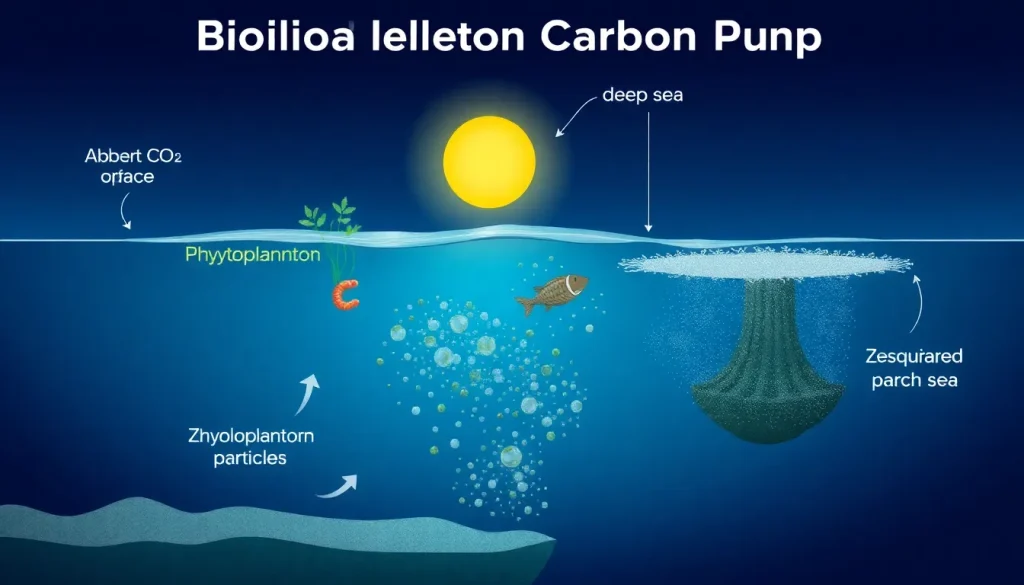
At its core, the biological carbon pump is driven by photosynthesis. In the euphotic zone—the upper 200 meters of the ocean where sunlight penetrates—phytoplankton and other marine autotrophs convert dissolved CO₂ into organic carbon. When these organisms die, are consumed, or produce fecal pellets, a portion of the organic matter sinks into the deep ocean. This downward flux of particulate organic carbon (POC) is the primary mechanism of the pump. Additionally, dissolved organic carbon (DOC) can be transported to depth via mixing and advection, forming the less-studied but significant dissolved organic carbon pump. Together, these processes sequester an estimated 5–12 gigatons of carbon per year, with a net export of about 0.2–0.5 gigatons reaching the deep ocean for long-term storage.
How It Works
The biological carbon pump operates through a series of interconnected steps that begin with the fixation of inorganic carbon and end with its sequestration in the deep ocean or sediments. The process can be broken down into three main stages: primary production, sinking and export, and deep-ocean remineralization.
1. Primary Production: In the sunlit surface layer (euphotic zone), phytoplankton use photosynthesis to convert dissolved CO₂ and nutrients into organic matter. This process is often limited by the availability of nutrients such as nitrogen, phosphorus, and iron, as well as light. The resulting organic carbon forms the base of the marine food web.
2. Sinking and Export: A fraction of the organic matter produced in the surface ocean sinks out of the euphotic zone as particulate organic carbon (POC). This includes dead phytoplankton cells, fecal pellets from zooplankton, and other detritus. The sinking particles aggregate into larger, faster-sinking “marine snow.” Only a small percentage—typically 5–10%—of the total primary production reaches depths below 1,000 meters, where carbon can be stored for centuries. The rest is remineralized (broken down) by bacteria and other organisms in the upper water column, returning CO₂ to the surface ocean and atmosphere.
3. Deep-Ocean Sequestration: Once organic carbon reaches the deep ocean, it is either consumed by deep-sea organisms or buried in sediments. The carbon that is remineralized at depth remains isolated from the atmosphere for long periods due to slow ocean circulation. A tiny fraction is permanently buried in seafloor sediments, effectively removing it from the carbon cycle for millions of years.
Importance and Impact
The biological carbon pump is a critical regulator of Earth’s climate. By transporting carbon to the deep ocean, it reduces the concentration of CO₂ in surface waters, which in turn allows the ocean to absorb more CO₂ from the atmosphere. Without this pump, atmospheric CO₂ levels would be significantly higher—some models estimate an increase of 200–300 parts per million (ppm)—leading to a much stronger greenhouse effect and a warmer planet.
Beyond climate regulation, the pump sustains deep-sea ecosystems. The sinking organic matter provides the primary food source for organisms living in the dark ocean, from bacteria to large abyssal creatures. It also influences the distribution of nutrients and oxygen in the ocean interior. Changes in the pump’s efficiency can therefore have cascading effects on marine biodiversity and biogeochemical cycles.
Main Drivers
The efficiency of the biological carbon pump is controlled by a combination of physical, chemical, and biological factors:
- Nutrient Availability: The supply of nutrients like nitrate, phosphate, and iron limits phytoplankton growth. In high-nutrient regions (e.g., upwelling zones), primary production is high, enhancing the pump.
- Light and Temperature: Sunlight drives photosynthesis, while temperature affects metabolic rates. Warmer surface waters can increase stratification, reducing nutrient supply from deeper layers and potentially weakening the pump.
- Ecosystem Structure: The composition of the plankton community matters. Larger phytoplankton (e.g., diatoms) and zooplankton that produce dense fecal pellets lead to faster sinking rates and more efficient carbon export. In contrast, microbial-dominated systems may recycle more carbon in the surface layer.
- Grazing and Food Web Dynamics: Zooplankton grazing packages small particles into larger, faster-sinking fecal pellets, enhancing export. However, if zooplankton consume sinking particles at depth, they can reduce the flux.
- Ocean Circulation: Upwelling and downwelling redistribute nutrients and carbon, influencing where and how much organic matter is produced and exported.
Connections to Other Systems
The biological carbon pump does not operate in isolation; it is tightly linked to the physical carbon pump (solubility pump) and the carbonate pump. The solubility pump refers to the physical dissolution of CO₂ in cold, dense surface waters that sink to the deep ocean, while the carbonate pump involves the formation and sinking of calcium carbonate shells by marine organisms. Together, these three pumps determine the ocean’s total carbon storage capacity.
The biological pump also interacts with the global climate system. For example, changes in atmospheric CO₂ and temperature affect ocean circulation and stratification, which in turn influence nutrient supply and primary production. Additionally, the pump is connected to ocean acidification: as CO₂ dissolves in seawater, it forms carbonic acid, lowering pH. While the biological pump can mitigate acidification at the surface by removing CO₂, the remineralization of organic matter at depth releases CO₂, contributing to deeper acidification. This complex interplay highlights the pump’s role in both climate regulation and marine chemistry.
Common Misconceptions
Misconception 1: The biological carbon pump is the only way the ocean absorbs CO₂. In reality, the ocean also takes up CO₂ through physical processes (the solubility pump) and through the formation of calcium carbonate shells (the carbonate pump). The biological pump is just one component of a larger system.
Misconception 2: The pump is a rapid solution to rising CO₂ emissions. While the biological pump naturally sequesters carbon, it operates on timescales of decades to millennia and cannot keep pace with the current rate of anthropogenic emissions. Proposals to artificially enhance the pump (e.g., ocean iron fertilization) carry significant ecological risks and uncertainties.
Misconception 3: All organic matter produced at the surface sinks to the deep ocean. In fact, the vast majority—over 90%—is remineralized in the upper water column and returns to the surface as CO₂. Only a small fraction reaches the deep sea, and an even smaller amount is permanently buried.
Misconception 4: The pump only involves dead organisms. Living organisms, particularly zooplankton, actively transport carbon to depth through daily vertical migration. They feed at the surface at night and excrete carbon-rich waste at depth during the day, contributing to the “active flux” of carbon.
What the Evidence Shows
Scientists study the biological carbon pump using a variety of methods, each providing a piece of the puzzle. Sediment traps deployed at different depths collect sinking particles, allowing direct measurement of POC flux. Satellite sensors estimate surface chlorophyll and primary production, while autonomous floats and gliders measure oxygen and carbon concentrations. Geochemical tracers, such as thorium-234, help quantify particle export rates. Models integrate these observations to simulate the pump’s behavior under past, present, and future conditions.
Evidence indicates that the pump’s strength varies regionally and seasonally. High-latitude regions and coastal upwelling zones tend to have high export efficiency, while subtropical gyres are less productive. Long-term studies suggest that climate change is already affecting the pump: warming-induced stratification reduces nutrient supply in some areas, potentially weakening the pump, while changes in plankton community composition may alter sinking rates. However, significant uncertainties remain, particularly regarding the response of the biological pump to ocean acidification and the role of the dissolved organic carbon pump.
FAQ
What is the biological carbon pump?
The biological carbon pump is the ocean's natural process of converting CO2 into organic matter through photosynthesis and transporting it to the deep sea, where it is stored for long periods, helping to regulate atmospheric CO2 levels.
How does the biological carbon pump work?
It works through phytoplankton absorbing CO2 in sunlit surface waters, then sinking as organic particles or being consumed and excreted by zooplankton. A fraction of this carbon reaches the deep ocean, where it is sequestered for centuries to millennia.
Why does the biological carbon pump matter?
It matters because it significantly reduces atmospheric CO2 concentrations, mitigating the greenhouse effect. Without it, Earth's climate would be much warmer, and it also sustains deep-sea ecosystems by providing food.
References
- National Oceanic and Atmospheric Administration (NOAA) – Ocean Carbon Cycle. https://www.noaa.gov/education/resource-collections/ocean-coasts/ocean-carbon-cycle
- Intergovernmental Panel on Climate Change (IPCC) Special Report on the Ocean and Cryosphere in a Changing Climate (2019). Chapter 5: Changing Ocean, Marine Ecosystems, and Dependent Communities.
- Falkowski, P. G. (2012). Ocean Science: The power of plankton. Nature, 483(7387), S17–S20. doi:10.1038/483S17a