In brief
At a glance
Quick Facts
- Core Focus
- CSR emphasizes voluntary social contributions; sustainability integrates environmental, social, and economic goals into core business strategy.
- Origin
- CSR gained prominence in the 1950s-60s; corporate sustainability emerged from the 1987 Brundtland Report and triple bottom line concept.
- Integration
- CSR is often a peripheral function; sustainability is embedded in operations, products, and business models.
- Time Horizon
- CSR projects are often short-term; sustainability requires long-term planning and systemic change.
- Measurement
- CSR reporting may be less standardized; sustainability often uses frameworks like GRI, SASB, and science-based targets.
- Investor Relevance
- Sustainability is increasingly tied to ESG ratings and access to capital; CSR alone may not satisfy investor criteria.
- Risk Management
- Sustainability addresses material risks like climate change and resource scarcity; CSR may not mitigate core business risks.
Key Takeaways
- Corporate Social Responsibility (CSR) is typically a voluntary, often philanthropic approach to business ethics, while Corporate Sustainability (CS) is a strategic integration of environmental, social, and economic goals into core operations.
- CSR often focuses on a company’s obligations to society and can be seen as a cost or charitable activity; sustainability is about creating long-term value by managing risks and opportunities across the triple bottom line.
- The two concepts are not interchangeable: CSR can be a component of a broader sustainability strategy, but sustainability requires systemic change in business models.
- Understanding the difference helps stakeholders assess whether a company is genuinely future-proofing its business or simply engaging in reputation management.
What Is Corporate Sustainability vs Corporate Social Responsibility?
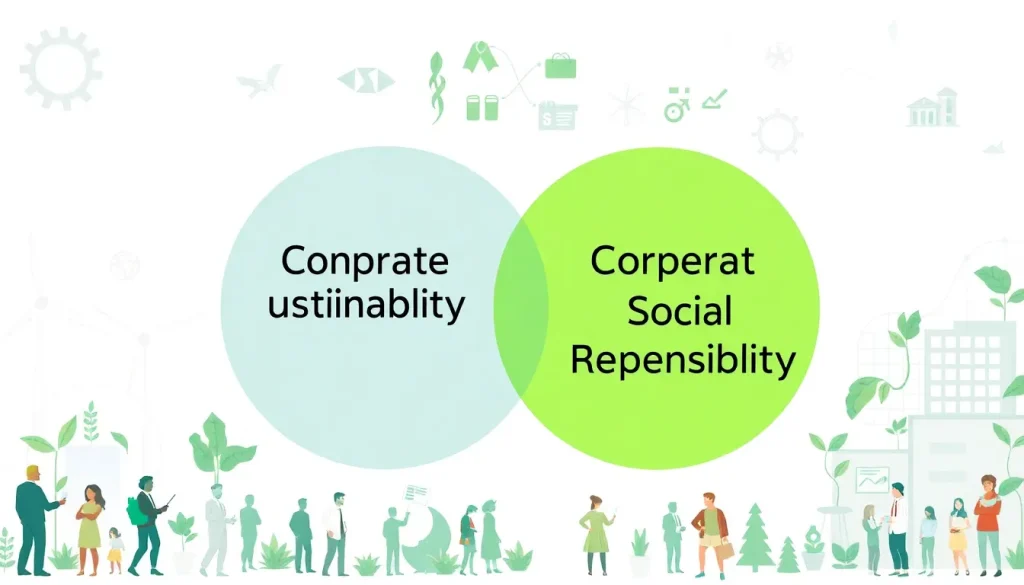
Corporate Social Responsibility (CSR) and Corporate Sustainability (CS) are related but distinct concepts that describe how businesses address their impacts on society and the environment. CSR traditionally refers to a company’s voluntary initiatives to contribute to a better society, often through philanthropy, ethical labor practices, and community engagement. It is typically seen as a moral obligation or a way to manage stakeholder relationships, and it often operates at the periphery of core business strategy. In contrast, Corporate Sustainability is a more comprehensive and strategic approach that embeds environmental, social, and economic considerations into the very fabric of a company’s operations, aiming to ensure the long-term viability of both the business and the systems it depends on.
The key distinction lies in integration and purpose. CSR activities are frequently managed as separate programs—such as corporate giving, volunteer days, or sustainability reports that highlight good deeds—while sustainability is woven into product design, supply chain management, and business models. For example, a company practicing CSR might donate a portion of profits to environmental causes, whereas a sustainable company would redesign its production processes to eliminate waste and reduce resource use. The shift from CSR to sustainability reflects a broader recognition that social and environmental issues are not just ethical concerns but also material risks and opportunities that affect long-term profitability and resilience.
History
The concept of corporate social responsibility emerged in the mid-20th century, gaining traction with the idea that businesses have obligations beyond profit maximization. Early CSR was often rooted in philanthropy and community relations, with companies making charitable donations or supporting local initiatives. The term gained academic and practical prominence in the 1950s and 1960s, notably through the work of scholars like Howard Bowen, who argued that businesses should consider the social implications of their decisions. By the 1990s, CSR had become a mainstream business practice, driven by stakeholder pressure, corporate scandals, and the rise of ethical consumerism.
Corporate sustainability, on the other hand, evolved from the broader sustainable development movement, which gained global attention with the 1987 Brundtland Report’s definition of sustainable development as meeting present needs without compromising future generations. The concept was further shaped by John Elkington’s “triple bottom line” framework in the 1990s, which urged businesses to account for social, environmental, and economic performance. Over time, sustainability shifted from a niche concern to a strategic imperative, influenced by climate change, resource scarcity, and investor demand for long-term value creation. Today, many companies are moving from CSR as a peripheral activity to sustainability as a core business principle, though the two terms are still often used interchangeably.
How They Work
CSR typically operates through discrete programs and initiatives that are often managed by a dedicated department or foundation. Common CSR activities include corporate giving, employee volunteer programs, cause-related marketing, and issuing annual sustainability or CSR reports that highlight social and environmental achievements. These efforts are frequently designed to enhance reputation, build brand loyalty, and mitigate risks, but they may not be deeply integrated into the company’s core strategy. CSR can be seen as a “bolt-on” approach—added to existing business practices rather than fundamentally changing them.
Corporate Sustainability, in contrast, works by embedding environmental, social, and governance (ESG) considerations into every aspect of the business. This involves redesigning products and services to be more sustainable, optimizing supply chains for resource efficiency, adopting circular economy principles, and setting science-based targets for emissions reductions. Sustainability is often driven by a long-term strategic vision and requires cross-functional collaboration, innovation, and sometimes a transformation of the business model. For example, a sustainable company might shift from selling products to offering services that reduce material consumption, or it might invest in renewable energy to power its operations. Measurement and reporting are also more rigorous, often aligned with frameworks such as the Global Reporting Initiative (GRI) or the Sustainability Accounting Standards Board (SASB).
Importance and Impact
Distinguishing between CSR and sustainability is crucial for businesses, investors, and consumers because it affects how corporate actions are evaluated. CSR initiatives can generate positive publicity and goodwill, but they may not address the fundamental environmental or social impacts of a company’s operations. For instance, a company might donate to reforestation projects while continuing to contribute to deforestation through its supply chain. Sustainability, by contrast, aims to eliminate negative impacts at the source, leading to more meaningful and lasting change.
The impact of this distinction extends to financial performance and risk management. Research suggests that companies with deeply integrated sustainability strategies tend to outperform their peers over the long term, as they are better positioned to navigate regulatory changes, resource constraints, and shifting consumer preferences. Investors increasingly use ESG criteria to assess corporate resilience, and a superficial CSR approach may not satisfy these demands. Moreover, employees and customers are becoming more discerning, often distinguishing between genuine sustainability efforts and “greenwashing.” Thus, understanding the difference helps stakeholders make informed decisions and encourages businesses to pursue authentic, systemic change.
Benefits, Limitations and Trade-offs
CSR offers several benefits: it can enhance a company’s reputation, strengthen community relations, and provide a “license to operate.” It is often easier and less costly to implement than full-scale sustainability initiatives, making it accessible to companies of all sizes. However, CSR has significant limitations. It can be superficial, focusing on short-term projects that do not address core business impacts. It may also be vulnerable to criticism as greenwashing if the company’s overall operations remain unsustainable. Additionally, CSR programs are often the first to be cut during economic downturns, as they are seen as discretionary rather than essential.
Corporate Sustainability, while more impactful, comes with its own trade-offs. Integrating sustainability into core strategy requires substantial investment, organizational change, and long-term commitment. It may involve short-term costs, such as higher expenses for sustainable materials or process redesign, and can be complex to implement across global supply chains. However, the long-term benefits include risk mitigation, innovation, cost savings through efficiency, and enhanced brand value. The main trade-off is between the immediate, visible benefits of CSR and the deeper, systemic changes required for sustainability. Companies must balance stakeholder expectations for quick wins with the need for fundamental transformation.
Common Misconceptions
One of the most common misconceptions is that CSR and corporate sustainability are synonymous. While they overlap, CSR is often a subset of sustainability, focusing on a company’s social obligations, whereas sustainability encompasses environmental and economic dimensions as well. Another misconception is that CSR is merely philanthropy or charity. In reality, CSR can include ethical labor practices, fair trade, and corporate governance, but it is still often limited in scope compared to sustainability.
Another misunderstanding is that sustainability is only about the environment. True corporate sustainability addresses the triple bottom line: people, planet, and profit. It includes social equity, economic viability, and environmental stewardship. Finally, some believe that adopting sustainability means sacrificing profitability. On the contrary, many sustainable practices—such as energy efficiency, waste reduction, and innovation—can lead to cost savings and new revenue streams, enhancing long-term financial performance.
FAQ
What is the main difference between CSR and corporate sustainability?
CSR is typically a voluntary, often philanthropic approach focused on a company’s social obligations, while corporate sustainability is a strategic integration of environmental, social, and economic goals into core business operations to ensure long-term viability.
Can a company have CSR without sustainability?
Yes. A company can engage in CSR activities like charitable donations or community programs without fundamentally changing its business model to be sustainable. However, such an approach may be seen as superficial if the company’s core operations remain environmentally or socially harmful.
Why does the distinction between CSR and sustainability matter?
The distinction matters because it affects how stakeholders assess a company’s true impact and long-term resilience. Investors, consumers, and regulators increasingly demand genuine sustainability rather than symbolic CSR, and companies that fail to integrate sustainability may face reputational, financial, and regulatory risks.
References
- World Commission on Environment and Development. (1987). Our Common Future (Brundtland Report). Oxford University Press.
- Elkington, J. (1997). Cannibals with Forks: The Triple Bottom Line of 21st Century Business. Capstone.
- Global Reporting Initiative (GRI) Standards. https://www.globalreporting.org/