In brief
At a glance
Quick Facts
- Definition
- Genetic material shed by organisms into the environment.
- Sample types
- Water, soil, sediment, air, and even snow.
- Detection method
- PCR amplification and DNA sequencing of specific genetic markers.
- First macrobial eDNA study
- 2008 detection of American bullfrog in French wetlands.
- Persistence in water
- Typically degrades within days to weeks, depending on conditions.
- Key advantage
- Non-invasive and highly sensitive, can detect species at low densities.
- Limitation
- Cannot determine exact population size or individual demographics.
- Applications
- Invasive species monitoring, endangered species detection, biodiversity surveys.
Key Takeaways
- Environmental DNA (eDNA) is genetic material shed by organisms into their surroundings, allowing species detection without direct observation.
- Scientists collect eDNA from water, soil, or air samples and analyze it using molecular techniques like PCR and DNA sequencing.
- eDNA methods are highly sensitive and can detect rare, elusive, or invasive species early, often before they are seen.
- This technology is transforming biodiversity monitoring, conservation, and ecosystem management by providing a non-invasive, cost-effective tool.
What Is Environmental DNA: How Scientists Detect Hidden Species?
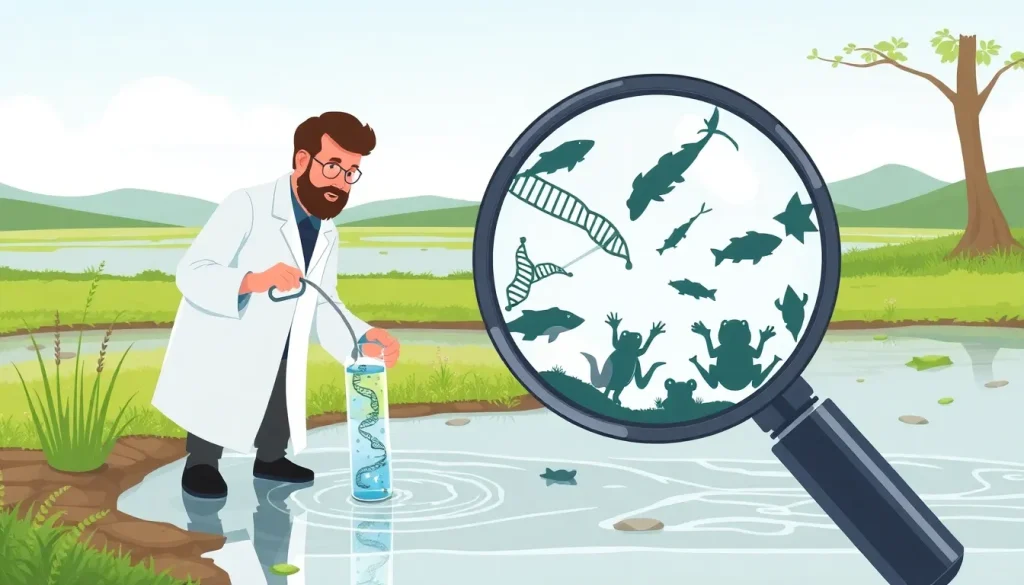
Environmental DNA, commonly abbreviated as eDNA, refers to genetic material that organisms release into their environment through skin cells, hair, feces, mucus, gametes, or decomposing matter. Unlike traditional DNA sampling, which requires capturing or observing an organism directly, eDNA is collected from environmental samples such as water, soil, sediment, or even air. This DNA can persist in the environment for days to weeks, depending on conditions, and can be extracted and analyzed to identify the species that left it behind. The concept is rooted in the idea that all living things constantly shed DNA, leaving a molecular signature of their presence.
eDNA analysis has emerged as a transformative tool in ecology and conservation biology. It allows scientists to detect species that are difficult to observe—such as rare, cryptic, or nocturnal animals—without the need for physical capture or visual confirmation. The method is particularly valuable for monitoring aquatic ecosystems, where a simple water sample can reveal the presence of fish, amphibians, invertebrates, and even microorganisms. Beyond species detection, eDNA can provide insights into population genetics, diet, and ecosystem health, making it a versatile and increasingly essential technique in modern biology.
Overview
Environmental DNA (eDNA) is part of a broader field of molecular ecology that uses genetic material from environmental samples to study biodiversity. Unlike traditional survey methods that rely on direct observation, trapping, or acoustic monitoring, eDNA analysis offers a non-invasive, efficient, and often more sensitive alternative. The approach has gained significant traction since the early 2000s, particularly with advances in high-throughput DNA sequencing and bioinformatics. Today, eDNA is used in diverse applications, from detecting invasive species in ballast water to monitoring endangered amphibians in remote wetlands. Its ability to provide a snapshot of entire biological communities from a single sample has revolutionized how scientists assess and manage ecosystems.
How It Works
The process of eDNA analysis involves several key steps. First, environmental samples are collected from the target habitat. In aquatic systems, this often means filtering water through a fine membrane to capture particulate matter containing DNA. Soil, sediment, or even air samples can be collected using specialized equipment. Once collected, the DNA is extracted from the sample using chemical or mechanical methods to break open cells and isolate the genetic material. The extracted DNA is then amplified using polymerase chain reaction (PCR) techniques, which target specific genetic markers—short DNA sequences unique to particular species or groups. For broader biodiversity surveys, metabarcoding is used, where universal primers amplify DNA from many species simultaneously. The amplified DNA is then sequenced, and the resulting sequences are compared to reference databases to identify the species present. Advanced bioinformatics tools help filter out errors, remove contaminants, and assign taxonomic identities. The entire workflow, from sample collection to data interpretation, requires careful controls to avoid contamination and ensure reliable results.
History
The concept of environmental DNA dates back to the 1980s when microbiologists first extracted DNA from soil and sediment to study microbial communities without culturing. The term “environmental DNA” was initially used in this microbial context. The application of eDNA to detect macroorganisms—animals and plants—began in the early 2000s. A landmark study in 2008 by Ficetola et al. used eDNA from water samples to detect the presence of the invasive American bullfrog in French wetlands, demonstrating the method’s potential for monitoring aquatic species. Since then, the field has expanded rapidly. Advances in sequencing technologies, such as next-generation sequencing, and the development of comprehensive DNA reference libraries have enabled the detection of entire communities from environmental samples. The method has been adopted globally for conservation, biosecurity, and ecological research.
Importance and Impact
eDNA has become a critical tool for biodiversity assessment and conservation. It enables early detection of invasive species, allowing for rapid response before populations become established. For endangered species, eDNA can confirm presence in habitats where visual surveys are challenging, such as murky waters or dense forests. The method also supports ecosystem monitoring by providing data on species richness and community composition. In aquatic environments, eDNA has been used to track fish migrations, assess the impact of pollution, and monitor the effectiveness of restoration efforts. Beyond ecology, eDNA has applications in public health, such as detecting pathogens in water supplies, and in forensics, for example, identifying species from trace evidence. Its non-invasive nature reduces stress on wildlife and minimizes habitat disturbance, aligning with ethical research practices.
Benefits, Limitations and Trade-offs
The primary benefits of eDNA include its sensitivity, cost-effectiveness, and non-invasiveness. It can detect species at very low densities, often before they are observed by traditional methods. Sampling is relatively simple and can be performed by non-specialists after minimal training, enabling large-scale citizen science projects. However, eDNA has limitations. DNA degrades over time, so positive detection indicates recent presence but not necessarily current occupancy. False positives can occur due to contamination or the movement of DNA through water or air from other locations. False negatives are also possible if DNA concentrations are too low or if inhibitors in the sample interfere with analysis. Additionally, eDNA cannot provide information on the age, sex, or number of individuals, and population size estimates remain challenging. The method relies heavily on comprehensive reference databases; gaps in these databases can limit species identification. Finally, eDNA is a complement to, not a replacement for, traditional survey methods, as it provides presence/absence data but not demographic details.
Common Misconceptions
One common misconception is that eDNA can provide an exact count of individuals in a population. While research is advancing, current methods primarily detect presence or relative abundance, not absolute numbers. Another misconception is that eDNA persists indefinitely; in reality, it degrades within days to weeks, so detection indicates recent presence. Some believe eDNA can identify any species from any sample, but success depends on the quality of reference databases and the specificity of genetic markers. Finally, eDNA is sometimes seen as a silver bullet that can replace all traditional monitoring, but it is best used as a complementary tool alongside other methods to provide a more complete picture of biodiversity.
FAQ
What is environmental DNA?
Environmental DNA (eDNA) is genetic material that organisms shed into their surroundings, such as water, soil, or air. It can be collected and analyzed to detect the presence of species without directly observing them.
How does eDNA work?
Scientists collect environmental samples, extract DNA, and use techniques like PCR and DNA sequencing to identify species-specific genetic markers. The sequences are compared to reference databases to determine which species are present.
Why does eDNA matter?
eDNA provides a non-invasive, sensitive, and cost-effective way to monitor biodiversity, detect invasive species early, and track endangered species. It complements traditional survey methods and supports conservation and ecosystem management.
References
- Ficetola, G. F., et al. (2008). Species detection using environmental DNA from water samples. Biology Letters.
- Thomsen, P. F., & Willerslev, E. (2015). Environmental DNA – An emerging tool in conservation for monitoring past and present biodiversity. Biological Conservation.
- Taberlet, P., et al. (2012). Environmental DNA. Molecular Ecology.