In brief
At a glance
Quick Facts
- Definition
- The difference between potential yield and actual farm yield.
- Potential yield
- The maximum yield of a crop variety when grown without water or nutrient limitations and with pests and diseases fully controlled.
- Actual yield
- The average yield achieved by farmers in a given region.
- Global significance
- Closing yield gaps is a key strategy to meet future food demand without expanding agricultural land.
- Measurement
- Yield gaps are often expressed as a percentage: (Potential yield - Actual yield) / Potential yield × 100.
- Main causes
- Include nutrient deficiencies, water stress, pests, diseases, and suboptimal management practices.
- Regional variation
- Yield gaps are larger in developing countries due to limited access to inputs and technology.
- Environmental impact
- Closing yield gaps sustainably can reduce pressure to convert natural ecosystems to farmland.
Key Takeaways
- The agricultural yield gap is the difference between the potential yield of a crop under ideal conditions and the actual yield achieved on farms.
- Yield gaps exist due to a combination of biophysical, management, and socioeconomic factors, including water stress, nutrient deficiencies, pests, and limited access to technology.
- Closing yield gaps is a critical strategy for increasing global food production without expanding agricultural land, thereby reducing pressure on natural ecosystems.
- Accurate yield gap analysis requires robust data and models, and solutions must be tailored to local conditions to be effective and sustainable.
What Is Agricultural Yield Gap?
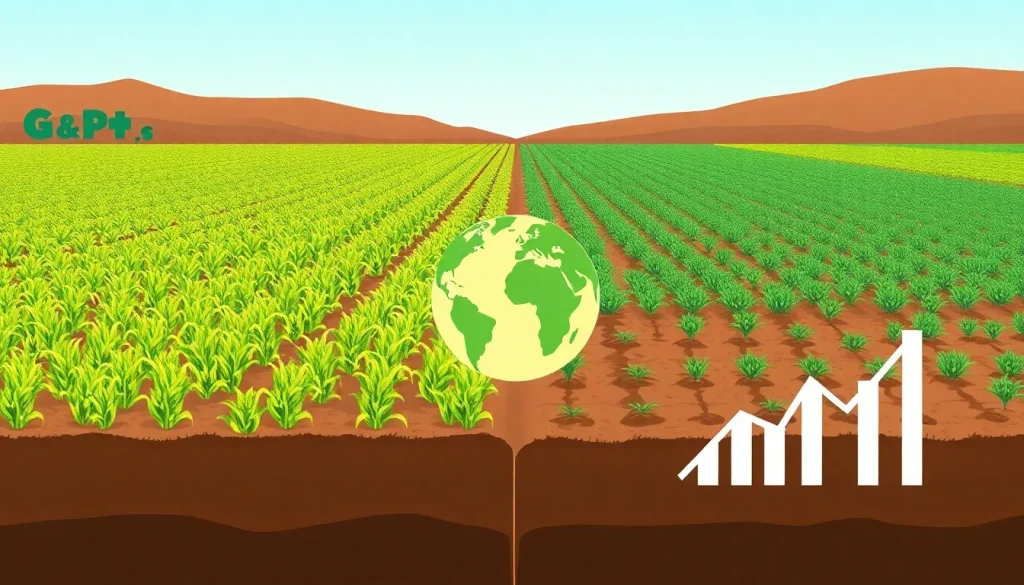
The agricultural yield gap is defined as the difference between the potential yield of a crop—the maximum yield achievable under ideal management and environmental conditions—and the actual yield that farmers obtain in a given region. This gap represents the unrealized production capacity of agricultural systems and is a central concept in agronomy and food security research. It is typically expressed as a percentage or absolute difference (e.g., tonnes per hectare) and can be measured at the field, farm, regional, or global level.
Understanding the yield gap is essential because it highlights the opportunities for increasing food production on existing farmland. With global population growth and limited arable land, closing yield gaps is often seen as a more sustainable alternative to expanding agriculture into natural habitats. The concept also helps identify the biophysical and socioeconomic constraints that limit crop productivity, guiding targeted interventions such as improved irrigation, better nutrient management, and adoption of high-yielding varieties.
Overview
The yield gap concept is rooted in the observation that crop yields vary widely across regions and even within the same region. While plant breeders and agronomists have developed crop varieties with high genetic yield potential, actual farm yields are often much lower due to a range of limiting factors. The yield gap is not a fixed value; it changes with location, climate, crop type, and management practices. For example, maize yields in sub-Saharan Africa are often a fraction of those in North America, not solely because of genetic differences but because of disparities in soil fertility, water availability, and access to inputs.
Yield gap analysis has become a key tool for agricultural research and policy. It helps prioritize investments in research and infrastructure by identifying where the largest gaps exist and what causes them. The concept is also central to discussions on sustainable intensification—producing more food on the same land area while minimizing environmental harm. By quantifying the gap between current and potential production, stakeholders can set realistic targets for yield improvement and monitor progress over time.
How It Works
Yield gap analysis involves comparing actual yields with different benchmarks of potential productivity. The most common benchmarks are:
- Potential yield (Yp): The yield of a crop cultivar when grown with water and nutrients non-limiting and biotic stress (pests, diseases, weeds) effectively controlled. It is determined by solar radiation, temperature, and crop genetics.
- Water-limited potential yield (Yw): Similar to Yp but under rainfed conditions, where water supply is the main limiting factor. This is relevant for most global cropland.
- Actual yield (Ya): The average yield achieved by farmers in a defined area over a specified period, typically obtained from agricultural statistics or field surveys.
The yield gap is then calculated as Yp – Ya (or Yw – Ya) and can be expressed in absolute terms (e.g., tonnes per hectare) or as a percentage of potential yield. For example, if the water-limited potential yield for wheat in a region is 8 t/ha and farmers achieve 4 t/ha, the yield gap is 4 t/ha or 50%.
Estimating potential yields requires robust crop simulation models, which use weather, soil, and crop management data to simulate growth under optimal conditions. These models are calibrated and validated with field experiments where water and nutrients are non-limiting and pests are controlled. Actual yields are derived from government statistics, farm surveys, or remote sensing. The analysis can be performed at different spatial scales, from individual fields to global grids, using geographic information systems (GIS).
Main Causes or Drivers
The yield gap arises from a complex interplay of biophysical and socioeconomic factors that prevent crops from reaching their potential. Key causes include:
- Water stress: In rainfed systems, inadequate or irregular rainfall is a primary limitation. Even in irrigated areas, poor water management can reduce yields.
- Nutrient deficiencies: Soils lacking essential nutrients, particularly nitrogen, phosphorus, and potassium, limit crop growth. In many smallholder systems, fertilizer application rates are far below optimal.
- Pests, diseases, and weeds: Inadequate pest and disease control can cause significant yield losses. Weeds compete for resources and reduce crop performance.
- Poor soil health: Soil degradation, compaction, acidity, or salinity can restrict root development and nutrient uptake.
- Suboptimal crop management: Factors such as late planting, low plant density, and improper variety selection reduce yield potential.
- Socioeconomic constraints: Limited access to credit, markets, extension services, and high-quality inputs often prevent farmers from adopting yield-enhancing practices.
- Institutional and policy barriers: Insecure land tenure, inadequate infrastructure, and lack of supportive agricultural policies can discourage investment in productivity improvements.
Importance and Impact
Addressing yield gaps has profound implications for global food security, environmental sustainability, and economic development. With the world population projected to reach nearly 10 billion by 2050, food production must increase substantially. Since expanding agricultural land often leads to deforestation and biodiversity loss, closing yield gaps on existing farmland is a more sustainable pathway. It can also reduce greenhouse gas emissions per unit of food produced by increasing efficiency.
For farmers, narrowing the yield gap means higher incomes and improved livelihoods, especially in developing countries where agriculture is a primary source of employment. At the national level, reducing yield gaps can enhance food self-sufficiency and reduce reliance on imports. However, it is important to pursue yield gap closure in an environmentally responsible manner, avoiding excessive use of fertilizers and water that could lead to pollution and resource depletion.
Solutions
Closing the yield gap requires a combination of technological, agronomic, and policy interventions tailored to local conditions. Key solutions include:
- Improved crop varieties: Developing and disseminating high-yielding, stress-tolerant cultivars adapted to specific environments.
- Better water management: Expanding irrigation where sustainable, and promoting water-saving techniques like drip irrigation and rainwater harvesting.
- Integrated soil fertility management: Combining organic and inorganic fertilizers, along with practices like crop rotation and cover cropping, to maintain soil health.
- Pest and disease control: Implementing integrated pest management (IPM) strategies that reduce losses while minimizing environmental impact.
- Access to inputs and credit: Ensuring farmers can obtain quality seeds, fertilizers, and financial services at affordable rates.
- Extension services and training: Providing farmers with knowledge on best agronomic practices and new technologies.
- Infrastructure development: Improving roads, storage, and market access to reduce post-harvest losses and enable farmers to invest in productivity.
- Policy support: Establishing stable land tenure, subsidies for sustainable practices, and research funding.
Data Limitations and Uncertainties
Yield gap analysis is subject to several uncertainties and data limitations. Potential yield estimates depend on the accuracy of crop models and the quality of input data, such as weather records and soil maps. In many regions, especially in developing countries, reliable data on actual farm yields are scarce or outdated. The definition of “potential yield” can vary among studies, leading to inconsistent gap estimates. Additionally, yield gaps are dynamic and can change with climate variability and technological progress, so periodic reassessment is necessary.
Another challenge is that yield gaps are often calculated at coarse spatial resolutions, which may mask significant within-region variability. Socioeconomic factors are difficult to quantify and incorporate into biophysical models, yet they are critical drivers of the gap. Therefore, yield gap estimates should be interpreted with caution and used as indicative guides rather than precise targets. Ongoing efforts to improve data collection, remote sensing, and modeling techniques are helping to reduce these uncertainties.
FAQ
What is agricultural yield gap?
The agricultural yield gap is the difference between the potential yield of a crop under ideal conditions and the actual yield achieved by farmers. It indicates the room for improving productivity on existing farmland.
How is yield gap calculated?
Yield gap is calculated by subtracting actual yield from potential yield (or water-limited potential yield). It can be expressed in absolute terms (e.g., tonnes per hectare) or as a percentage of potential yield.
Why does closing the yield gap matter?
Closing the yield gap matters because it can increase food production without expanding agricultural land, helping to meet growing food demand while reducing environmental pressures such as deforestation and greenhouse gas emissions.
References
- Lobell, D. B., Cassman, K. G., & Field, C. B. (2009). Crop yield gaps: their importance, magnitudes, and causes. Annual Review of Environment and Resources, 34, 179-204.
- van Ittersum, M. K., et al. (2013). Yield gap analysis with local to global relevance—A review. Field Crops Research, 143, 4-17.
- Global Yield Gap Atlas (www.yieldgap.org)