In brief
At a glance
Quick Facts
- Core technologies
- GPS, GIS, remote sensing, variable rate technology, and automated machinery.
- Potential fertilizer reduction
- Variable rate application can reduce nitrogen use by 10–30% in some contexts.
- Water savings
- Precision irrigation can cut water use by up to 20–50% compared to conventional methods.
- Greenhouse gas emissions
- Optimized field operations can lower fuel consumption and soil emissions, but data centers add energy demand.
- E-waste concern
- Obsolete sensors, drones, and batteries contribute to electronic waste if not recycled properly.
- Adoption barriers
- High upfront costs, need for technical skills, and data privacy concerns limit uptake, especially among smallholders.
- Soil health
- Controlled traffic farming reduces soil compaction, improving water infiltration and root growth.
- Rebound effect risk
- Efficiency gains may lead to expanded production, offsetting environmental savings.
Key Takeaways
- Precision agriculture uses data-driven technologies to optimize crop inputs, potentially reducing environmental harm.
- It can lower chemical use, greenhouse gas emissions, and soil erosion, but may also increase energy consumption and electronic waste.
- The net environmental impact is highly context-dependent, influenced by farm size, crop type, and management decisions.
- Adoption of precision agriculture requires addressing barriers such as cost, data privacy, and the digital divide to maximize benefits and minimize risks.
What Is Precision Agriculture: Environmental Benefits and Risks?
Precision agriculture (PA) is a farming management concept that uses information technology to observe, measure, and respond to variability in crops and soils. By applying inputs such as water, fertilizer, and pesticides only where and when they are needed, PA aims to increase efficiency, productivity, and sustainability. The environmental benefits and risks of precision agriculture refer to the potential positive and negative outcomes of deploying these technologies on ecosystems, natural resources, and human health.
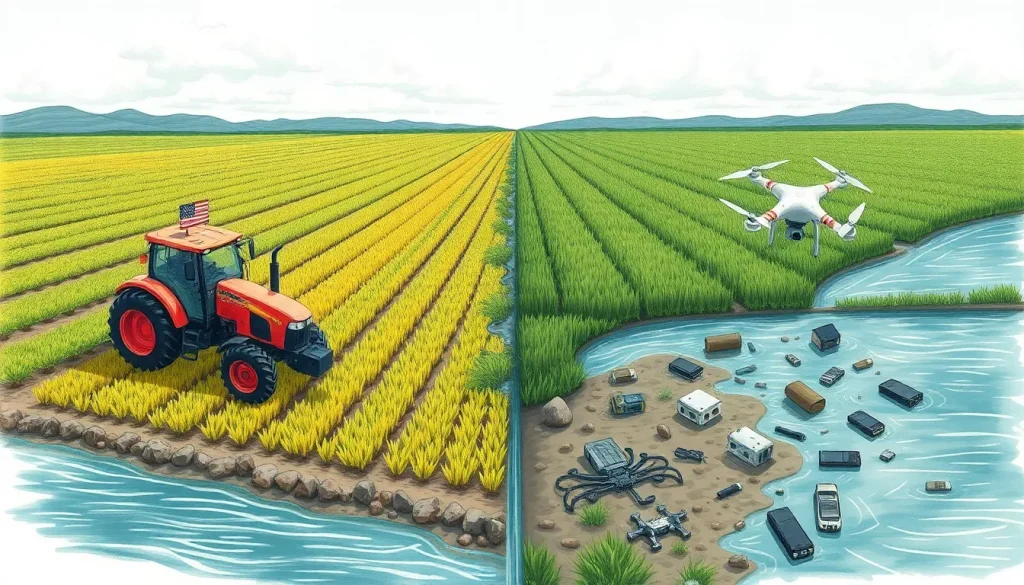
On the one hand, PA can reduce the overapplication of agrochemicals, minimize nutrient runoff into waterways, and lower greenhouse gas emissions through optimized field operations. On the other hand, the production and disposal of high-tech equipment, increased energy use for data processing, and the risk of encouraging more intensive farming practices can offset some of these gains. Understanding this duality is essential for policymakers, farmers, and the public as agriculture faces pressure to feed a growing population while reducing its environmental footprint.
Overview
Precision agriculture encompasses a suite of technologies and practices that enable site-specific management of crops. Core components include Global Positioning Systems (GPS), Geographic Information Systems (GIS), remote sensing, variable rate technology (VRT), and automated machinery. These tools allow farmers to map field variability, monitor crop health in real time, and apply inputs at variable rates across a field rather than uniformly. The environmental implications are profound: by matching inputs to actual plant needs, PA can reduce excess application of fertilizers and pesticides, thereby decreasing pollution and conserving resources. However, the adoption of PA also introduces new environmental challenges, such as the energy and materials required to manufacture and operate sensors, drones, and data centers, as well as the disposal of electronic waste. The balance between these benefits and risks is a subject of ongoing research and debate.
How It Works
Precision agriculture relies on a cycle of data collection, analysis, and action. First, data on soil properties, crop health, topography, and weather are gathered using sensors mounted on tractors, drones, satellites, or handheld devices. This information is then processed with specialized software to create detailed maps that reveal variability within a field. Based on these maps, variable rate technology adjusts the application of seeds, fertilizers, pesticides, and water in real time as machinery moves across the field. For example, a variable rate fertilizer spreader can increase or decrease the amount of nitrogen applied in different zones, reducing over-fertilization in areas with already sufficient nutrients. Similarly, precision irrigation systems deliver water only where soil moisture is low, conserving water and preventing runoff. Automated guidance systems reduce overlaps and skips, saving fuel and minimizing soil compaction. The entire system is often integrated with farm management software that tracks yields and environmental conditions, enabling continuous improvement.
What the Evidence Shows
Research on the environmental effects of precision agriculture yields mixed but generally positive results. Studies indicate that variable rate application of fertilizers can reduce nitrogen use by 10–30% without sacrificing yields, thereby decreasing nitrate leaching into groundwater and emissions of nitrous oxide, a potent greenhouse gas. Similarly, precision pesticide application can lower the volume of chemicals used, reducing risks to non-target organisms and water quality. Controlled traffic farming, which uses GPS to confine machinery to permanent lanes, has been shown to improve soil structure and reduce erosion. On the other hand, evidence also points to potential negative outcomes. The increased use of electronics and sensors generates e-waste, and the energy required for data processing and automated machinery can contribute to a larger carbon footprint. Moreover, some studies suggest that PA can enable expansion of farming into marginal lands or intensify production on existing farmland, potentially leading to habitat loss or increased chemical use overall. The net environmental effect depends heavily on how the technology is applied and the specific context.
Environmental and Human Impacts
The environmental impacts of precision agriculture are multifaceted. Positive effects include reduced leaching of nitrates and pesticides into water bodies, lower emissions of greenhouse gases from soil and machinery, and improved soil health through minimized compaction and targeted tillage. By optimizing input use, PA can also conserve non-renewable resources such as phosphate rock. For humans, these benefits translate into cleaner water, reduced exposure to agrochemicals, and a more stable food supply. However, negative impacts exist. The production of high-tech equipment requires rare earth minerals and energy-intensive manufacturing, contributing to pollution and resource depletion. The disposal of obsolete sensors, drones, and batteries adds to the growing problem of electronic waste, which can leach toxic substances into the environment if not properly managed. Additionally, the reliance on data centers for processing and storing agricultural data consumes significant amounts of electricity, often generated from fossil fuels. There are also social dimensions: the digital divide may exclude smallholder farmers from accessing these technologies, potentially widening economic disparities and affecting rural communities.
Benefits, Limitations and Trade-offs
The primary environmental benefits of precision agriculture are well-documented: reduced chemical inputs, lower water consumption, decreased soil erosion, and diminished carbon footprint per unit of output. These advantages can contribute to more sustainable farming systems and help meet regulatory requirements for environmental protection. However, these benefits are not automatic. Limitations include high initial investment costs, the need for technical expertise, and the complexity of integrating diverse data sources. Small-scale farmers may find the technology prohibitively expensive, and in some cases, the environmental gains may be offset by increased energy use or the rebound effect, where efficiency improvements lead to expanded production and higher total resource use. Trade-offs also exist between different environmental goals; for instance, precision irrigation saves water but may require more energy for pumping and sensors. A holistic assessment is necessary to ensure that the adoption of PA leads to genuine environmental improvement rather than shifting burdens from one area to another.
Common Misconceptions
One common misconception is that precision agriculture always reduces environmental impact. In reality, the outcome depends on how the technology is used. If PA enables more intensive farming on previously marginal land, it can lead to habitat destruction and increased chemical use. Another myth is that PA is only suitable for large, industrial farms. While scale can facilitate adoption, many PA tools—such as smartphone apps for soil testing or low-cost sensors—are increasingly accessible to smallholders. A third misconception is that PA eliminates the need for agronomic knowledge. On the contrary, effective use of PA requires a deep understanding of local soil, climate, and crop interactions to interpret data correctly and make sound decisions. Finally, some believe that PA automatically leads to data-driven sustainability, but without proper data governance, the information collected can be misused, raising privacy concerns for farmers.
FAQ
What is precision agriculture?
Precision agriculture is a farming management approach that uses information technology to observe, measure, and respond to variability in crops and soils, applying inputs only where and when needed to increase efficiency and sustainability.
How does precision agriculture benefit the environment?
It can reduce the overuse of fertilizers and pesticides, lower greenhouse gas emissions, conserve water, and minimize soil erosion by enabling site-specific management and reducing unnecessary field operations.
What are the environmental risks of precision agriculture?
Risks include increased energy consumption from data processing and automated machinery, electronic waste from obsolete devices, potential for intensified farming on marginal lands, and data privacy concerns that may affect adoption and governance.
References
- Food and Agriculture Organization of the United Nations (FAO). 'Precision Agriculture and the Future of Farming.'
- United States Department of Agriculture (USDA). 'Precision Agriculture in Crop Production.'
- Basso, B., & Antle, J. (2020). 'Digital agriculture to design sustainable agricultural systems.' Nature Sustainability, 3, 254–256.