In brief
At a glance
Quick Facts
- Number of registered chemicals
- Over 350,000 chemicals and mixtures are registered for commercial use globally.
- Planetary boundary status
- The novel entities boundary is considered transgressed, meaning the safe operating space has been exceeded.
- Control variable
- No single control variable has been defined; scientists use multiple indicators like production trends and chemical footprints.
- Key challenge
- Chemicals have diverse properties (persistence, toxicity, mobility) that cannot be aggregated into one metric.
- Global transport
- Persistent organic pollutants can travel thousands of kilometers, accumulating in remote regions like the Arctic.
- Data gap
- Only a small fraction of commercial chemicals have been thoroughly assessed for environmental and health risks.
- Precautionary approach
- The framework advocates reducing the overall release of novel entities in the absence of a quantified boundary.
Key Takeaways
- Chemical pollution is not a single substance but a vast mixture of synthetic chemicals, each with unique properties, making a single global boundary scientifically impractical.
- The planetary boundaries framework treats chemical pollution as a “novel entities” boundary that remains unquantified due to the sheer number of chemicals and lack of comprehensive data.
- Regional differences in chemical production, use, and environmental fate mean that safe limits vary geographically, preventing a one-size-fits-all global threshold.
- The absence of a single boundary highlights the need for precautionary, multi-indicator approaches to manage chemical risks and protect ecosystem and human health.
What Is Why There Is No Single Global Boundary for Chemical Pollution?
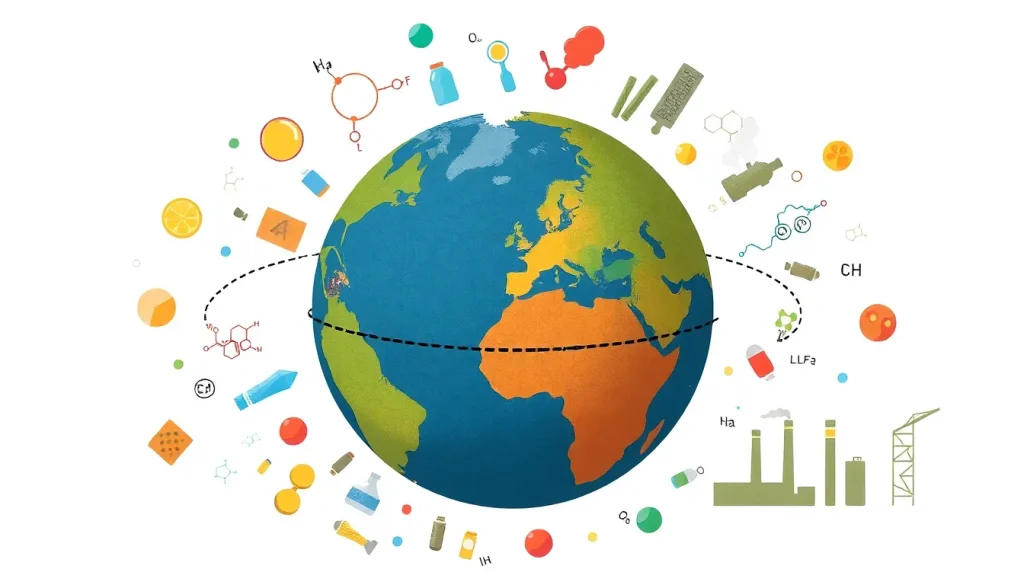
The absence of a single global boundary for chemical pollution refers to the fact that, unlike other Earth system processes such as climate change or stratospheric ozone depletion, there is no single measurable threshold that defines a safe operating space for the release of all synthetic chemicals into the environment. Chemical pollution encompasses an enormous variety of substances—industrial chemicals, pesticides, pharmaceuticals, plastics, and more—each with distinct chemical properties, toxicities, persistence, and environmental behaviors. Because these substances do not act as a unified entity, a single global limit cannot capture the complexity of their impacts on planetary health.
This concept is central to the planetary boundaries framework, which identifies nine critical Earth system processes that regulate the stability and resilience of the planet. While boundaries like climate change and ocean acidification have well-defined control variables (e.g., atmospheric CO₂ concentration), the boundary for “novel entities”—which includes synthetic chemicals and other human-made pollutants—remains unquantified. Scientists have not been able to define a single safe threshold because chemical pollution is not a single process but a multitude of interacting stressors with diverse and often poorly understood effects. Instead, the framework uses a set of indicators and a precautionary approach to assess whether the boundary is being transgressed.
Overview
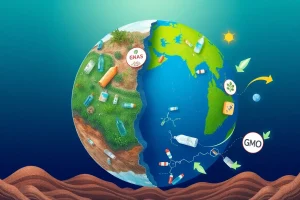
The planetary boundaries framework, first proposed in 2009, defines a safe operating space for humanity by identifying key Earth system processes and proposing quantitative boundaries that should not be exceeded. For most boundaries, a single control variable is used: for climate change, it is atmospheric CO₂ concentration; for ocean acidification, it is carbonate ion concentration; for stratospheric ozone depletion, it is ozone column thickness. However, the boundary for “novel entities”—synthetic chemicals, plastics, radioactive materials, and genetically modified organisms—has never been assigned a single global control variable. This is not because chemical pollution is unimportant, but because its nature defies simple quantification.
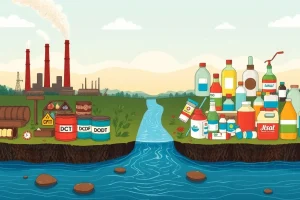
Chemical pollution is inherently multifaceted. Over 350,000 chemicals and mixtures are registered for commercial use, and many more are created as byproducts. They range from persistent organic pollutants (POPs) that travel globally and accumulate in food chains, to short-lived but highly toxic pesticides, to microplastics that pervade oceans and soils. Each chemical has a unique combination of persistence, bioaccumulation potential, toxicity, and mobility. Some cause acute effects; others act as endocrine disruptors at extremely low concentrations. The sheer diversity and the lack of comprehensive toxicity data for most chemicals make it impossible to condense all risks into a single number.
How It Works
The elusiveness of a single global boundary for chemical pollution stems from several scientific and practical challenges. First, there is no common metric that can aggregate the risks of all chemicals. Unlike greenhouse gases, which can be compared using global warming potential, chemical pollutants have no universal unit of harm. A boundary would need to account for carcinogenicity, ecotoxicity, endocrine disruption, and other effects, which are measured on different scales and often depend on exposure pathways and species sensitivity.
Second, the environmental fate of chemicals varies widely. Some degrade quickly in sunlight or water, while others persist for decades and undergo long-range atmospheric or oceanic transport. A global boundary would have to consider not only the amount released but also where and how it is released, because impacts are highly location-dependent. Third, many chemicals interact synergistically or antagonistically, creating mixture effects that are poorly understood. A boundary based on individual substances would miss these complex interactions. Finally, the rate of new chemical introductions far outpaces the capacity to assess their safety. The planetary boundary for novel entities is considered transgressed precisely because society is producing and releasing novel substances faster than they can be evaluated or controlled.
In the absence of a single control variable, scientists have proposed alternative approaches. One is the “chemical footprint,” which measures the dilution capacity needed to keep chemical concentrations below ecological thresholds. Another is a set of indicators, such as the trend in plastic production, the number of new chemicals registered, and the rate of release of persistent organic pollutants. These multi-indicator frameworks acknowledge that no single number can define a safe limit, but they provide a way to monitor whether humanity is moving toward or away from a safer state.
Importance and Impact
The lack of a single global boundary does not diminish the urgency of chemical pollution. On the contrary, it underscores the pervasive and insidious nature of the threat. Chemical pollutants are now found in every corner of the planet, from the deep sea to the polar ice caps, and in the bodies of virtually all living organisms. They contribute to biodiversity loss, ecosystem degradation, and a range of human health problems, including cancer, reproductive disorders, and neurological damage. The planetary boundaries framework identifies the novel entities boundary as one that has already been transgressed, meaning that the safe operating space has been exceeded, with potentially irreversible consequences.
Because there is no single threshold, the impacts are often underestimated or overlooked in policy discussions. Climate change has a clear target (e.g., 1.5°C warming), which galvanizes action. Chemical pollution lacks such a focal point, making it harder to mobilize global efforts. However, the absence of a single boundary also highlights the need for a more holistic and precautionary approach to chemical management, one that prioritizes reducing the overall chemical burden on the environment rather than waiting for a magic number to be defined.
Regional Differences
Chemical pollution is not evenly distributed across the globe. Industrialized regions tend to have higher production and release of synthetic chemicals, but pollution does not respect borders. Persistent organic pollutants, for example, evaporate in warmer regions and condense in colder areas, leading to high concentrations in the Arctic, far from their sources. Developing countries may face acute local pollution from unregulated industries, agricultural runoff, or inadequate waste management, while also being recipients of exported hazardous waste.
These regional disparities make a single global boundary even more problematic. A limit that is safe for one region may be too lax or too strict for another, depending on local ecosystems, population density, and technological capacity for pollution control. Moreover, the benefits and risks of chemical use are unevenly distributed: wealthier nations often enjoy the benefits of chemical products while poorer nations bear a disproportionate share of the environmental and health costs. Any effective governance framework must account for these regional differences, which a single global number cannot do.
Data Limitations and Uncertainties
A major reason why no single global boundary has been set is the profound lack of data. Of the hundreds of thousands of chemicals in commerce, only a small fraction have been thoroughly tested for toxicity, environmental persistence, or bioaccumulation. For most, even basic information on production volumes and release pathways is missing. Monitoring networks are sparse, especially in developing countries and for emerging contaminants like microplastics or per- and polyfluoroalkyl substances (PFAS).
Uncertainties also arise from the complex behavior of chemicals in the environment. Degradation products can be more toxic than the parent compound. Low-dose effects, such as endocrine disruption, may not follow traditional dose-response curves. The combined effects of multiple chemicals are largely unknown. These knowledge gaps mean that any attempt to define a single global boundary would rest on shaky scientific ground. The planetary boundaries framework explicitly acknowledges this by keeping the novel entities boundary unquantified and calling for a precautionary approach until more data become available.
Connections to Other Systems
Chemical pollution is deeply interconnected with other planetary boundaries. Pesticides and industrial chemicals contribute to biodiversity loss by harming pollinators, soil organisms, and aquatic life. Plastic pollution affects marine ecosystems and may alter carbon cycling in the oceans. Some chemicals, such as nitrogen and phosphorus from agricultural runoff, directly link to the biogeochemical flows boundary. Climate change can amplify the impacts of chemical pollution by altering the fate and transport of contaminants, while some chemicals (e.g., black carbon) can influence climate forcing.
These interconnections mean that chemical pollution cannot be managed in isolation. A single global boundary would need to account for these feedback loops, adding another layer of complexity. The planetary boundaries framework treats the boundaries as interconnected, and transgressing one can push others further into the danger zone. Thus, the absence of a single chemical pollution boundary is not a weakness of the framework but a reflection of the intricate web of Earth system interactions that must be considered.
FAQ
What is the planetary boundary for chemical pollution?
The planetary boundary for chemical pollution, called the 'novel entities' boundary, addresses the release of synthetic chemicals, plastics, and other human-made substances. Unlike other boundaries, it has no single global threshold because of the vast diversity of chemicals and their effects.
Why can't we set a single safe limit for all chemicals?
Chemicals vary widely in toxicity, persistence, and environmental behavior. There is no common unit to measure their combined harm, and data on most chemicals is lacking. A single number would oversimplify the complex risks and regional differences.
Does the lack of a boundary mean chemical pollution is not a serious problem?
No. The boundary is considered transgressed, indicating that chemical pollution already exceeds safe levels. The absence of a single number reflects scientific complexity, not a lack of urgency. It calls for precautionary action to reduce chemical releases.
References
- Rockström, J., et al. (2009). 'Planetary Boundaries: Exploring the Safe Operating Space for Humanity.' Ecology and Society.
- Steffen, W., et al. (2015). 'Planetary Boundaries: Guiding human development on a changing planet.' Science.
- Persson, L., et al. (2022). 'Outside the Safe Operating Space of the Planetary Boundary for Novel Entities.' Environmental Science & Technology.