In brief
At a glance
Quick Facts
- Status
- Widely used but debated; 6 of 9 boundaries transgressed (2023)
- Control variable
- Multiple, one per boundary (e.g., CO₂ concentration, extinction rate)
- Proposed boundary
- Varies; e.g., 350 ppm CO₂, 10 E/MSY extinction rate
- Current value
- 417 ppm CO₂ (2022); extinction rate >100 E/MSY
- Pre-industrial baseline
- Holocene epoch (last 11,700 years) conditions
Current status
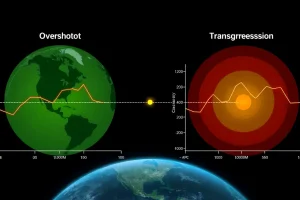
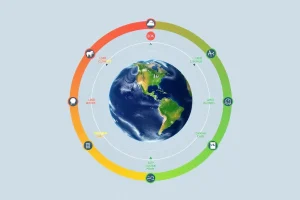
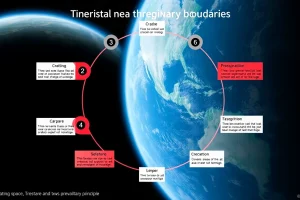
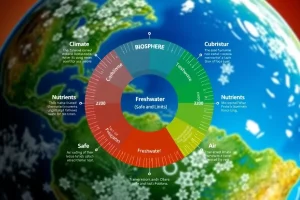
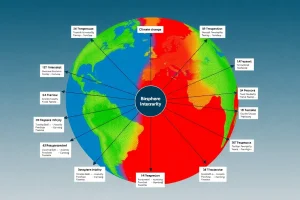
The planetary boundaries framework, first proposed by Rockström et al. (2009) and updated in Steffen et al. (2015) and Richardson et al. (2023), has become a prominent concept in global sustainability science. It is widely cited in policy documents, including by the United Nations and the European Commission, and has inspired the “doughnut economics” model. As of the 2023 assessment, six of the nine boundaries are considered transgressed, indicating that humanity is operating outside the safe operating space for climate change, biosphere integrity, land-system change, freshwater change, biogeochemical flows, and novel entities. Despite its influence, the framework continues to attract substantial criticism from within the scientific community, with debates centering on its conceptual foundations, methodological choices, and practical implications.
Control variable
Each planetary boundary is defined by one or more control variables intended to capture the state of the Earth-system process. For example, climate change is tracked by atmospheric CO₂ concentration and radiative forcing, while biosphere integrity uses genetic diversity (extinction rate) and functional diversity (e.g., the Biodiversity Intactness Index). Critics argue that the selection of control variables is often arbitrary and may not represent the most policy-relevant or scientifically robust indicators. For instance, the use of species extinction rate as a global metric for biodiversity loss has been questioned because it is difficult to measure accurately and may not reflect ecosystem functioning at local scales (Brook et al., 2013). Similarly, the freshwater boundary originally relied on consumptive blue water use, a choice that was later revised to include green water and regional limits after criticism that the global aggregate masked critical water stress in many basins.
Proposed boundary or threshold
The framework sets a “safe” boundary at the lower end of a zone of increasing risk, based on expert judgment and available Earth-system science. For climate change, the boundary is 350 ppm CO₂ and a radiative forcing of +1.0 W/m² relative to pre-industrial. For biosphere integrity, the extinction rate should not exceed 10 extinctions per million species-years (E/MSY), with a more precautionary boundary of 1 E/MSY. These values have been criticized as lacking a clear empirical basis. Nordhaus (2018) argued that the 350 ppm CO₂ target is inconsistent with economic integrated assessment models and would require implausibly rapid decarbonization. Others note that the boundary for novel entities (chemical pollution) remains unquantified, undermining its operational value. The reliance on a single global threshold for processes that exhibit strong regional variation, such as freshwater use and land-system change, has also been a persistent point of contention.
Current measured value
According to Richardson et al. (2023), the current CO₂ concentration is approximately 417 ppm (2022), well above the 350 ppm boundary. The extinction rate is estimated at over 100 E/MSY, far exceeding the proposed limit. Six boundaries are now in the high-risk zone. However, the measured values themselves are subject to significant uncertainty. For example, the global extinction rate is inferred from limited data and models, and the functional diversity indicator is still under development. The framework’s reliance on global averages can obscure the fact that some regions are far more severely affected than others, leading to criticism that the “transgressed” label may not accurately reflect local realities or the potential for regional tipping points.
How the boundary is calculated
The methodology involves identifying Earth-system processes that are critical for maintaining Holocene-like conditions, selecting control variables, determining a Holocene baseline range, and then setting a boundary at the point where the risk of leaving that range becomes significant. The boundary is placed at the lower edge of the zone of uncertainty, reflecting a precautionary approach. This process relies heavily on expert elicitation and literature synthesis, which introduces subjectivity. Critics have pointed out that the framework does not use a consistent quantitative method across boundaries; some boundaries are based on global thresholds (e.g., climate), while others are based on regional budgets (e.g., freshwater) or on qualitative assessments (e.g., novel entities). The lack of a unified methodology makes the framework less transparent and harder to validate (Blomqvist et al., 2012).
Historical trend
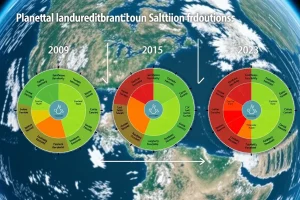
The framework has evolved considerably since its inception. The original 2009 version identified seven boundaries, with three transgressed. The 2015 update expanded to nine boundaries, added regional components, and reported four transgressed. The 2023 update further refined control variables and concluded that six boundaries are now transgressed. This evolution has been both praised as scientific progress and criticized as “moving the goalposts.” Some researchers argue that the addition of new boundaries (e.g., novel entities) and the revision of existing ones (e.g., freshwater) reflect a post-hoc adjustment to maintain the framework’s relevance rather than a purely hypothesis-driven scientific process. The shifting baselines also complicate long-term policy planning, as the definition of a safe operating space changes over time.
What is driving the change
The transgression of planetary boundaries is driven by human activities—fossil fuel combustion, deforestation, intensive agriculture, industrial pollution, and resource extraction. The framework identifies these drivers in general terms but does not incorporate socio-economic dynamics or feedbacks. Critics argue that by treating human activities as external pressures, the framework overlooks the complex interactions between social and ecological systems. This limits its ability to inform policies that address the root causes of environmental degradation, such as inequality, consumption patterns, and governance failures. Some scholars have called for integrating the planetary boundaries with the social foundations of the doughnut model to better capture the human dimension.
What crossing the boundary means
The framework posits that crossing a planetary boundary increases the risk of triggering non-linear, abrupt, or irreversible environmental changes at the global scale. However, the concept of a global threshold is contested. For processes like freshwater use and land-system change, the most critical impacts are often regional, and a global aggregate may not correspond to any real tipping point. Even for climate change, the existence of a single global tipping point is debated; the Earth system may instead exhibit a cascade of regional tipping elements. The framework’s emphasis on global boundaries may therefore overstate the risk of global catastrophe while understating the importance of regional crises. Additionally, the “zone of increasing risk” is not well defined, making it difficult to assess how much risk increases with further transgression.
Regional variations
Several planetary boundaries are inherently regional, yet the framework initially presented them as global limits. The 2015 update introduced regional boundaries for freshwater use, land-system change, and biogeochemical flows, but the approach remains incomplete. For example, the freshwater boundary is now defined by allowable human water consumption as a percentage of mean monthly flow in each basin, but the global aggregation still reports a single transgression status. Critics argue that a global “safe operating space” may not be meaningful for issues like water scarcity or deforestation, where local thresholds are more relevant. The framework’s global focus can also lead to inequitable policy prescriptions, as it may impose uniform constraints on countries with vastly different historical responsibilities and development needs.
Interaction with other boundaries
The framework acknowledges that boundaries interact—for instance, land-system change affects climate, biodiversity, and freshwater cycles—but it does not quantitatively model these interactions. The boundaries are treated largely as independent, which may underestimate systemic risks. Earth-system models show that transgressing one boundary can amplify pressures on others, potentially leading to cascading effects. The lack of integrated modeling is a significant limitation, as it prevents a holistic assessment of the Earth system’s state. Some researchers have proposed using dynamic global vegetation models or integrated assessment models to capture these feedbacks, but such efforts are still in their infancy.
Impacts on people and ecosystems
The framework links boundary transgression to risks for human well-being, including food and water security, health, and economic stability. However, the causal chain from a global boundary to local impacts is often indirect and uncertain. Critics note that the framework does not adequately address the social and economic dimensions of these impacts, such as differential vulnerability, adaptive capacity, or the distribution of harms. This limits its utility for designing equitable policies. Moreover, the focus on biophysical thresholds may divert attention from more immediate social and environmental problems that are not captured by global boundaries, such as local air pollution or soil degradation.
Possible pathways back toward the safe zone
The framework suggests that returning to the safe operating space requires reducing human pressures on Earth-system processes, but it does not prescribe specific policies. Critics argue that the framework is too abstract to guide actionable pathways. For example, it does not specify how to reduce CO₂ concentrations to 350 ppm, a target that would require not only rapid decarbonization but also large-scale carbon dioxide removal. The lack of integration with economic and political realities makes the framework less useful for decision-makers. Some scholars have called for combining planetary boundaries with scenario analysis and backcasting to develop concrete transition pathways, but such work remains preliminary.
Scientific uncertainty
Uncertainty pervades every aspect of the planetary boundaries framework. The position of the boundaries, the current state of control variables, the shape of the risk function, and the interactions between boundaries are all subject to large uncertainties. The framework uses a precautionary approach by setting boundaries at the lower end of the uncertainty zone, but this choice is itself a value judgment. Some scientists argue that the uncertainties are so large that the boundaries are not scientifically meaningful and may lead to false alarms or misallocation of resources. Others counter that the precautionary principle is justified given the stakes, but acknowledge that the framework should be more transparent about the confidence levels associated with each boundary.
Criticism and alternative frameworks
The planetary boundaries framework has been criticized on multiple fronts. Blomqvist et al. (2012) argued that the concept of a global safe operating space is poorly defined and that the boundaries are based on arbitrary assumptions rather than robust empirical evidence. Nordhaus (2018) contended that the climate boundary is inconsistent with economic analysis and would impose unrealistic costs. Lewis (2012) questioned the scientific basis for several boundaries, particularly biodiversity and nitrogen, noting that the evidence for global thresholds is weak. Some researchers have also raised concerns that the framework could be misused to justify top-down environmental governance that ignores local contexts and equity considerations.
Alternative frameworks have emerged to address some of these limitations. The “doughnut economics” model (Raworth, 2012) combines planetary boundaries with social foundations, creating a safe and just space for humanity. The “tipping elements” framework (Lenton et al., 2008) focuses on specific biophysical tipping points and their interactions, offering a more dynamic perspective. The “Earth system justice” approach emphasizes the distributional and procedural dimensions of global environmental change. These alternatives do not necessarily replace the planetary boundaries framework but complement it by addressing its blind spots. Ongoing research aims to refine the boundaries, improve regionalization, and integrate socio-economic feedbacks, but the fundamental tensions between global simplicity and local complexity remain unresolved.
FAQ
What are the main criticisms of the planetary boundaries framework?
The main criticisms include: (1) the selection of control variables and boundary values is often arbitrary and lacks a consistent empirical basis; (2) the framework relies on global aggregates that mask critical regional variations; (3) the concept of a global safe operating space is poorly defined and may not correspond to real biophysical thresholds; (4) the framework does not adequately incorporate socio-economic drivers or feedbacks, limiting its policy relevance; and (5) the uncertainties in boundary positions and current states are so large that the framework may not be scientifically robust.
How has the planetary boundaries framework evolved over time?
The framework was first published in 2009 with seven boundaries, three of which were transgressed. In 2015, it was updated to nine boundaries, with four transgressed, and introduced regional components for some boundaries. The 2023 update further refined control variables and reported that six boundaries are now transgressed. This evolution reflects advances in Earth-system science but has also been criticized as moving the goalposts and adjusting boundaries to maintain relevance.
Are there alternative frameworks to planetary boundaries?
Yes, several alternative or complementary frameworks exist. The 'doughnut economics' model combines planetary boundaries with social foundations to define a safe and just space for humanity. The 'tipping elements' framework focuses on specific biophysical tipping points and their interactions. The 'Earth system justice' approach emphasizes equity and governance dimensions. These alternatives address some of the limitations of the planetary boundaries framework, such as its lack of social integration and its global-scale focus.
References
- Rockström, J., Steffen, W., Noone, K., et al. (2009). A safe operating space for humanity. Nature, 461, 472–475.
- Steffen, W., Richardson, K., Rockström, J., et al. (2015). Planetary boundaries: Guiding human development on a changing planet. Science, 347(6223), 1259855.
- Richardson, K., Steffen, W., Lucht, W., et al. (2023). Earth beyond six of nine planetary boundaries. Science Advances, 9(37), eadh2458.
- Blomqvist, L., Brook, B. W., Ellis, E. C., et al. (2012). Does the terrestrial biosphere have planetary tipping points? Trends in Ecology & Evolution, 28(7), 396–401.
- Nordhaus, W. D. (2018). Projections and uncertainties about climate change in an era of minimal climate policies. American Economic Journal: Economic Policy, 10(3), 333–360.
- Brook, B. W., Ellis, E. C., Perring, M. P., et al. (2013). Does the terrestrial biosphere have planetary tipping points? Trends in Ecology & Evolution, 28(7), 396–401.
- Lewis, S. L. (2012). We must set planetary boundaries wisely. Nature, 485, 417.
- Raworth, K. (2012). A safe and just space for humanity: Can we live within the doughnut? Oxfam Discussion Paper.
- Lenton, T. M., Held, H., Kriegler, E., et al. (2008). Tipping elements in the Earth's climate system. Proceedings of the National Academy of Sciences, 105(6), 1786–1793.