In brief
At a glance
Quick Facts
- Status
- Multiple boundaries transgressed
- Control variable
- Nine Earth-system processes (e.g., climate, biodiversity, land use)
- Proposed boundary
- Holocene-like conditions for each process
- Current value
- 6 of 9 boundaries transgressed (2023 assessment)
- Pre-industrial baseline
- Holocene epoch (last 11,700 years)
Current status
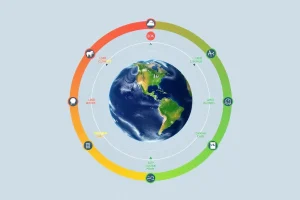
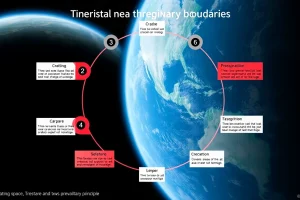
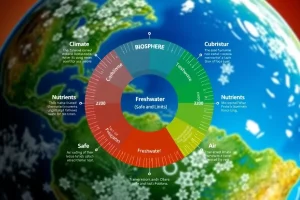
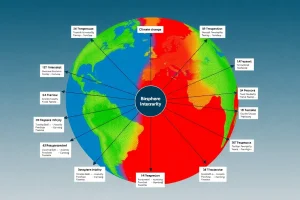
The concept of a “safe operating space for humanity” is assessed through the planetary boundaries framework, which identifies nine Earth-system processes that regulate the stability and resilience of the planet. As of the 2023 update by Richardson et al., six of these nine boundaries are transgressed: climate change, biosphere integrity (genetic diversity and functional integrity), land-system change, freshwater change, biogeochemical flows (nitrogen and phosphorus cycles), and novel entities (including synthetic chemicals and plastics). Three boundaries—stratospheric ozone depletion, ocean acidification, and atmospheric aerosol loading—remain within the safe operating space, though ocean acidification is approaching its limit. The overall safe operating space is therefore currently exceeded for multiple critical processes, placing the Earth system in a state of heightened risk.
Control variable
The safe operating space is not defined by a single control variable but by a set of nine planetary boundaries, each with its own control variable(s). These variables are measurable indicators that capture the state of the corresponding Earth-system process. For example, the control variable for climate change is atmospheric CO2 concentration (in parts per million) and radiative forcing (in watts per square meter); for biosphere integrity, it is genetic diversity (extinction rate) and functional integrity (e.g., the Biodiversity Intactness Index); for land-system change, it is the percentage of global ice-free land area that remains as forest; for freshwater change, it is the percentage of global land area experiencing deviations from baseline water flows; for biogeochemical flows, it is global phosphorus and nitrogen loading; for ocean acidification, it is the saturation state of aragonite in surface seawater; for stratospheric ozone depletion, it is the global ozone concentration; for atmospheric aerosol loading, it is aerosol optical depth; and for novel entities, it is the percentage of synthetic chemicals released without safety testing. These control variables collectively define the state of the Earth system relative to the Holocene baseline.
Proposed boundary or threshold
The proposed safe boundary for each Earth-system process is set at a level that maintains the stable environmental conditions of the Holocene—the interglacial period of the last 11,700 years during which human civilization developed. The boundary is placed upstream of a critical threshold or tipping point, incorporating a precautionary buffer to account for scientific uncertainty and system inertia. For instance, the climate change boundary is set at 350 ppm CO2 (with a zone of increasing risk up to 450 ppm), while the biosphere integrity boundary for genetic diversity is set at an extinction rate of less than 10 extinctions per million species-years (E/MSY), compared to the background rate of ~1 E/MSY. The overall safe operating space is the multidimensional region where all nine boundaries are respected simultaneously.
Current measured value
According to the 2023 assessment, the current values of the control variables are as follows: atmospheric CO2 concentration is approximately 417 ppm (2022), exceeding the safe boundary of 350 ppm; genetic diversity loss is estimated at >100 E/MSY, far beyond the boundary of <10 E/MSY; functional integrity (measured by the Biodiversity Intactness Index) has fallen below the proposed boundary across most biomes; land-system change has reduced global forest cover to about 60% of original forest area, below the boundary of 75%; freshwater change shows that over 20% of global land area has experienced significant deviations from baseline flows, exceeding the boundary; phosphorus and nitrogen flows have massively surpassed safe levels; and novel entities are considered transgressed due to the vast number of synthetic chemicals released without adequate safety testing. Three boundaries remain within the safe zone: stratospheric ozone (recovering due to the Montreal Protocol), ocean acidification (aragonite saturation still above the boundary in most regions), and atmospheric aerosol loading (regional differences exist, but global boundary not yet quantified).
How the boundary is calculated
The safe operating space is delineated through a synthesis of Earth-system science, paleoclimatic data, global models, and expert judgment. For each boundary, scientists identify a critical Earth-system process, define a control variable, and determine a threshold value based on observed or modeled non-linear responses in the Earth system. The boundary is then set at a safe distance from that threshold, using the Holocene as a reference state. The methodology involves literature reviews, meta-analyses, and iterative expert elicitation. The framework is updated as new scientific evidence emerges; the 2015 and 2023 updates refined several boundaries and introduced a two-tier approach (safe boundary and zone of increasing risk) for some processes. The overall safe operating space is not a single number but a multidimensional envelope defined by the intersection of all boundaries.
Historical trend
For most of the Holocene, Earth-system processes remained within a narrow, stable range. Since the Industrial Revolution, and particularly during the Great Acceleration from the 1950s onward, human activities have driven rapid changes. Atmospheric CO2 has risen from ~280 ppm to over 420 ppm; species extinction rates have increased by orders of magnitude; nitrogen fixation has doubled; and land conversion has accelerated. The planetary boundaries framework shows that humanity has moved from a safe operating space to a state where multiple boundaries are transgressed, with the first transgression (climate change) occurring in the late 20th century. The number of transgressed boundaries has increased over time, reflecting the cumulative pressure of human development.
What is driving the change
The primary drivers pushing the Earth system beyond the safe operating space are human activities linked to population growth, economic expansion, and consumption patterns. These include fossil fuel combustion (climate change, ocean acidification), agricultural expansion and intensification (land-system change, freshwater use, biogeochemical flows, biosphere integrity loss), industrial production and chemical synthesis (novel entities, aerosol loading), and resource extraction. Underlying these direct drivers are indirect drivers such as economic systems that prioritize short-term growth, technological lock-ins, and governance failures. The scale of human enterprise has become a dominant geological force, marking the Anthropocene.
What crossing the boundary means
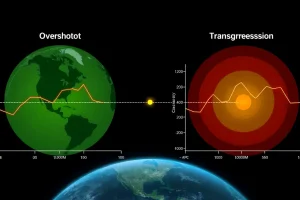
Transgressing one or more planetary boundaries increases the risk of triggering non-linear, abrupt, or irreversible changes in the Earth system. The safe operating space is the zone where the Earth system remains resilient and can absorb disturbances without shifting to a new state. Crossing boundaries erodes this resilience and can activate tipping points—such as the collapse of ice sheets, dieback of the Amazon rainforest, or disruption of ocean circulation—that would fundamentally alter the planet’s life-support systems. Once multiple boundaries are crossed, the risk of cascading effects and a global tipping cascade rises, potentially leading to a less habitable Earth state.
Regional variations
Although the safe operating space is a global concept, several planetary boundaries have strong regional dimensions. Freshwater change, land-system change, and biogeochemical flows exhibit significant spatial heterogeneity. For example, freshwater use may be within safe limits globally but severely transgressed in specific basins. Similarly, aerosol loading is a regional phenomenon, with high concentrations in South and East Asia. The framework acknowledges that some boundaries must be defined and managed at sub-global scales to prevent local tipping points that can aggregate to global impacts. The 2023 update introduced a distinction between global and regional boundaries for some processes.
Interaction with other boundaries
The nine planetary boundaries are tightly coupled. Climate change and biosphere integrity are considered “core” boundaries because they strongly influence all others. For instance, climate change exacerbates biodiversity loss, alters freshwater availability, and accelerates ocean acidification. Land-system change contributes to climate change, biodiversity loss, and freshwater disruption. Biogeochemical flows (nitrogen and phosphorus) drive eutrophication, harming aquatic ecosystems and contributing to greenhouse gas emissions. Transgressing one boundary often amplifies the pressure on others, creating feedback loops that can push the Earth system further from the safe operating space. The framework emphasizes that boundaries cannot be managed in isolation.
Impacts on people and ecosystems
Operating outside the safe space threatens the essential life-support functions that human societies depend on. Transgressed boundaries undermine food security (through soil degradation, freshwater scarcity, and pollinator loss), water availability and quality, human health (via pollution, heat stress, and disease), and economic stability (through extreme events and resource scarcity). Ecosystem services such as carbon sequestration, water purification, and nutrient cycling are degraded. The most vulnerable populations, often in low-income countries, bear the brunt of these impacts, even though they have contributed least to the transgressions. The erosion of Earth-system resilience increases the likelihood of societal disruptions and conflicts.
Possible pathways back toward the safe zone
Returning to the safe operating space requires transformative changes across multiple sectors. Key pathways include: rapid decarbonization of the energy system to meet the Paris Agreement goals; sustainable food systems that reduce land and water footprints, minimize nutrient pollution, and protect biodiversity; circular economy models to reduce novel entities and waste; conservation and restoration of ecosystems to enhance biosphere integrity; and strengthened international governance to manage global commons. The planetary boundaries framework can guide target-setting for businesses, cities, and nations. Scenarios show that it is still possible to return to the safe space for most boundaries through concerted, systemic action, but the window of opportunity is narrowing.
Scientific uncertainty
The planetary boundaries framework is built on complex, non-linear Earth-system science with inherent uncertainties. Key uncertainties include: the precise location of thresholds and tipping points; the interactions and feedbacks between boundaries; the spatial and temporal scales at which boundaries operate; and the representativeness of control variables. For some boundaries (e.g., novel entities, atmospheric aerosol loading), the safe boundary is not yet quantified due to insufficient data or understanding. The framework uses a precautionary approach, setting boundaries at the lower end of the uncertainty range to minimize the risk of crossing dangerous thresholds. Ongoing research aims to reduce these uncertainties through improved Earth-system models and observations.
Criticism and alternative frameworks
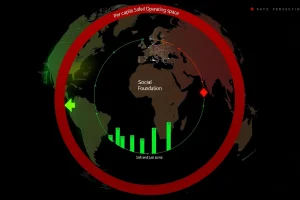
The planetary boundaries concept has been criticized on several grounds. Some scientists argue that the global, top-down approach oversimplifies regional dynamics and may not be actionable at local scales. Others question the choice of boundaries and control variables, suggesting that some are not truly global or that the thresholds are arbitrary. The framework has also been critiqued for not adequately incorporating social dimensions, such as equity and justice. Alternative or complementary frameworks include the “doughnut economics” model (Raworth, 2017), which combines planetary boundaries with social foundations, and the “planetary opportunities” concept, which emphasizes positive transformation pathways. Despite criticisms, the planetary boundaries framework remains a widely used and influential tool for understanding Earth-system limits and guiding global sustainability policy.
FAQ
What is the safe operating space for humanity?
It is the state of the Earth system that has allowed human civilizations to develop and thrive during the Holocene epoch. The planetary boundaries framework defines this space by identifying nine critical Earth-system processes and setting quantitative limits that should not be exceeded to maintain a stable and resilient planet.
How many planetary boundaries have been crossed?
As of the 2023 update, six of the nine boundaries are transgressed: climate change, biosphere integrity, land-system change, freshwater change, biogeochemical flows, and novel entities. Three boundaries remain within the safe zone: stratospheric ozone depletion, ocean acidification, and atmospheric aerosol loading.
Can we return to the safe operating space?
Yes, it is still possible to return to the safe operating space for most boundaries through rapid and systemic transformations in energy, food, and economic systems. However, the window of opportunity is narrowing, and some changes may be irreversible if tipping points are crossed.
References
- Rockström, J., Steffen, W., Noone, K., et al. (2009). A safe operating space for humanity. Nature, 461, 472–475.
- Steffen, W., Richardson, K., Rockström, J., et al. (2015). Planetary boundaries: Guiding human development on a changing planet. Science, 347(6223), 1259855.
- Richardson, K., Steffen, W., Lucht, W., et al. (2023). Earth beyond six of nine planetary boundaries. Science Advances, 9(37), eadh2458.
- Rockström, J., Gupta, J., Qin, D., et al. (2023). Safe and just Earth system boundaries. Nature, 619, 102–111.
- Steffen, W., Broadgate, W., Deutsch, L., Gaffney, O., & Ludwig, C. (2015). The trajectory of the Anthropocene: The Great Acceleration. The Anthropocene Review, 2(1), 81–98.