In brief
At a glance
Quick Facts
- Definition
- Radiative forcing is the change in net irradiance at the tropopause due to a change in an external driver of climate change, measured in W/m².
- Unit
- Watts per square meter (W/m²).
- Positive forcing
- Leads to warming (e.g., increased CO₂).
- Negative forcing
- Leads to cooling (e.g., volcanic aerosols).
- CO₂ forcing since 1750
- Approximately 1.5 W/m² increase.
- Total anthropogenic forcing
- Estimated around 2.3 W/m² (positive).
- Solar forcing
- About 0.05 W/m² since 1750, much smaller than human-caused forcing.
- Aerosol forcing
- Net negative (cooling) but with large uncertainty, masking some greenhouse warming.
- Climate sensitivity
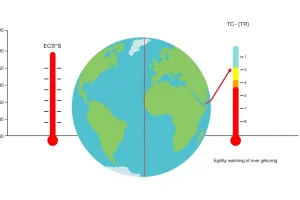
- The temperature increase from a doubling of CO₂ (3.7 W/m² forcing) is a key metric derived from radiative forcing.
Key Takeaways
- Radiative forcing quantifies the change in Earth’s energy balance due to factors like greenhouse gases, aerosols, and solar variations, expressed in watts per square meter (W/m²).
- Positive forcing warms the planet, while negative forcing cools it; the net human-caused forcing since pre-industrial times is positive and drives global warming.
- It is the standard metric used by climate scientists to compare the warming or cooling effects of different climate drivers on an equal basis.
- Understanding radiative forcing is essential for projecting future climate change and evaluating the effectiveness of mitigation strategies.
What Is Radiative Forcing Explained in Simple Terms?
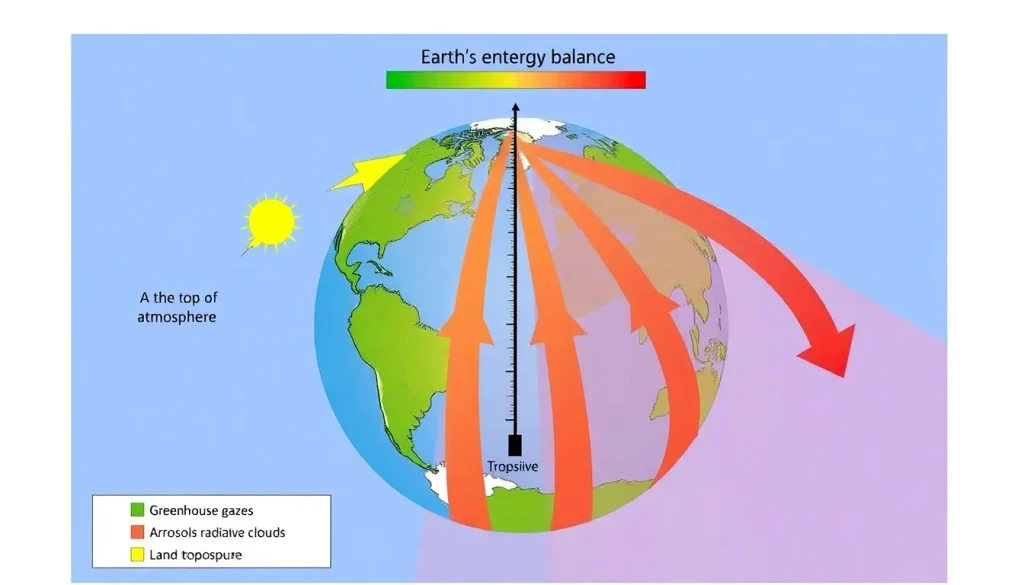
Radiative forcing is a measure of how much a particular factor—such as greenhouse gases, aerosols, or changes in the sun’s output—alters the balance of incoming and outgoing energy in the Earth’s atmosphere. In simple terms, it is the difference between the sunlight energy absorbed by Earth and the energy radiated back to space, caused by a change in the climate system. When this balance is disturbed, the climate responds by warming or cooling until a new equilibrium is reached. Radiative forcing is expressed in watts per square meter (W/m²) and is typically calculated at the tropopause, the boundary between the troposphere and stratosphere, after allowing stratospheric temperatures to adjust.
Think of Earth’s energy budget like a bank account: incoming solar radiation is a deposit, and outgoing infrared radiation is a withdrawal. A positive radiative forcing means more energy is coming in than going out, leading to a net warming. A negative forcing means more energy is leaving, leading to cooling. The concept was developed by the Intergovernmental Panel on Climate Change (IPCC) as a practical way to compare the climate effects of different agents, such as carbon dioxide, methane, aerosols, and land-use changes. By expressing all these effects in the same units, scientists can add them up to estimate the total human influence on climate and project future temperature changes.
How It Works
Earth’s climate is driven by a balance between absorbed solar radiation and outgoing thermal infrared radiation. The sun delivers energy primarily in the visible spectrum, which passes through the atmosphere and warms the surface. The Earth then emits this energy back as infrared radiation. Greenhouse gases in the atmosphere absorb some of this outgoing infrared radiation and re-emit it in all directions, including back toward the surface, trapping heat. This natural greenhouse effect keeps our planet habitable. Radiative forcing measures any change that perturbs this energy balance, whether from human activities or natural phenomena.

When a forcing agent is introduced—for example, an increase in atmospheric carbon dioxide—it reduces the amount of infrared radiation escaping to space at the top of the atmosphere. To restore balance, the Earth’s surface and lower atmosphere must warm up, which increases the outgoing radiation until it once again matches the incoming solar energy. The initial change in the net radiation at the tropopause, before the climate system has time to respond, is the radiative forcing. This metric allows scientists to compare the strength of different climate drivers: a forcing of +1 W/m² from CO₂ has the same direct warming influence as +1 W/m² from methane, even though the mechanisms differ. It is a foundational concept in climate modeling and projections.
Main Causes or Drivers
Radiative forcing arises from both natural and human-caused changes. The most significant drivers include:
- Greenhouse gases: Carbon dioxide (CO₂) is the largest contributor to positive forcing, primarily from fossil fuel combustion and deforestation. Methane (CH₄), nitrous oxide (N₂O), and halocarbons also exert strong positive forcings. Since 1750, the CO₂ forcing alone has increased by about 1.5 W/m², and total well-mixed greenhouse gas forcing is around 2.8 W/m².
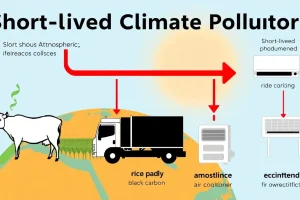
- Aerosols: Tiny particles suspended in the atmosphere, such as sulfates, black carbon, and organic carbon, can have both cooling and warming effects. Sulfate aerosols from industrial emissions reflect sunlight, causing a negative forcing (cooling). Black carbon absorbs sunlight and warms the atmosphere. The net aerosol forcing is negative, estimated at around -0.9 W/m², but with large uncertainty.
- Land-use changes: Alterations in surface reflectivity (albedo) due to deforestation, agriculture, and urbanization affect the amount of solar energy absorbed. Generally, land-use changes have resulted in a small negative forcing.
- Solar variations: Changes in the sun’s output follow an 11-year cycle and contribute a small positive forcing, about 0.05 W/m² since 1750, which is much smaller than human-caused forcings.
- Volcanic eruptions: Explosive eruptions inject sulfur dioxide into the stratosphere, forming reflective sulfate aerosols that cause a temporary negative forcing, cooling the planet for a few years.
Importance and Impact
Radiative forcing is the fundamental metric linking human activities and natural phenomena to climate change. It provides a standardized way to compare the warming or cooling influence of different factors, enabling scientists to attribute observed temperature changes to specific causes. The total net anthropogenic radiative forcing since 1750 is positive, meaning human activities have caused a net warming effect on the climate. This net forcing is the primary driver of the observed global warming, sea-level rise, and other climate changes.
Moreover, radiative forcing is used to estimate climate sensitivity—the amount of surface warming expected from a given increase in forcing, such as a doubling of CO₂ concentration. This relationship is central to climate projections and policy decisions. For example, the concept of CO₂-equivalent emissions relies on radiative forcing to express the impact of different greenhouse gases in terms of the amount of CO₂ that would cause the same forcing. Understanding radiative forcing also helps evaluate the potential of mitigation strategies, such as reducing black carbon emissions or enhancing carbon sinks, by quantifying their effect on the energy balance.
Common Misconceptions
Several misunderstandings surround radiative forcing. One common misconception is that it is the same as temperature change. In reality, radiative forcing is the initial perturbation to the energy balance, while temperature change is the eventual response after the climate system adjusts. Another myth is that radiative forcing is only about carbon dioxide. While CO₂ is the largest single contributor, many other agents—including methane, nitrous oxide, aerosols, and land-use changes—also play significant roles. Some also believe that natural factors like solar variations dominate the forcing; however, measurements show that solar forcing is small compared to human-caused greenhouse gas forcing.
Additionally, there is confusion about negative forcings. Some assume that because aerosols have a cooling effect, they cancel out greenhouse warming entirely. In reality, the net forcing is still strongly positive, and the cooling from aerosols masks only a portion of the warming. Finally, radiative forcing is sometimes dismissed as a theoretical construct, but it is grounded in well-understood physics and confirmed by satellite observations and radiative transfer models.
Connections to Other Systems
Radiative forcing is intimately linked to climate feedbacks, which amplify or dampen the initial temperature response. For example, water vapor feedback is a powerful positive feedback: as the atmosphere warms, it holds more water vapor, a greenhouse gas, which causes additional warming. The ice-albedo feedback is another: melting ice reduces Earth’s reflectivity, causing more solar absorption and further warming. These feedbacks do not directly alter the radiative forcing but influence the resulting temperature change. The concept of effective radiative forcing accounts for some rapid adjustments in the atmosphere that occur before the global mean temperature changes.
Radiative forcing also connects to the global carbon cycle, ocean heat uptake, and atmospheric chemistry. Changes in forcing from methane, for instance, affect the oxidative capacity of the atmosphere and stratospheric water vapor. The metric is used to derive the Global Warming Potential (GWP) and Global Temperature change Potential (GTP) of different gases, which are essential for policy frameworks like the Kyoto Protocol and Paris Agreement. Thus, radiative forcing serves as a hub linking physical climate science, biogeochemistry, and climate policy.
Data Limitations and Uncertainties
While the concept of radiative forcing is robust, quantifying it precisely involves uncertainties. The largest uncertainty lies in aerosol forcing, both from aerosol-radiation interactions and aerosol-cloud interactions. The complex nature of aerosols—varying composition, size, and spatial distribution—makes their net effect difficult to measure and model. Satellite retrievals and ground-based networks have improved estimates, but the uncertainty range remains wide. Similarly, the forcing from land-use changes and contrails from aviation carries significant uncertainty.
Another challenge is the accurate calculation of radiative forcing for short-lived climate forcers like methane and black carbon, which have indirect effects on atmospheric chemistry and clouds. The IPCC regularly updates its forcing estimates as new research emerges, and the uncertainty ranges are communicated transparently. Despite these limitations, the overall picture is clear: the net anthropogenic forcing is positive and substantial, and the dominant role of CO₂ is unequivocal. Ongoing improvements in observations and modeling continue to refine our understanding.
FAQ
What is radiative forcing?
Radiative forcing is a measure of the change in Earth's energy balance caused by factors like greenhouse gases, aerosols, or solar variations. It is expressed in watts per square meter (W/m²) and indicates whether a factor warms (positive forcing) or cools (negative forcing) the planet.
How is radiative forcing measured?
Radiative forcing is calculated using radiative transfer models that simulate how radiation interacts with the atmosphere and surface. It is based on observed changes in atmospheric composition, satellite measurements of solar and infrared radiation, and laboratory data on gas absorption properties.
Why does radiative forcing matter?
Radiative forcing is the primary metric for comparing the climate impact of different drivers and for attributing observed global warming to human activities. It is essential for projecting future climate change and for setting emissions reduction targets.
References
- IPCC, 2021: Climate Change 2021: The Physical Science Basis. Contribution of Working Group I to the Sixth Assessment Report of the Intergovernmental Panel on Climate Change. Cambridge University Press.
- NASA Climate Science: Radiative Forcing. https://climate.nasa.gov/
- NOAA Earth System Research Laboratory: Radiative Forcing. https://www.esrl.noaa.gov/gmd/aggi/