In brief
At a glance
Quick Facts
- Core Principle
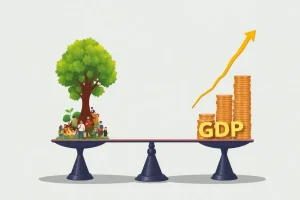
- Economic activity should prioritize human and ecological well-being over GDP growth.
- Key Thinkers
- Herman Daly, Tim Jackson, Kate Raworth, Serge Latouche.
- Related Concepts
- Degrowth, Steady-State Economy, Doughnut Economics, Well-being Economy.
- Planetary Boundaries
- Post-growth economics is rooted in the recognition that the economy is a subsystem of the biosphere and must respect ecological limits.
- Alternative Indicators
- Genuine Progress Indicator (GPI), Happy Planet Index, Better Life Index.
- Policy Proposals
- Universal basic services, work-time reduction, job guarantee, carbon caps.
- Historical Roots
- "The Limits to Growth" (1972), steady-state economics (Herman Daly, 1970s).
- Evidence
- Easterlin Paradox shows that beyond a certain income, happiness does not increase with GDP.
Key Takeaways
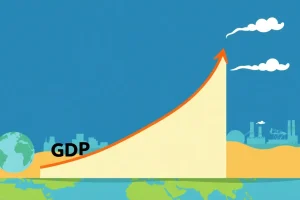
- Post-growth economics argues that continuous GDP growth is neither possible nor desirable on a finite planet, and that societies should prioritize well-being and ecological sustainability instead.
- It draws on ecological economics, which recognizes that the economy is a subsystem of the biosphere and must operate within planetary boundaries.
- Empirical evidence suggests that beyond a certain income threshold, further GDP growth does not significantly improve subjective well-being or happiness (the Easterlin Paradox).
- Post-growth thinking informs policy proposals such as universal basic services, work-time reduction, and alternative indicators like the Genuine Progress Indicator (GPI) to replace GDP as a measure of success.
What Is Post-Growth Economics Explained?
Post-growth economics is a broad intellectual framework that challenges the central assumption of modern economic policy: that continuous, exponential growth in gross domestic product (GDP) is essential for societal progress. It posits that in high-income countries, further economic growth is ecologically unsustainable, socially unnecessary, and potentially counterproductive to human well-being. Instead, post-growth economics advocates for a deliberate shift toward an economic system that can flourish without growth, focusing on improving quality of life, reducing inequality, and respecting environmental limits.
This perspective is rooted in ecological economics, which views the economy as a subsystem of the finite biosphere. It draws on insights from heterodox economics, environmental science, and social philosophy. Post-growth economics is not a single unified theory but a family of ideas that includes steady-state economics, degrowth, and doughnut economics. These approaches share a common critique: the pursuit of endless growth ignores the laws of thermodynamics, leads to resource depletion and environmental degradation, and fails to deliver lasting happiness. Instead, they propose reorienting economic activity toward what truly matters—health, education, community, and a thriving natural world.
Overview
Post-growth economics emerges from the recognition that the global economy is already exceeding several planetary boundaries, such as climate change, biodiversity loss, and nitrogen cycles. The conventional response—green growth or decoupling—is seen by post-growth thinkers as insufficient. They argue that absolute decoupling of GDP from resource use and environmental impact at the required scale and speed is not supported by evidence. Thus, a post-growth economy would prioritize sufficiency over efficiency, aiming to meet human needs with a smaller material footprint. It does not necessarily mean a decline in quality of life; rather, it redefines prosperity in terms of non-material well-being.
History
The intellectual roots of post-growth economics trace back to the 1970s with the publication of “The Limits to Growth” by the Club of Rome, which used computer modeling to show that exponential economic growth could not continue indefinitely on a finite planet. Around the same time, economist Herman Daly articulated the concept of a steady-state economy, where the scale of the economy remains constant within ecological limits. The term “degrowth” (décroissance) emerged in French intellectual circles in the early 2000s, later gaining international attention. In the 21st century, the 2008 financial crisis and growing climate awareness spurred renewed interest, leading to conferences like the Degrowth Conference and influential works such as Tim Jackson’s “Prosperity Without Growth” (2009) and Kate Raworth’s “Doughnut Economics” (2017).
How It Works
A post-growth economy would operate on principles that differ fundamentally from growth-oriented capitalism. Key mechanisms include: reducing resource and energy throughput to sustainable levels; shifting from linear “take-make-dispose” production to circular systems; shortening the working week to share available work and improve work-life balance; implementing universal basic services (e.g., healthcare, education, housing) to decouple well-being from income; and introducing alternative macroeconomic tools such as ecological tax reform, debt-free money creation for public purpose, and caps on resource use. The goal is to maintain economic stability and full employment without relying on growth, often through a combination of public investment, redistribution, and a redefinition of productivity that values care work and ecosystem services.
What the Evidence Shows
Research in ecological economics provides evidence that absolute decoupling of GDP from material throughput and carbon emissions has not occurred at the global scale, and is unlikely to happen fast enough to avert environmental crises. Studies on the Easterlin Paradox show that beyond a certain income level (roughly $15,000–$20,000 per capita), additional GDP does not correlate with higher life satisfaction. Furthermore, countries with high levels of well-being, such as Costa Rica, often have moderate GDP per capita but strong social safety nets and low inequality. Modeling exercises, such as those by the Centre for the Understanding of Sustainable Prosperity, suggest that a post-growth scenario could achieve high well-being with significantly lower resource use, provided there is a radical redistribution of income and wealth.
Importance and Impact
Post-growth economics is important because it directly addresses the existential risks of climate change, biodiversity collapse, and resource scarcity. By questioning the growth imperative, it opens policy space for measures that might otherwise be dismissed as harming the economy. The impact of these ideas is seen in the increasing adoption of well-being budgets by governments (e.g., New Zealand, Scotland), the rise of alternative indicators like the Genuine Progress Indicator (GPI) and the Human Development Index (HDI), and the growing global movement for a Green New Deal that incorporates post-growth principles. It also influences grassroots initiatives such as transition towns, local currencies, and cooperative enterprises that embody post-growth values in practice.
Benefits, Limitations and Trade-offs
Benefits of a post-growth economy include reduced environmental pressure, improved work-life balance, greater social equity, and enhanced resilience to shocks. By focusing on well-being rather than consumption, it can foster stronger communities and more meaningful lives. However, there are significant limitations and trade-offs. Transitioning away from growth poses challenges for funding public services and pensions in systems designed for expansion. It may also face political resistance due to the perceived threat to jobs and profits. Moreover, the global nature of trade and finance means that a post-growth transition in one country could be undermined by growth-oriented policies elsewhere. Careful management of these trade-offs is essential, including international coordination and innovative social policies.
FAQ
What is post-growth economics?
Post-growth economics is an economic paradigm that questions the necessity and desirability of perpetual GDP growth, advocating for a focus on well-being and sustainability instead.
How does post-growth economics differ from degrowth?
Degrowth is a specific strand within post-growth economics that emphasizes a planned reduction in material and energy use, while post-growth is a broader umbrella term that includes steady-state and other approaches.
Why does post-growth economics matter?
It addresses the ecological limits of the planet and the diminishing returns of growth for human happiness, offering a pathway to a sustainable and equitable future.
References
- Daly, H. E. (1991). Steady-State Economics. Island Press.
- Jackson, T. (2009). Prosperity Without Growth: Economics for a Finite Planet. Earthscan.
- Raworth, K. (2017). Doughnut Economics: Seven Ways to Think Like a 21st-Century Economist. Random House.
- Meadows, D. H., Meadows, D. L., Randers, J., & Behrens III, W. W. (1972). The Limits to Growth. Universe Books.
- Kallis, G., Kostakis, V., Lange, S., et al. (2018). "Research on Degrowth." Annual Review of Environment and Resources.