In brief
At a glance
Quick Facts
- Definition
- Forest moisture recycling is the process by which forests return water to the atmosphere through evapotranspiration, contributing to rainfall locally and downwind.
- Key mechanism
- Evapotranspiration combines evaporation from soil/water surfaces and transpiration from plant leaves.
- Water output
- A single large tree can transpire hundreds of liters of water per day.
- Amazon self-reliance
- The Amazon rainforest generates about half of its own rainfall through moisture recycling.
- Continental impact
- In some continental interiors, forest evapotranspiration provides the majority of precipitation.
- Cloud formation
- Forests emit biogenic volatile organic compounds that act as cloud condensation nuclei, enhancing rainfall.
- Deforestation effect
- Large-scale deforestation can reduce downwind rainfall by disrupting moisture supply.
- Biotic pump theory
- A hypothesis suggests forests create low-pressure zones that draw in moist ocean air, sustaining continental rainfall.
Key Takeaways
- Forests act as massive water pumps, returning vast quantities of moisture to the atmosphere through evapotranspiration, which then contributes to rainfall both locally and in distant regions.
- The process is driven by the combination of evaporation from soil and water surfaces and transpiration from plant leaves, collectively moving water from the ground into the air.
- Large-scale forest moisture recycling helps maintain continental rainfall patterns, with some regions receiving a majority of their precipitation from forest-generated moisture.
- Deforestation disrupts this cycle, leading to reduced rainfall, increased drought frequency, and altered climate patterns far beyond the deforested area.
What Is Forest Moisture Recycling?
Forest moisture recycling is the process by which forests capture, store, and release water back into the atmosphere, where it can condense and fall again as precipitation. This continuous loop of water movement—from soil and vegetation to the air and back to the land—is a fundamental component of the terrestrial water cycle. Forests, with their extensive canopies and deep root systems, serve as highly efficient regulators of this cycle, often contributing more moisture to the atmosphere than nearby oceans do in continental interiors.
This phenomenon is not confined to local areas; it operates at regional and even continental scales. Water vapor generated by forests can travel hundreds or thousands of kilometers before condensing into rain, linking the fate of downwind regions to the health of upwind forests. The concept highlights the role of forests as “green infrastructure” that sustains rainfall, supports agriculture, and maintains the climatic conditions necessary for their own survival and that of other ecosystems.
How It Works
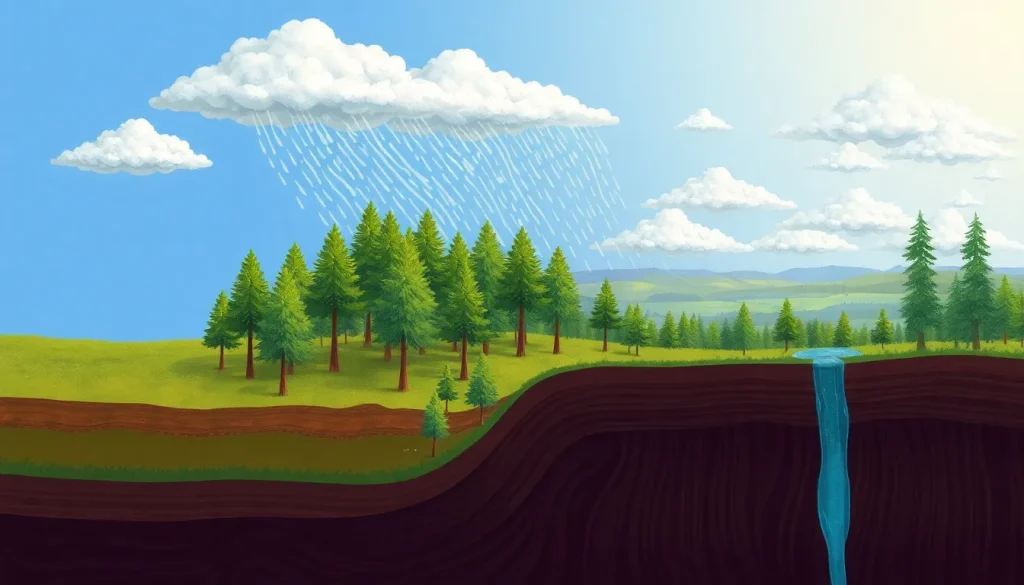
Forest moisture recycling is driven by evapotranspiration, the combined process of evaporation from soil and water surfaces and transpiration from plant leaves. Trees absorb water from the soil through their roots and transport it upward to the leaves, where it is released as water vapor through stomata—tiny pores on the leaf surface. A single large tree can transpire hundreds of liters of water per day. Additionally, rainfall intercepted by leaves and branches evaporates directly back into the atmosphere, while soil moisture also contributes through evaporation.
The water vapor released by forests does not simply disappear; it becomes part of the atmospheric boundary layer. As the air warms and rises, the vapor is transported by winds. When this moist air cools, the vapor condenses around microscopic particles—such as dust, pollen, or biogenic aerosols emitted by the forest itself—forming clouds and eventually precipitation. This precipitation can fall locally, replenishing soil moisture and sustaining the forest, or be carried downwind to nourish distant ecosystems, croplands, and even other forests.
Key steps in the process include:
- Interception: Forest canopies capture rainfall, reducing direct runoff and storing water on leaves and branches for later evaporation.
- Infiltration and storage: Tree roots and forest soils enhance water infiltration, storing moisture in the ground for gradual release.
- Transpiration: Trees draw water from the soil and release it as vapor through stomata, a process driven by solar energy and atmospheric demand.
- Evaporation: Water from wet leaves, stems, and the forest floor evaporates directly into the air.
- Atmospheric transport: Winds carry the moisture downwind, sometimes across entire continents.
- Condensation and precipitation: The vapor condenses into clouds and falls as rain or snow, completing the cycle.
Forests also emit biogenic volatile organic compounds (BVOCs) that act as cloud condensation nuclei, promoting cloud formation and potentially increasing rainfall efficiency. This biological influence on atmospheric processes underscores the active role forests play in shaping their own climate.
Importance and Impact
Forest moisture recycling is a cornerstone of regional water security. In many continental areas, a significant fraction of rainfall originates from evapotranspiration rather than from ocean evaporation. For example, the Amazon basin generates roughly half of its own rainfall through this recycling, while the Congo Basin and Southeast Asian rainforests exhibit similarly high ratios. This self-sustaining mechanism allows forests to thrive in regions that might otherwise be too dry, and it provides water for agriculture, drinking supplies, and hydropower generation downwind.
Beyond water supply, the process regulates climate by cooling the land surface through latent heat flux—the energy absorbed when water evaporates. This cooling effect can moderate local and regional temperatures, reducing heat extremes. Forests also influence the timing and intensity of wet and dry seasons, buffering against floods and droughts. The loss of forest cover can therefore trigger a cascade of impacts: reduced rainfall, higher temperatures, increased fire risk, and diminished agricultural productivity, with consequences that ripple through economies and ecosystems.
Regional Differences
The magnitude and patterns of forest moisture recycling vary across the globe due to differences in climate, forest type, and geography. Tropical rainforests, such as the Amazon and Congo, are among the most intense recyclers because of their high leaf area, year-round warmth, and abundant solar energy. In the Amazon, studies using isotopic tracers have shown that up to 70% of rainfall in some interior regions originates from forest evapotranspiration. The Congo Basin similarly recycles a large portion of its moisture, sustaining one of the world’s largest tropical forest blocks.
In temperate and boreal forests, recycling ratios are generally lower but still significant. The vast boreal forests of Canada and Russia contribute moisture that helps maintain precipitation patterns across northern latitudes. In Mediterranean and dryland regions, even sparse forests and woodlands can play a disproportionate role in local water cycles, often providing the only source of atmospheric moisture during dry seasons. Mountain forests, through cloud interception—where fog and low clouds condense on leaves—add additional water inputs that are not captured by rain gauges, a process especially important in coastal and montane ecosystems.
Connections to Other Systems
Forest moisture recycling is tightly linked to the global carbon cycle. The same stomata that release water vapor also take in carbon dioxide for photosynthesis, meaning that transpiration and carbon uptake are coupled. When forests are stressed by drought or deforestation, both water recycling and carbon sequestration decline, amplifying climate change. Conversely, healthy forests that maintain high evapotranspiration rates also act as strong carbon sinks, creating a positive feedback loop that stabilizes the climate.
The process also interacts with atmospheric circulation patterns. The “biotic pump” theory proposes that large, continuous forests create low-pressure zones that draw in moist air from oceans, sustaining rainfall deep into continents. While this theory remains debated, it highlights the potential for forests to actively influence wind and weather patterns. Additionally, forest moisture contributes to the formation of atmospheric rivers—narrow corridors of concentrated water vapor—that can transport huge volumes of moisture across continents, linking forest health to water availability thousands of kilometers away.
Common Misconceptions
A widespread misconception is that forests simply consume water and reduce available supplies. In reality, while trees do use water, they also return enormous quantities to the atmosphere, often increasing total regional rainfall. The net effect of forests on water availability depends on scale and context: at a local level, reforestation may reduce streamflow initially, but at a regional level, it can enhance precipitation and groundwater recharge. Another myth is that only oceans matter for rainfall; in fact, continental evapotranspiration is a primary moisture source for many inland areas, and forests are the dominant contributors.
Some also believe that deforestation only affects the immediate area. However, the impacts can extend far downwind, as reduced moisture recycling leads to declining rainfall in distant agricultural regions and even other countries. This transboundary dimension makes forest conservation a matter of international water security, not just local environmental concern.
What the Evidence Shows
Scientific understanding of forest moisture recycling has advanced through multiple lines of evidence. Isotopic analysis of water vapor and rainfall allows researchers to trace the origin of moisture, distinguishing between ocean-derived and land-derived sources. These studies consistently show that forests contribute a large share of precipitation in continental interiors. Satellite observations of atmospheric water vapor, combined with climate models, have mapped the trajectories of forest-generated moisture, revealing teleconnections between upwind forests and downwind rainfall.
Field experiments, such as those in the Amazon and boreal zones, have measured evapotranspiration rates directly, confirming the high water output of forests. Modeling studies simulate the effects of deforestation, consistently projecting reduced rainfall and increased dry-season length in deforested scenarios. While uncertainties remain—particularly regarding the biotic pump mechanism and the precise role of biogenic aerosols—the fundamental role of forests in recycling atmospheric moisture is well-established and supported by a robust body of research.
FAQ
What is forest moisture recycling?
It is the process by which forests absorb water from the soil and release it as vapor through evapotranspiration. This moisture forms clouds and falls as rain, sustaining the water cycle locally and in distant regions.
How does deforestation affect rainfall?
Deforestation reduces evapotranspiration, cutting off a major source of atmospheric moisture. This can lead to decreased rainfall, longer dry seasons, and more frequent droughts in downwind areas, sometimes hundreds of kilometers away.
Why is the Amazon rainforest important for rainfall?
The Amazon generates about half of its own rainfall through moisture recycling and also supplies moisture to other parts of South America. Its vast forest cover acts as a water pump that sustains regional climate and agriculture.
References
- Intergovernmental Panel on Climate Change (IPCC) reports on land–climate interactions and the water cycle.
- Food and Agriculture Organization of the United Nations (FAO), 'Forests and Water' thematic studies.
- Makarieva, A. M., & Gorshkov, V. G. (2007). Biotic pump of atmospheric moisture as driver of the hydrological cycle on land. Hydrology and Earth System Sciences.