In brief
At a glance
Quick Facts
- Status
- Multiple boundaries transgressed, increasing risk of cascading effects
- Control variable
- No single variable; interactions tracked via Earth-system models
- Proposed boundary
- Safe operating space defined by all boundaries within limits
- Current value
- 6 of 9 boundaries transgressed (Richardson et al., 2023)
- Pre-industrial baseline
- Holocene epoch (last 11,700 years) with stable Earth-system conditions
Current status
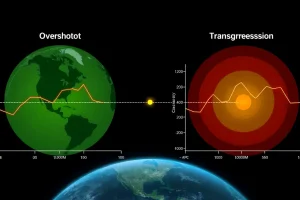
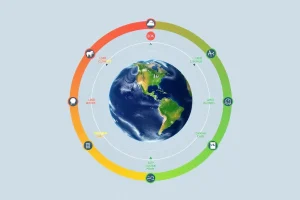
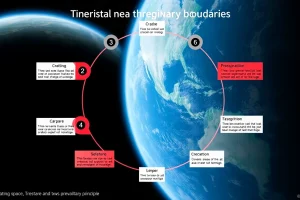
The planetary boundaries framework identifies nine processes that regulate Earth-system stability. As of the 2023 update by Richardson et al., six of these boundaries are assessed as transgressed: climate change, biosphere integrity (genetic diversity and functional integrity), land-system change, freshwater change, biogeochemical flows (nitrogen and phosphorus), and novel entities. The interconnected nature of these boundaries means that the transgression of one can exacerbate pressures on others, increasing the risk of cascading effects and pushing the Earth system further away from the Holocene-like state that has supported human civilizations. The current status is therefore one of heightened risk due to multiple, interacting transgressions.
Control variable
There is no single control variable for interconnectedness itself. Instead, the planetary boundaries framework defines control variables for each of the nine boundaries, such as atmospheric CO₂ concentration for climate change, extinction rate for biosphere integrity, and phosphorus flow to oceans for biogeochemical flows. The interconnectedness is studied through Earth-system models that simulate the interactions between these variables. For example, the control variable for climate change (CO₂ concentration) directly influences ocean acidification (carbonate ion concentration) and indirectly affects biosphere integrity through temperature rise and habitat loss. Thus, the interconnectedness is captured by the coupling of these individual control variables in models and observations.
Proposed boundary or threshold
The framework does not propose a single threshold for interconnectedness. Instead, it defines a safe operating space where all boundaries are within their respective safe zones. The concept of a “planetary boundary” for each process is set at a level that avoids triggering non-linear, abrupt Earth-system changes. However, the interactions imply that the safe level for one boundary may depend on the status of others. For instance, the climate boundary of 350 ppm CO₂ and 1 W/m² radiative forcing was set to avoid large-scale ice sheet melting and other feedbacks, but if biosphere integrity is already compromised, the safe climate boundary might be lower. The framework acknowledges that the boundaries are not independent and that a holistic, systems approach is needed.
Current measured value
The current status of interconnectedness is not measured by a single value but by the number of boundaries transgressed and the strength of their interactions. As of 2023, six boundaries are transgressed, meaning the Earth system is outside the safe operating space for those processes. For example, atmospheric CO₂ is around 417 ppm (2022), exceeding the 350 ppm boundary. The rate of species extinction is estimated to be tens to hundreds of times higher than the background rate, placing the biosphere integrity boundary in the high-risk zone. The phosphorus flow to oceans is about double the safe boundary. These transgressions interact: climate change accelerates biodiversity loss, while deforestation reduces carbon sinks, further increasing CO₂. The cumulative effect is a system under multiple, mutually reinforcing stresses.
Historical trend
Since the Industrial Revolution, human activities have progressively pushed multiple planetary boundaries away from their Holocene baselines. The historical trend shows a synchronous rise in pressures: atmospheric CO₂, reactive nitrogen production, land-use change, and species extinctions all began to increase markedly in the 19th and 20th centuries. The Great Acceleration graphs (Steffen et al., 2015) illustrate how socio-economic trends (population, GDP, energy use) and Earth-system trends (CO₂, N₂O, CH₄, ocean acidification, tropical forest loss, etc.) have risen in parallel since 1950. This co-evolution is a direct manifestation of interconnectedness: the same human drivers (e.g., fossil fuel combustion, industrial agriculture) simultaneously affect multiple boundaries, and the Earth-system responses are linked through biogeochemical and physical feedbacks.
What is driving the change
The primary driver of the transgression of multiple boundaries is the expansion of human activities, particularly the burning of fossil fuels, industrial agriculture, and land-use change. These activities release greenhouse gases, convert natural ecosystems to cropland and urban areas, mobilize vast quantities of reactive nitrogen and phosphorus, and introduce novel entities like plastics and synthetic chemicals. The interconnectedness arises because these drivers often act on multiple boundaries at once. For example, deforestation for agriculture not only affects land-system change but also contributes to climate change (carbon release), biodiversity loss (habitat destruction), freshwater change (altered runoff), and biogeochemical flows (fertilizer runoff). The globalized economy further links pressures across regions, as consumption in one area drives production and resource extraction in another.
What crossing the boundary means
When multiple boundaries are crossed, the risk of triggering irreversible, large-scale Earth-system changes increases. Interactions can lead to “tipping cascades,” where crossing one tipping point increases the likelihood of crossing others. For instance, Amazon rainforest dieback (a tipping point in the biosphere integrity and land-system change boundaries) would release massive amounts of CO₂, accelerating climate change, which in turn could destabilize the Greenland ice sheet and disrupt ocean circulation. Such cascades could push the Earth system into a new state, fundamentally different from the Holocene, with severe consequences for global ecosystems and human societies. The interconnectedness means that the whole system can lose resilience, making it more sensitive to perturbations.
Regional variations
The interconnectedness of planetary boundaries manifests differently across regions. Some boundaries, like freshwater change and land-system change, are inherently sub-global, with regional transgressions that can aggregate to global effects. For example, deforestation in the Amazon affects regional rainfall patterns and global carbon storage. Nitrogen and phosphorus pollution are concentrated in agricultural regions but have downstream effects on coastal ecosystems worldwide. Climate change is global, but its impacts are regionally differentiated, with the Arctic warming faster. The interactions between boundaries also vary: in the Arctic, climate warming accelerates permafrost thaw, releasing methane and affecting the climate boundary further, while also disrupting local ecosystems. In South Asia, aerosol loading interacts with the monsoon system, affecting freshwater availability and agricultural productivity. Thus, the interconnectedness is not uniform; it creates region-specific risk clusters.
Interaction with other boundaries
The planetary boundaries are deeply interconnected through a web of feedbacks. Climate change and biosphere integrity are considered “core boundaries” because they have the most pervasive interactions. Climate change amplifies ocean acidification (via CO₂ absorption), alters freshwater availability (through changes in precipitation and evaporation), and stresses biosphere integrity (through temperature rise and extreme events). Biosphere integrity loss reduces the Earth’s capacity to regulate climate (e.g., forests as carbon sinks), affects freshwater cycles (e.g., evapotranspiration), and influences nutrient cycling. Land-system change directly impacts biosphere integrity, climate, and freshwater. Biogeochemical flows (nitrogen and phosphorus) cause eutrophication, harming aquatic ecosystems and contributing to greenhouse gas emissions (N₂O). Novel entities like plastics can affect biosphere integrity and potentially climate through microplastic interactions. The interactions are not always linear; they can involve time lags and threshold effects, making the system’s response complex and difficult to predict.
Impacts on people and ecosystems
The interconnected transgression of planetary boundaries poses severe risks to human well-being and ecosystem services. Climate change, biodiversity loss, and freshwater scarcity interact to threaten food security, water availability, and human health. For example, the combined effects of droughts (climate change and freshwater change) and pollinator decline (biosphere integrity) can reduce crop yields. Ocean acidification and warming harm fisheries and coral reefs, affecting livelihoods and coastal protection. The spread of novel entities, including chemical pollution and plastics, can contaminate water and food sources, with unknown long-term health effects. Ecosystem services such as carbon sequestration, water purification, and disease regulation are undermined when multiple boundaries are transgressed. The impacts are often disproportionately borne by vulnerable populations, exacerbating inequalities. The interconnectedness means that addressing one issue in isolation may not be sufficient to safeguard human well-being.
Possible pathways back toward the safe zone
Returning to a safe operating space requires integrated, systemic actions that address the interconnected drivers. Key pathways include: rapid decarbonization of the global economy to reduce climate change and ocean acidification; protection and restoration of ecosystems to enhance biosphere integrity and carbon sinks; sustainable agriculture practices that reduce nitrogen and phosphorus pollution while maintaining food production; circular economy approaches to minimize novel entities and waste; and integrated water resource management. Because the boundaries are interconnected, actions can have co-benefits: reforestation can sequester carbon, enhance biodiversity, regulate water cycles, and reduce land-system change. Policy frameworks need to account for interactions, avoiding siloed approaches. The concept of “planetary stewardship” emphasizes the need for global cooperation and governance that respects the interconnected nature of Earth-system processes. Transformative changes in energy, food, and economic systems are required to bring humanity back within the safe operating space.
Scientific uncertainty
There are significant uncertainties in quantifying the interactions between planetary boundaries. Earth-system models are still limited in their ability to simulate complex feedbacks, especially those involving biosphere integrity and novel entities. The precise thresholds for many boundaries are uncertain, and the interactions may shift these thresholds in ways that are not fully understood. For example, the climate boundary of 350 ppm CO₂ was set based on paleoclimate evidence, but if biosphere integrity is severely degraded, the safe level could be lower. The strength of feedbacks, such as the carbon-cycle feedback from permafrost thaw, is uncertain. Additionally, the regional heterogeneity of some boundaries complicates global-scale assessments. The framework itself is a simplification, and the true complexity of Earth-system interactions is only partially captured. Ongoing research aims to improve models and observations to better understand these dynamics.
Criticism and alternative frameworks
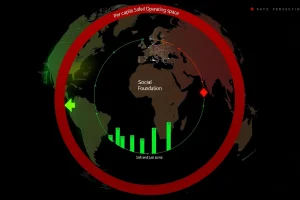
The planetary boundaries framework has been criticized for its global, top-down approach, which may not adequately capture regional dynamics and social dimensions. Some scientists argue that the boundaries are not all independent, and the interactions are not fully accounted for, potentially leading to double-counting or underestimation of risks. Alternative frameworks include “doughnut economics” (Raworth, 2012), which combines planetary boundaries with social foundations, emphasizing the interconnectedness of environmental and social goals. The “Earth-system tipping points” approach focuses on specific tipping elements and their potential cascades, providing a more detailed view of interactions. The “safe and just operating space” concept extends the boundaries to include justice and equity. These frameworks complement the planetary boundaries by highlighting different aspects of interconnectedness and the need for integrated solutions. Despite criticisms, the planetary boundaries framework remains influential in communicating the urgency of addressing multiple environmental crises simultaneously.
FAQ
What does it mean that planetary boundaries are interconnected?
It means that the nine Earth-system processes are not independent; changes in one boundary can influence others through feedback loops. For example, climate change can accelerate biodiversity loss, which in turn reduces the Earth's capacity to absorb carbon, further exacerbating climate change. This interconnectedness increases the risk of cascading environmental changes.
How many planetary boundaries have been crossed?
According to the 2023 update by Richardson et al., six of the nine boundaries are currently transgressed: climate change, biosphere integrity, land-system change, freshwater change, biogeochemical flows, and novel entities. The remaining three (stratospheric ozone depletion, atmospheric aerosol loading, and ocean acidification) are still within the safe operating space, though ocean acidification is approaching the boundary.
Can we solve one planetary boundary without addressing others?
Because of the strong interconnections, addressing one boundary in isolation is often insufficient and may even have unintended consequences. For instance, some climate mitigation strategies like large-scale bioenergy with carbon capture and storage (BECCS) could increase pressure on land-system change, freshwater use, and biosphere integrity. A holistic approach that considers interactions is necessary to return to a safe operating space.
References
- Rockström, J., et al. (2009). A safe operating space for humanity. Nature, 461, 472–475.
- Steffen, W., et al. (2015). Planetary boundaries: Guiding human development on a changing planet. Science, 347(6223), 1259855.
- Richardson, K., et al. (2023). Earth beyond six of nine planetary boundaries. Science Advances, 9(37), eadh2458.
- Lade, S. J., et al. (2020). Human impacts on planetary boundaries amplified by Earth system interactions. Earth System Dynamics, 11, 119–132.
- Steffen, W., et al. (2018). Trajectories of the Earth System in the Anthropocene. Proceedings of the National Academy of Sciences, 115(33), 8252–8259.