In brief
At a glance
Quick Facts
- Verdict
- Mixed (both have roles but quality concerns)
- Problem addressed
- Climate change mitigation
- Evidence strength
- Moderate (variable by project type)
- Potential scale
- Global
- Relative cost
- Avoidance: Low to moderate; Removal: Moderate to high
- Time to impact
- Avoidance: Immediate; Removal: Years to decades
Quick verdict
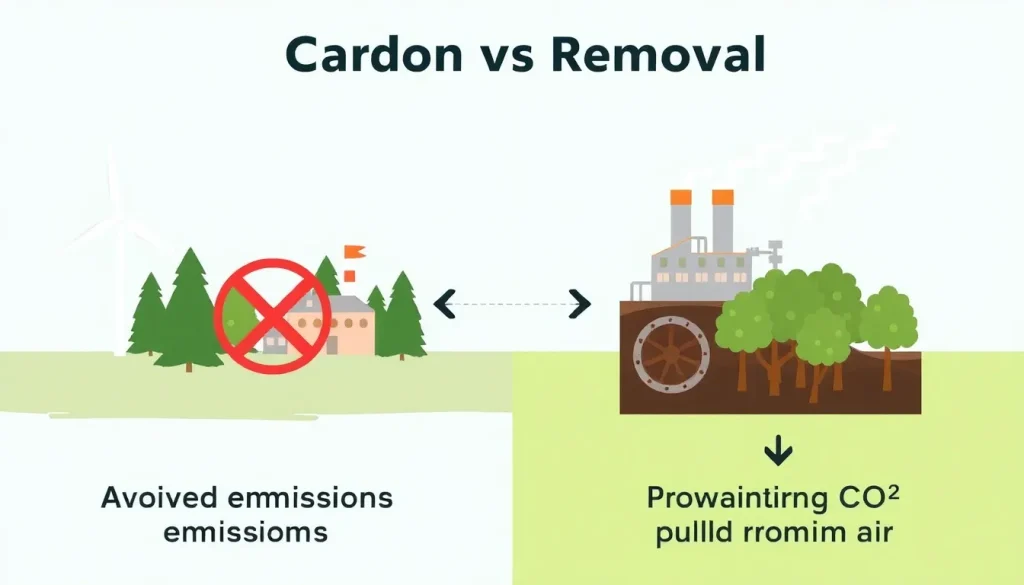
Avoidance credits and removal credits serve distinct but complementary roles in carbon markets. Avoidance credits, which represent emission reductions relative to a hypothetical baseline, are cheaper and more abundant but face persistent concerns about additionality and permanence. Removal credits, which represent the physical extraction and storage of CO2 from the atmosphere, offer more durable climate benefits but are currently scarce, expensive, and technologically immature at scale. Both are necessary for a comprehensive climate strategy, but their effectiveness hinges on rigorous quality standards and a clear understanding of their limitations. The evidence for carbon credits overall is mixed, with significant integrity challenges in voluntary markets.
Problem addressed
Anthropogenic greenhouse gas emissions are driving global warming, and achieving the Paris Agreement goals requires both drastic emission reductions and the removal of CO2 already in the atmosphere. Carbon credits are a market-based instrument designed to channel finance toward activities that reduce or remove emissions. The distinction between avoidance and removal credits matters because net-zero targets demand that any residual emissions be balanced by permanent removals, while avoidance credits can help reduce the flow of new emissions in the near term. The core problem is how to design and use these instruments to deliver real, additional, and durable climate benefits without undermining direct emission cuts.
How the solution works
Carbon crediting operates on the principle that one credit represents one tonne of CO2 equivalent (CO2e) reduced or removed. Projects are developed under standards (e.g., Verra, Gold Standard) that set methodologies for quantifying emission impacts against a counterfactual baseline. After third-party verification, credits are issued and can be sold to entities seeking to offset their emissions.
Avoidance credits are generated by projects that prevent emissions that would have otherwise occurred. Examples include renewable energy installations displacing fossil fuels, forest conservation (REDD+) preventing deforestation, and energy efficiency improvements. The climate benefit is the difference between actual emissions and the projected baseline.
Removal credits are generated by projects that actively capture CO2 from the atmosphere and store it. Nature-based removals include afforestation, reforestation, and soil carbon sequestration. Technological removals include direct air capture with carbon storage (DACCS) and bioenergy with carbon capture and storage (BECCS). The climate benefit is the measured amount of CO2 durably stored.
The table below summarizes key differences:
| Feature | Avoidance Credits | Removal Credits |
|---|---|---|
| Mechanism | Prevent emissions relative to baseline | Extract CO2 from atmosphere and store it |
| Typical projects | Renewable energy, forest conservation, clean cookstoves | Afforestation, DACCS, BECCS, enhanced weathering |
| Permanence | Not applicable (emissions avoided once) | Critical; reversal risks (e.g., fire, leakage) |
| Additionality risk | High; many projects may be business-as-usual | Lower for tech removals; moderate for nature-based |
| Cost range (USD/tCO2e) | $3–$15 (voluntary market average) | $10–$50 (nature-based); $100–$1,000+ (tech) |
| Current market share | ~90% of voluntary carbon market volume | ~10%, but growing rapidly |
Evidence strength
The evidence base for carbon credits is extensive but uneven. Numerous peer-reviewed studies and market analyses have examined the environmental integrity of both credit types. For avoidance credits, a large body of research—particularly on the Clean Development Mechanism (CDM) and REDD+—has found systemic over-crediting and weak additionality. A 2016 study by Cames et al. estimated that up to 85% of CDM projects had a low likelihood of being additional. More recent analyses of voluntary market projects have identified similar concerns, though newer standards are attempting to tighten rules.
For removal credits, the evidence is more limited due to the nascency of the market. Nature-based removals face well-documented permanence risks: forest carbon can be released by wildfires, pests, or land-use change. Technological removals like DACCS are still at the pilot or early commercial stage, with few independent assessments of life-cycle effectiveness. The overall evidence strength is moderate, with high variability depending on project type, methodology, and governance.
Potential scale
Avoidance credits have the potential to cover billions of tonnes of CO2e annually, as they can be applied across energy, industry, and land-use sectors. The voluntary carbon market could grow to $50 billion or more by 2030 under optimistic scenarios, but this depends on demand and quality reforms. Removal credits are currently a tiny fraction of the market (a few million tonnes per year) but must scale to billions of tonnes by mid-century to meet net-zero pathways. The IPCC estimates that 5–16 GtCO2 of annual removals will be needed by 2050. Scaling nature-based removals is constrained by land availability and competition with food production, while technological removals face energy, infrastructure, and cost barriers. Realistically, both credit types will need to expand dramatically, but removal credits face the steeper scaling challenge.
Cost considerations
Costs vary widely. Avoidance credits are generally the cheapest option, with prices in the voluntary market often between $3 and $15 per tonne, though high-quality credits with strong co-benefits can command higher prices. Removal credits are more expensive: nature-based removals (e.g., afforestation) range from $10 to $50 per tonne, while engineered solutions like DACCS currently cost $400–$1,000+ per tonne, with pathways to $100–$200 in the long term. The cost-effectiveness of avoidance credits is attractive for immediate emission reductions, but if they do not represent real reductions, the apparent low cost is illusory. Removal credits are more costly but provide a more certain climate service. For net-zero claims, the higher cost of removals may incentivize deeper internal emission cuts before offsetting.
Implementation time
Avoidance projects can often be implemented relatively quickly—within months to a few years—because they typically involve deploying proven technologies or changing land management practices. Emission reductions begin as soon as the project is operational. Removal projects have longer lead times. Nature-based removals like tree planting can start within a year, but carbon sequestration accumulates over decades and is back-loaded. Technological removal plants require several years for construction and scaling, and the net carbon benefit depends on the energy source and full life cycle. Thus, avoidance credits offer a faster climate return, while removal credits are a long-term investment.
Environmental benefits
Both credit types can deliver environmental co-benefits beyond climate mitigation. Avoidance projects such as renewable energy reduce local air pollution and can conserve ecosystems (e.g., forest protection). Removal projects, particularly nature-based ones, can restore degraded land, enhance biodiversity, and improve water regulation. However, poorly sited projects can have negative environmental impacts: monoculture tree plantations for removals may harm biodiversity, and large-scale BECCS could strain water and land resources. The net environmental benefit depends heavily on project design and safeguards.
Social and economic co-benefits
Carbon credit projects can generate employment, technology transfer, and community development. Avoidance projects like clean cookstoves improve indoor air quality and reduce fuel costs for households. Forest conservation projects can support indigenous livelihoods if designed with community consent. Removal projects, especially in rural areas, can create jobs in forestry and land management. However, there are also risks of land grabbing, displacement, and inequitable benefit sharing, particularly in weak governance contexts. The social license for carbon credits depends on transparent, inclusive processes and fair distribution of revenues.
Risks and unintended consequences
The primary risk of avoidance credits is that they may not represent real emission reductions, leading to an increase in net emissions if used to offset actual pollution. This is the additionality problem. Permanence is not an issue for avoidance (once avoided, the emission does not occur), but leakage—where emissions shift elsewhere—can undermine benefits. For removal credits, the main risk is reversal: stored carbon can be released back into the atmosphere due to fire, disease, or intentional harvest. Technological removals carry risks of high energy use, CO2 leakage from storage, and public opposition. A broader systemic risk is that the availability of cheap offsets may delay necessary structural emission reductions, a moral hazard known as mitigation deterrence. Over-reliance on future removals to justify continued emissions is a dangerous gamble given the uncertainty of scaling.
Where it works best
Avoidance credits are most effective in sectors and regions where baselines are clear, additionality can be robustly demonstrated, and governance is strong. For example, renewable energy projects in grids heavily dependent on coal with no existing policy support can be additional. Removal credits work best where permanence can be ensured: afforestation in low-fire-risk, legally protected areas; DACCS with geological storage in stable formations. Both types benefit from strong regulatory oversight and independent verification.
Where it may not work
Avoidance credits are a poor fit where the counterfactual baseline is highly uncertain or where projects are already financially viable without carbon revenue (e.g., grid-connected solar in markets with falling costs). Forest conservation credits in areas with weak land tenure and high corruption risk often fail to deliver. Removal credits are ill-suited in regions with high reversal risk (e.g., fire-prone forests, unstable geological storage) or where the energy system is carbon-intensive, making technological removals net emitters. In all cases, credits should not be used as a substitute for deep, rapid emission cuts within the value chain of the purchasing entity.
Comparison with alternatives
Carbon credits are one of several policy tools for climate mitigation. Direct regulation (e.g., emissions standards, technology mandates) can guarantee reductions but may be economically inefficient. Carbon taxes provide a clear price signal and revenue but face political resistance. Internal abatement—companies reducing their own emissions—is the most direct and credible approach but may be costlier in the short term. Avoidance credits offer a flexible, lower-cost complement to internal efforts, but their environmental integrity is less certain. Removal credits are unique in addressing historical emissions and hard-to-abate residual emissions; no other mechanism can physically draw down atmospheric CO2 at scale. A robust climate strategy likely combines stringent internal reductions, a rising carbon price, and high-quality removals for the remaining emissions, with avoidance credits playing a transitional role under strict quality criteria.
Case studies
Avoidance: Wind power in India under the CDM. Many wind farms in India were registered as CDM projects, generating millions of credits. However, research found that a significant share would have been built anyway due to falling technology costs and government subsidies, calling additionality into question. This case illustrates the challenge of setting credible baselines in rapidly changing sectors.
Removal: Climeworks Orca DACCS plant, Iceland. Orca is one of the first commercial direct air capture plants, capturing about 4,000 tonnes of CO2 per year and storing it underground in basalt rock. The credits are sold for several hundred dollars per tonne to corporate buyers. While the permanence is high, the scale is minuscule relative to global emissions, and the high cost limits demand. It demonstrates the potential of technological removals but also the immense scaling challenge.
Removal: Afforestation in the tropics. Numerous afforestation/reforestation projects have been implemented under voluntary standards. Some have delivered genuine carbon sequestration and community benefits, but others have faced criticism for displacing local communities, using non-native monocultures, and overestimating carbon uptake. The permanence of these credits is threatened by fire and land-use change, highlighting the need for robust buffer pools and long-term monitoring.
Final assessment
Avoidance credits and removal credits are not interchangeable; they serve different functions in the climate toolkit. Avoidance credits can help finance the transition to a low-carbon economy in the near term, but their credibility depends on rigorous additionality testing and conservative baselines. Removal credits are essential for achieving net-zero and net-negative emissions, but they are not yet available at the scale or cost required. The evidence suggests that both types have been oversold in voluntary markets, with many credits failing to deliver real climate benefits. A prudent approach would prioritize deep internal emission reductions, use high-quality avoidance credits only for transitional purposes, and invest heavily in scaling durable removals. For buyers, the highest integrity lies in removal credits with strong permanence, while avoidance credits should be treated with caution and subjected to the most stringent standards. Ultimately, the distinction matters less than the quality of the underlying project and the overall strategy to phase out fossil fuels.
FAQ
What is the difference between avoidance and removal credits?
Avoidance credits are generated by projects that reduce or prevent greenhouse gas emissions compared to a baseline scenario, such as renewable energy or forest conservation. Removal credits come from projects that actively extract CO2 from the atmosphere and store it, like afforestation or direct air capture. The key distinction is that avoidance addresses the flow of emissions, while removal addresses the stock of atmospheric CO2.
Which type of credit is more effective for climate mitigation?
Both are necessary but serve different purposes. Avoidance credits can quickly reduce emissions at lower cost, but their climate impact depends on proving that the reductions would not have happened otherwise (additionality). Removal credits directly lower atmospheric CO2 concentrations and are essential for neutralizing residual emissions in net-zero strategies, but they are currently more expensive and limited in scale. High-quality credits of both types are needed.
Are avoidance credits still valid for net-zero claims?
According to leading guidance like the Oxford Principles for Net Zero Aligned Carbon Offsetting, net-zero claims should eventually rely primarily on removal credits to balance any remaining emissions, as avoidance credits do not physically remove CO2 from the atmosphere. However, avoidance credits can play a transitional role in the short term while scaling up removals, provided they meet stringent quality criteria.
References
- IPCC, 2022: Climate Change 2022: Mitigation of Climate Change. Working Group III contribution to the Sixth Assessment Report.
- Ecosystem Marketplace, 2023: State of the Voluntary Carbon Markets 2023. Forest Trends.
- Integrity Council for the Voluntary Carbon Market (ICVCM), 2023: Core Carbon Principles.
- Oxford Principles for Net Zero Aligned Carbon Offsetting, 2020 (revised 2024). University of Oxford.
- Cames, M., Harthan, R. O., Füssler, J., Lazarus, M., Lee, C. M., Erickson, P., & Spalding-Fecher, R. (2016). How additional is the Clean Development Mechanism? Öko-Institut e.V.