In brief
At a glance
Quick Facts
- Verdict
- Promising
- Problem addressed
- Excessive resource use and emissions from large vehicles
- Evidence strength
- Strong
- Potential scale
- Global
- Relative cost
- Low
- Time to impact
- Years
Quick verdict
Reducing vehicle size is a proven, low-cost strategy to cut greenhouse gas emissions, air pollution, and resource consumption. The relationship between vehicle mass and environmental impact is well-established: larger, heavier vehicles consistently consume more energy and materials throughout their lifecycle. While shifting consumer preferences and automaker trends toward larger vehicles present challenges, policies and incentives promoting smaller, lighter vehicles can yield immediate environmental benefits and are highly scalable globally.
Problem addressed
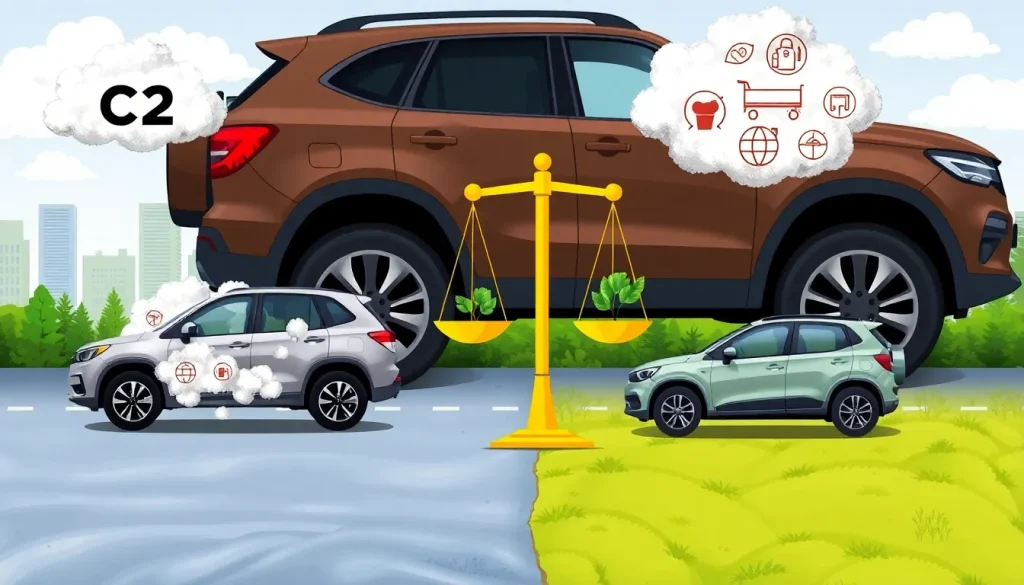
The problem is the disproportionate environmental footprint of large personal vehicles. Over recent decades, average vehicle size and weight have increased in many markets, driven by demand for SUVs, crossovers, and pickup trucks. This trend undermines gains in engine efficiency and electrification, as larger vehicles require more energy to move, more materials to build, and cause greater road wear and tire particulate emissions. The result is higher lifecycle greenhouse gas emissions, increased air pollutants, and greater resource extraction, exacerbating climate change and local environmental degradation.
How the solution works
The solution involves shifting the vehicle fleet toward smaller, lighter models through consumer choice, regulation, and design. Smaller vehicles have lower aerodynamic drag, reduced rolling resistance, and less mass to accelerate, directly cutting fuel or electricity consumption per kilometer. Manufacturing smaller vehicles uses fewer raw materials (steel, aluminum, plastics, battery minerals), reducing upstream emissions. Additionally, smaller vehicles occupy less space, easing urban congestion and reducing the need for expansive parking infrastructure, which can preserve green spaces and lower heat island effects. The mechanism is straightforward: less mass and size translate to lower energy and material throughput across the vehicle’s lifecycle.
Evidence strength
The evidence linking vehicle size to environmental impact is strong and based on decades of research. Numerous studies consistently show that vehicle mass is a primary determinant of fuel consumption and CO2 emissions. For internal combustion engine vehicles, each 100 kg of weight reduction can improve fuel economy by roughly 0.3–0.5 liters per 100 km, depending on driving conditions. For electric vehicles, heavier batteries increase energy consumption per kilometer and require more critical minerals. Lifecycle assessments confirm that manufacturing a larger vehicle generates significantly more emissions—estimates suggest that producing a large SUV can emit 50–70% more greenhouse gases than a small car. Data from the International Energy Agency and national environmental agencies corroborate that the global shift toward SUVs has been a major factor in stalling fuel economy improvements. The evidence is robust, though exact figures vary by vehicle type and methodology.
Potential scale
If widely adopted, a global shift to smaller vehicles could reduce transport emissions substantially. The International Energy Agency has noted that SUVs alone were the second-largest contributor to the increase in global CO2 emissions between 2010 and 2020, behind only the power sector. Reversing the trend toward larger vehicles could offset a significant portion of transport emissions growth. The potential scale is global, as vehicle size preferences are influenced by policy, fuel prices, and cultural factors that can be shifted. However, scaling is limited by consumer preferences for space, safety perceptions, and automaker profitability tied to larger models. In dense urban areas, smaller vehicles are already more practical, but in rural or low-density regions, larger vehicles may remain necessary for specific tasks, limiting full-scale adoption.
Cost considerations
For consumers, smaller vehicles generally have lower purchase prices, reduced fuel/electricity costs, and cheaper maintenance and insurance. Thus, shifting to smaller vehicles can be cost-saving for individuals. For society, reduced road wear and lower infrastructure demands can cut public spending. However, automakers may face lower profit margins on smaller cars, and there may be transition costs if production lines are retooled. Policy measures like feebates (taxing large vehicles and subsidizing small ones) can be revenue-neutral. Overall, the solution is low-cost or even cost-negative from a societal perspective, as the savings from reduced fuel use and emissions often outweigh any implementation costs.
Implementation time
At the individual level, switching to a smaller vehicle yields immediate reductions in fuel consumption and emissions. However, fleet-wide change takes years due to the slow turnover of the vehicle stock—typically 10–15 years in developed countries. Policy measures such as revised fuel economy standards, vehicle taxation based on size or weight, and urban access restrictions can accelerate the shift. If such policies are implemented, noticeable reductions in average fleet emissions could be seen within 5–10 years as new vehicle purchases respond to incentives. Full fleet transformation may take two decades or more.
Environmental benefits
Smaller vehicles offer multiple environmental benefits: lower tailpipe CO2 emissions (or reduced electricity demand for EVs), decreased air pollutants (NOx, PM2.5) due to lower energy use, and reduced non-exhaust emissions (tire and brake wear particles). Lifecycle material extraction and manufacturing emissions are also lower. For example, a typical small car might emit 100–120 g CO2/km, while a large SUV can exceed 180 g CO2/km. Widespread adoption of smaller vehicles could cut global transport emissions by 10–30% by 2050, depending on the scale of the shift and concurrent electrification. Additionally, smaller vehicles reduce land use for roads and parking, preserving ecosystems.
Social and economic co-benefits
Smaller vehicles improve urban livability by reducing traffic congestion, noise pollution, and the need for large parking spaces. They enhance road safety for pedestrians and cyclists due to lower front-end profiles and reduced mass in collisions. Lower-income households benefit from more affordable vehicle options and reduced operating costs. Reduced dependence on imported oil improves energy security. Health benefits arise from lower air pollution, decreasing respiratory and cardiovascular diseases. Compact vehicles also enable more efficient use of public space, potentially freeing up land for green areas or housing.
Risks and unintended consequences
A potential risk is the rebound effect: if smaller vehicles are cheaper to operate, people might drive more, partially offsetting emissions savings. However, studies suggest this effect is modest (typically 10–30% of the savings). There are also safety concerns: smaller vehicles may be perceived as less safe in collisions with larger vehicles, though modern safety features and lighter materials can mitigate this. If policies disproportionately penalize larger vehicles, they could burden rural residents or large families who genuinely need them. Additionally, a rapid shift could disrupt automaker revenues and employment in sectors tied to large vehicle production. Finally, if smaller vehicles are predominantly internal combustion, they might delay the transition to zero-emission electric vehicles, though smaller EVs are also beneficial.
Where it works best
Promoting smaller vehicles is most effective in urban and suburban areas where trip distances are short, parking is scarce, and public transit alternatives exist. Densely populated regions with high vehicle ownership, such as European and Asian cities, are ideal. It also works well in countries with high fuel prices or strong climate policies, as consumers naturally gravitate toward efficiency. In developing countries with rapidly growing vehicle fleets, encouraging smaller vehicles from the outset can avoid locking in high-emission infrastructure and preferences.
Where it may not work
In rural or remote areas where long-distance travel is common and road conditions may require robust vehicles, smaller cars may be impractical. In regions with low fuel prices and weak environmental regulations, consumer preference for large vehicles is entrenched and difficult to change without strong policy intervention. In some cultures, vehicle size is closely tied to social status, making voluntary downsizing unlikely. Additionally, for specific commercial or industrial uses (e.g., farming, construction), larger vehicles are functionally necessary, and size reduction is not feasible.
Comparison with alternatives
Vehicle downsizing complements other strategies like electrification, lightweighting, and modal shift (to public transit, cycling, walking). While electrification reduces tailpipe emissions, it does not address the resource and energy demands of manufacturing large vehicles or the non-exhaust emissions. Lightweighting through advanced materials can reduce mass without downsizing, but it is often expensive and may not fully offset the impact of larger footprints. Modal shift reduces vehicle use altogether but requires significant infrastructure investment. Vehicle size reduction is a low-cost, immediately available lever that enhances the effectiveness of these other strategies. However, it is not a substitute for decarbonizing the energy supply; the greatest environmental gains come from combining smaller, lighter vehicles with electrification and clean energy.
Case studies
In Japan, the kei car category (small, low-power vehicles) benefits from tax and insurance incentives, leading to a significant market share and lower average fleet emissions. European cities like Paris and London have implemented congestion charges and low-emission zones that effectively discourage large, high-emission vehicles, resulting in a shift toward smaller cars and improved air quality. In the United States, the 2009 “Cash for Clunkers” program temporarily boosted sales of smaller, more fuel-efficient vehicles, though the long-term impact was limited. More recently, some cities have explored weight-based registration fees, with preliminary data suggesting a modest shift toward lighter vehicles. These examples show that policy can influence vehicle size choices, but sustained change requires consistent, long-term incentives.
Final assessment
Reducing vehicle size is a well-evidenced, cost-effective strategy to lower the environmental impact of personal transportation. The relationship between mass and emissions is clear and immediate. While it faces cultural and practical barriers, targeted policies can accelerate adoption, especially in urban settings. The solution is most promising when integrated with electrification and broader sustainable transport policies. For policymakers and individuals seeking quick, tangible environmental gains, promoting smaller vehicles is a practical and impactful measure.
FAQ
Does vehicle size really affect emissions that much?
Yes. Heavier vehicles require more energy to move, so they consume more fuel or electricity per kilometer. For example, a large SUV can emit 50–100% more CO2 per kilometer than a small car. Additionally, manufacturing larger vehicles uses more materials, generating higher upstream emissions.
Are electric vehicles exempt from the size-impact relationship?
No. While electric vehicles have no tailpipe emissions, larger EVs still require more energy to operate and more materials to build, especially for larger batteries. This increases their lifecycle carbon footprint and resource extraction impacts. However, the relative benefit of downsizing an EV is smaller than for a gasoline vehicle because the energy source can be decarbonized.
What policies can encourage smaller vehicle adoption?
Policies include vehicle taxation based on weight or size, feebate systems that charge fees on large vehicles and rebate small ones, fuel economy standards that account for vehicle footprint, urban access restrictions for large vehicles, and public awareness campaigns. Incentives for smaller electric vehicles can also help.
References
- International Energy Agency (IEA) – Global Fuel Economy Initiative reports on vehicle weight and CO2 trends.
- U.S. Environmental Protection Agency (EPA) – Light-Duty Vehicle CO2 and Fuel Economy Trends data.
- European Environment Agency (EEA) – Monitoring of CO2 emissions from passenger cars.
- Research studies on lifecycle greenhouse gas emissions of vehicle production and use, e.g., from the Journal of Industrial Ecology.
- Analysis of the relationship between vehicle mass and fuel consumption, published in Transportation Research Part D.