In brief
Climate change is visible in rising temperatures.
Deforestation can be seen from satellites.
Melting glaciers are photographed every year.
Chemical pollution is different.
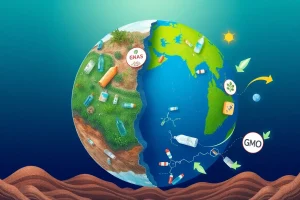
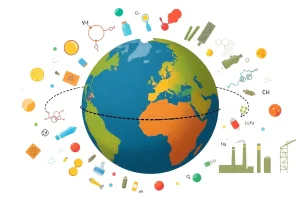
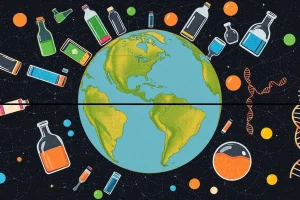
Many of the substances that now circulate through Earth’s atmosphere, rivers, soils, oceans, wildlife, and even human bodies are invisible. They often have no smell, no color, and no immediate warning signs. Yet collectively they represent one of the fastest-growing human pressures on the Earth system.
Modern civilization has created an extraordinary number of synthetic materials.
These include:
- Industrial chemicals
- Plastics
- Pesticides
- Pharmaceuticals
- PFAS (“forever chemicals”)
- Heavy metals mobilized by human activity
- Nanomaterials
- Radioactive materials
- Engineered particles
- Genetically modified organisms
Many of these substances provide enormous benefits. They improve medicine, food production, transportation, electronics, construction, and countless aspects of daily life.
The challenge is not that these materials exist.
The challenge is that their production, release, diversity, and persistence now exceed humanity’s ability to adequately assess and manage their risks.
For this reason, the Planetary Boundaries framework includes Introduction of Novel Entities as one of Earth’s nine critical life-support processes. Unlike many environmental problems that involve altering natural cycles, novel entities represent entirely new substances—or new forms of existing substances—that the Earth system has never previously encountered. (Planetary Health Check)
The latest Planetary Health Check 2025 concludes that this boundary remains transgressed. Thousands of inadequately tested chemicals continue to enter the environment each year, while chemical production and waste generation expand faster than scientific assessment and regulatory capacity. (Planetary Health Check)
Quick Answer
Novel entities are human-made substances, materials, or modified organisms that have the potential to disrupt Earth’s life-support systems.
They include:
- Synthetic chemicals
- Plastics
- PFAS
- Pesticides
- Industrial compounds
- Nanomaterials
- Radioactive substances
- Human-modified life forms
Unlike naturally occurring pollutants, many novel entities are:
- Highly persistent
- Widely distributed
- Difficult or impossible to remove
- Poorly understood
- Produced faster than they can be adequately tested
The current planetary-boundary assessment uses a precautionary indicator: the proportion of synthetic chemicals released without adequate safety testing. The safe boundary is effectively 0%, yet a substantial share of chemicals reaches widespread use before comprehensive assessment, meaning the planetary boundary remains exceeded. (Planetary Health Check)
What Are Novel Entities?
The phrase novel entities was introduced because the earlier label chemical pollution was too narrow.
Scientists realized the problem extends beyond chemicals alone.
Novel entities include:
- Entirely synthetic molecules
- Human-modified natural substances
- Engineered particles
- Persistent plastics
- Radioactive waste
- New biological technologies
What they share is that they are novel to the Earth system.
Many did not exist before industrial civilization.
Others existed naturally but are now mobilized in unprecedented quantities by human activity.
Why “Novel” Matters
Earth’s ecosystems evolved over billions of years.
Microorganisms, plants, animals, soils, and oceans gradually adapted to naturally occurring substances.
Synthetic chemistry changed that relationship.
Since the twentieth century, humanity has created hundreds of thousands of chemicals with structures never previously encountered by natural ecosystems.
Many organisms therefore have no evolutionary history with these compounds.
Some break down rapidly.
Others persist for decades—or even centuries.
Some accumulate in food webs.
Others interact with one another in ways that remain poorly understood.
The Earth system is increasingly exposed to chemical mixtures rather than isolated substances, making prediction far more difficult. (Planetary Health Check)
Examples of Novel Entities
Plastics
Plastic production has increased dramatically since the mid-twentieth century.
Plastic products include:
- Packaging
- Clothing
- Electronics
- Vehicles
- Medical equipment
- Construction materials
Many plastics eventually fragment into:
- Microplastics
- Nanoplastics
These particles are now found in:
- Oceans
- Rivers
- Mountain soils
- Arctic snow
- Wildlife
- Drinking water
Because plastics degrade slowly, they accumulate over time rather than disappearing. (Planetary Health Check)
PFAS (“Forever Chemicals”)
PFAS are used because they resist:
- Water
- Oil
- Heat
Applications include:
- Non-stick cookware
- Waterproof textiles
- Firefighting foams
- Food packaging
Their chemical stability makes them commercially useful.
It also makes them extremely persistent in the environment.
PFAS have been detected in:
- Rivers
- Groundwater
- Wildlife
- Human blood
- Remote Arctic ecosystems
Once released, they are very difficult to remove. (Planetary Health Check)
Pesticides
Modern agriculture relies on pesticides to control:
- Insects
- Weeds
- Plant diseases
Many improve crop yields.
However, some pesticides also affect:
- Pollinators
- Aquatic organisms
- Soil biodiversity
- Food webs
Their impacts depend on the specific compound, application method, persistence, and exposure.
Pharmaceuticals
Medicines improve human and animal health.
However, residues may enter:
- Rivers
- Wastewater
- Groundwater
Some pharmaceuticals influence aquatic organisms even at very low concentrations.
Heavy Metals
Elements such as:
- Mercury
- Lead
- Cadmium
occur naturally.
Human mining, industry, and fossil-fuel combustion greatly increase their environmental mobility.
Because they do not degrade, heavy metals can remain in ecosystems for very long periods.
Nanomaterials
Engineered nanoparticles possess unique physical and chemical properties.
Applications include:
- Electronics
- Medicine
- Energy
- Manufacturing
Their environmental behavior remains an active area of research because particles at the nanoscale may behave differently from larger materials.
Why Novel Entities Are Different From Other Pollution
Traditional pollution often involves increasing concentrations of naturally occurring substances.
Novel entities introduce:
- New molecules
- New combinations
- New materials
- New biological modifications
The challenge is therefore not only toxicity.
It is also:
- Persistence
- Mobility
- Bioaccumulation
- Mixture effects
- Uncertainty
Thousands of substances may interact simultaneously.
Testing each one individually cannot fully predict their combined environmental effects.
The Novel Entities Planetary Boundary
Unlike climate change or freshwater, there is no single physical measurement that captures every novel entity.
Scientists therefore adopted a precautionary approach.
The current control variable asks:
What proportion of synthetic chemicals enters widespread use without adequate safety testing?
The desired answer is straightforward:
Zero.
The planetary boundary is therefore set at:
0% of chemicals released without adequate safety assessment.
Current evidence indicates that chemical production greatly outpaces the world’s capacity to test, regulate, and monitor new substances, meaning the boundary remains transgressed. (Planetary Health Check)
Why This Boundary Is Difficult to Measure
Novel entities differ enormously.
They include:
- Millions of compounds
- Different production volumes
- Different persistence
- Different toxicities
- Different environmental pathways
Some degrade within days.
Others remain for centuries.
Some accumulate in soils.
Others accumulate in oceans.
Many exist as mixtures.
For these reasons, researchers are developing broader indicators that may eventually incorporate:
- Production volume
- Environmental release
- Persistence
- Mobility
- Bioaccumulation
- Mixture effects
- Earth-system impacts
rather than relying on one indicator alone. (Planetary Health Check)
Persistence: Why Time Matters
Many novel entities do not disappear after release.
Instead they:
- Accumulate
- Move through ecosystems
- Enter food webs
- Remain for decades
Examples include:
- PFAS
- Some plastics
- Certain pesticides
- Heavy metals
- Radioactive waste
Even if production stopped immediately, many legacy pollutants would continue affecting ecosystems for generations. (Planetary Health Check)
Bioaccumulation and Biomagnification
Some chemicals become more concentrated as they move through food webs.
This process occurs in two stages.
Bioaccumulation
An individual organism stores chemicals faster than it eliminates them.
Biomagnification
Predators consume many contaminated prey.
Chemical concentrations increase at higher trophic levels.
As a result, top predators—including marine mammals, birds of prey, and humans—may experience the highest exposures for certain persistent substances.
Plastics: A Global Example
Plastic illustrates why novel entities became a planetary boundary.
Plastic production has expanded continuously for decades.
Large plastic items fragment into:
- Microplastics
- Nanoplastics
These particles are now detected in:
- Marine sediments
- Agricultural soils
- Rivers
- Airborne dust
- Polar regions
Research continues into their long-term ecological and human-health implications, but their global distribution demonstrates how rapidly novel entities can spread throughout the Earth system. (Planetary Health Check)
Mixture Effects: The Unknown Challenge
Real ecosystems are exposed to mixtures.
A river may simultaneously contain:
- Pharmaceuticals
- Fertilizers
- PFAS
- Pesticides
- Microplastics
- Heavy metals
Each chemical may appear below its individual safety threshold.
Yet their combined effects may differ from those of any single substance.
Understanding these mixture effects remains one of the largest scientific challenges in chemical risk assessment. (Planetary Health Check)
Interactions With Other Planetary Boundaries
Novel entities rarely act alone.
They interact with many Earth-system processes.
Biosphere Integrity
Chemical pollution affects:
- Pollinators
- Fish
- Birds
- Soil organisms
- Marine mammals
These impacts reduce ecosystem resilience.
Freshwater Change
Many chemicals travel through:
- Rivers
- Lakes
- Groundwater
Freshwater systems often become major transport pathways.
Climate Change
Some fluorinated gases are powerful greenhouse gases.
Climate change also influences chemical transport, degradation, and exposure.
Biogeochemical Flows
Agricultural chemicals frequently interact with nutrient pollution, increasing stress on freshwater ecosystems.
Why Regulation Struggles to Keep Pace
Chemical innovation is rapid.
Every year:
- New substances are developed.
- Production increases.
- Applications expand.
Testing every compound for:
- Toxicity
- Persistence
- Bioaccumulation
- Ecosystem effects
- Human exposure
- Mixture interactions
requires enormous scientific and regulatory resources.
Current evidence suggests innovation is outpacing assessment capacity, which is precisely why the planetary boundary remains exceeded. (Planetary Health Check)
Reducing Planetary Risk
Managing novel entities requires action across the entire chemical life cycle.
Important approaches include:
Safer Chemical Design
Designing substances that degrade more readily and have lower toxicity.
Stronger Safety Assessment
Expanding pre-market testing for persistence, toxicity, and environmental fate.
Circular Economy
Reducing waste through:
- Reuse
- Recycling
- Material efficiency
Improved Waste Management
Preventing leakage into:
- Rivers
- Oceans
- Soils
International Cooperation
Chemical pollution crosses borders.
Effective management requires international standards and monitoring.
Better Monitoring
Improving environmental monitoring for:
- PFAS
- Plastics
- Emerging contaminants
- Chemical mixtures
Common Misunderstandings
“All synthetic chemicals are dangerous.”
No.
Many provide major benefits.
The concern is that some persistent or poorly understood substances are released faster than they can be adequately evaluated.
“Novel entities only mean plastics.”
Plastics are one example.
The boundary also includes synthetic chemicals, PFAS, pesticides, heavy metals mobilized by humans, nanomaterials, radioactive substances, and modified life forms.
“If a chemical is legal, it is completely safe.”
Regulatory approval reflects available evidence, but scientific understanding evolves over time. Some chemicals once considered acceptable were later found to have significant environmental impacts.
“Recycling alone solves plastic pollution.”
Recycling helps reduce waste, but it does not eliminate chemical production, legacy pollution, or all releases of persistent materials.
Frequently Asked Questions
What are novel entities?
Novel entities are human-made substances, materials, or modified organisms that can disrupt Earth-system processes. (Planetary Health Check)
Why are plastics considered novel entities?
Plastics are synthetic materials that persist in the environment, fragment into microplastics and nanoplastics, and accumulate across ecosystems worldwide. (Planetary Health Check)
What is the planetary boundary for novel entities?
The current assessment uses the proportion of synthetic chemicals released without adequate safety testing. The boundary is effectively 0%, reflecting the precautionary principle. (Planetary Health Check)
Why is this boundary difficult to quantify?
Because novel entities include hundreds of thousands of different substances with varying persistence, toxicity, mobility, and interactions, making a single universal metric challenging. (Planetary Health Check)
What are PFAS?
PFAS are highly persistent synthetic chemicals widely used for their resistance to heat, oil, and water. They have been detected globally in water, wildlife, and human populations. (Planetary Health Check)
Can the novel entities problem be solved?
Many risks can be reduced through safer chemical design, stronger regulation, improved monitoring, better waste management, circular-economy strategies, and international cooperation. Because many pollutants are long-lived, prevention is generally more effective than attempting cleanup after widespread release. (Planetary Health Check)
Conclusion
Novel entities represent one of the newest and least visible planetary challenges.
Unlike climate change or land-use change, they involve substances that often did not exist before modern industrial society. Their diversity, persistence, mobility, and complex interactions make them uniquely difficult to monitor and regulate.
The latest Planetary Health Check 2025 concludes that humanity continues to introduce synthetic chemicals, plastics, and other novel entities into the environment faster than they can be adequately assessed for safety. As a result, the planetary boundary remains transgressed, with environmental risks increasing as production expands and regulatory capacity struggles to keep pace. (Planetary Health Check)
The challenge is not to eliminate chemistry or innovation. Modern medicines, advanced materials, electronics, and countless technologies depend on synthetic substances that improve human well-being.
The goal is to ensure that innovation occurs within the limits of Earth’s life-support systems. Designing safer chemicals, strengthening precautionary testing, reducing persistent pollution, improving monitoring, and adopting circular-economy approaches can help reduce planetary risk while preserving the benefits that responsible chemistry provides.
Ultimately, the novel entities boundary reminds us that humanity’s ability to create new materials has outpaced its ability to fully understand their long-term consequences. Bringing those two capacities back into balance is essential for protecting both environmental resilience and future generations.