In brief
At a glance
Quick Facts
- Also known as
- Hydrological cycle
- Primary energy source
- Solar radiation
- Percentage of Earth's water that is saline
- About 97%
- Freshwater easily accessible for human use
- Less than 1% of all freshwater
- Average atmospheric residence time of water
- Approximately 9 days
- Main source of atmospheric moisture
- Evaporation from oceans (about 86%)
- Largest freshwater reservoir
- Ice caps and glaciers (about 68.7% of freshwater)
- Global water cycle system type
- Closed system (total water mass nearly constant)
Key Takeaways
- The global water cycle is the continuous movement of water within the Earth-atmosphere system, driven by solar energy and gravity.
- It involves processes such as evaporation, transpiration, condensation, precipitation, infiltration, runoff, and subsurface flow, linking oceans, atmosphere, land, and living organisms.
- Only about 2.5% of Earth’s water is freshwater, and less than 1% of that is easily accessible for human use, making the cycle critical for water resource management.
- Human activities, including land-use change, water extraction, and climate change, are altering the water cycle, affecting water availability, extreme weather events, and ecosystem health.
What Is The Global Water Cycle Explained?
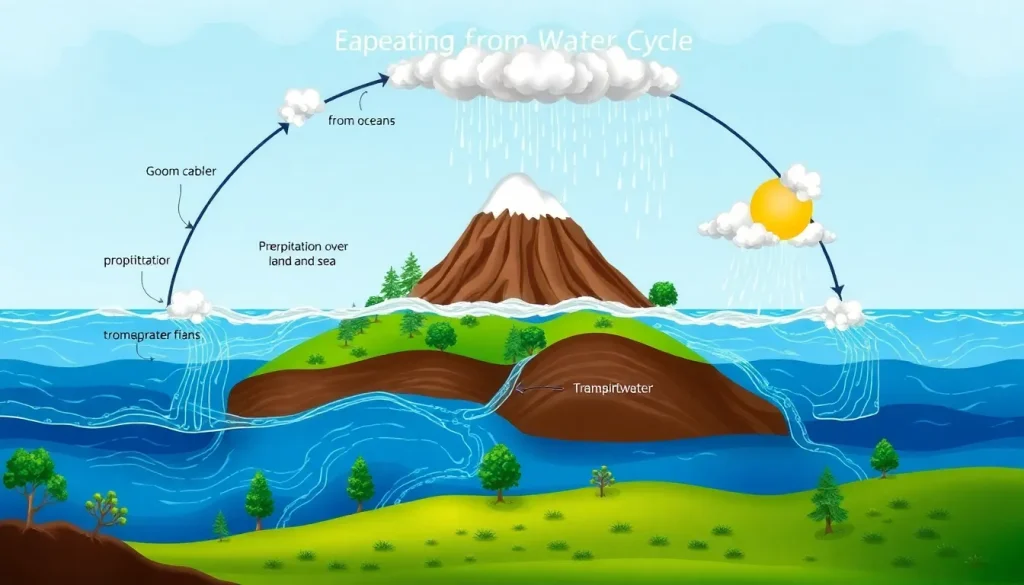
The global water cycle, also called the hydrological cycle, is the endless circulation of water through Earth’s systems. It describes how water evaporates from oceans and land surfaces, rises into the atmosphere, condenses into clouds, falls back to the ground as precipitation, and eventually returns to the oceans via rivers, groundwater flow, and direct runoff. This cycle has no beginning or end; water molecules may spend days in the atmosphere, weeks in rivers, or millennia locked in ice sheets or deep aquifers before moving on.
As a fundamental Earth system process, the water cycle connects the hydrosphere (all water on Earth), atmosphere, lithosphere (the solid Earth), and biosphere (living things). It is powered primarily by the sun, which provides the energy for evaporation, and by gravity, which pulls water downward through precipitation and runoff. The cycle is a closed system globally—the total amount of water on Earth remains relatively constant over time—but it is open at regional scales, where imbalances between precipitation and evaporation drive weather patterns, droughts, and floods. Understanding the water cycle is essential for fields ranging from meteorology and climatology to agriculture, ecology, and civil engineering.
Overview
Earth is often called the “water planet” because water covers about 71% of its surface. The vast majority—approximately 97%—is saline ocean water. Of the remaining 3% that is freshwater, most is locked in ice caps and glaciers (about 68.7%) or stored as groundwater (30.1%). Only a tiny fraction, roughly 0.3% of all freshwater, is found in lakes, rivers, and swamps, and an even smaller amount exists as soil moisture, atmospheric water vapor, and within living organisms. Despite these small percentages, the active cycling of water through these reservoirs makes life on land possible.
The water cycle operates across a wide range of timescales. Atmospheric water vapor is replaced about every 9 days, while water in rivers may be renewed every 16 days. In contrast, the deep ocean circulates over centuries, and large ice sheets can store water for hundreds of thousands of years. Groundwater residence times vary from days in shallow aquifers to millions of years in deep, confined formations. This variability means that some parts of the cycle respond quickly to changes, while others lag, creating complex feedbacks in the climate system.
How It Works
The water cycle is driven by a combination of physical processes that transfer water between reservoirs. The main processes are:
- Evaporation: The transformation of liquid water into water vapor, primarily from ocean surfaces (about 86% of global evaporation) and from lakes, rivers, and soil. Solar heating provides the energy needed for this phase change.
- Transpiration: The release of water vapor from plants through their leaves. Together with evaporation from land surfaces, this is called evapotranspiration and accounts for the remaining 14% of atmospheric moisture.
- Condensation: As moist air rises and cools, water vapor condenses into tiny liquid droplets or ice crystals, forming clouds. This process releases latent heat, which fuels atmospheric circulation.
- Precipitation: When cloud particles grow large enough, they fall as rain, snow, sleet, or hail. Most precipitation falls back into the oceans (about 77%), while the rest falls over land, replenishing freshwater systems.
- Runoff and Infiltration: Precipitation that reaches the ground either flows over the surface as runoff, eventually reaching streams and rivers, or infiltrates into the soil. Infiltrated water may be taken up by plants, evaporate, or percolate deeper to recharge groundwater aquifers.
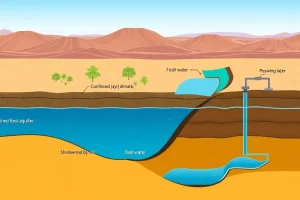
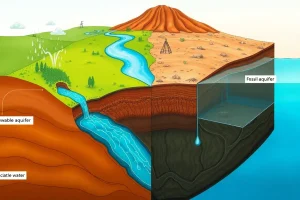
- Groundwater Flow: Water that reaches the saturated zone moves slowly through porous rock and sediment, eventually discharging into rivers, lakes, or directly into the ocean. This subsurface flow sustains river baseflow during dry periods.
- Ocean Circulation: The oceans are not static; wind-driven surface currents and thermohaline (density-driven) deep circulation redistribute water and heat around the globe, influencing regional climates and the rate of evaporation.
These processes are interconnected. For example, increased evaporation leads to more atmospheric moisture, which can enhance precipitation downwind. Similarly, changes in land cover affect infiltration and runoff, altering how much water returns to the atmosphere versus flowing to the sea.
Importance and Impact
The water cycle is fundamental to life on Earth. It provides the freshwater that sustains ecosystems, agriculture, industry, and human consumption. Without the continuous transport of moisture from oceans to land, continents would be arid and largely uninhabitable. The cycle also plays a critical role in regulating Earth’s climate. Evaporation and condensation transfer heat from the surface to the atmosphere, driving atmospheric circulation and weather systems. Water vapor is the most abundant greenhouse gas, and its distribution influences the planet’s energy balance.
Moreover, the water cycle shapes landscapes through erosion, sediment transport, and deposition. Rivers carve valleys, glaciers sculpt mountains, and groundwater dissolves rock to form caves. The cycle is also intimately linked to biogeochemical cycles, such as the carbon and nitrogen cycles, because water transports nutrients and dissolved gases. Changes in the water cycle can therefore cascade through ecosystems, affecting biodiversity, soil fertility, and the frequency of natural disasters like floods and droughts.
Regional Differences
The water cycle is not uniform across the globe; it varies significantly by latitude, climate zone, and geography. In tropical regions near the equator, intense solar radiation drives high evaporation and frequent, heavy precipitation, resulting in lush rainforests and high river discharge. Subtropical deserts, by contrast, lie under descending air masses that suppress cloud formation, leading to low precipitation and high evaporation rates. These regions are characterized by aridity and intermittent streams.
Mid-latitude regions experience seasonal variations, with precipitation often associated with frontal systems and storms. Polar regions have a slow water cycle because cold temperatures reduce evaporation, and much of the water is stored as ice. Mountainous areas force moist air to rise, cool, and condense, creating wet windward slopes and dry rain shadows on the leeward side. Monsoon systems, such as those in South Asia, represent a dramatic seasonal reversal of winds that brings intense rainfall, driven by differential heating of land and ocean. These regional patterns are critical for understanding water availability and the risks of floods and droughts.
Environmental and Human Impacts
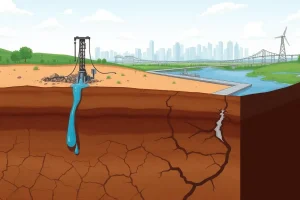
Human activities are increasingly modifying the global water cycle. Land-use changes, such as deforestation, urbanization, and agriculture, alter evapotranspiration, infiltration, and runoff. Deforestation reduces transpiration and can decrease regional rainfall, while urban surfaces increase runoff and reduce groundwater recharge. The extraction of groundwater for irrigation and drinking water has depleted many aquifers faster than they can be replenished, leading to land subsidence and reduced baseflow to rivers.
Climate change, driven by greenhouse gas emissions, intensifies the water cycle. Warmer air can hold more moisture, which increases evaporation and the potential for heavier precipitation events. This leads to more frequent and severe floods in some regions, while other areas experience prolonged droughts. Melting glaciers and ice sheets contribute to sea-level rise and alter the timing of freshwater runoff. Additionally, pollution from agricultural runoff, industrial discharge, and plastic waste contaminates water bodies, affecting both human health and aquatic ecosystems. These impacts highlight the need for sustainable water management and climate adaptation strategies.
Common Misconceptions
One common misconception is that the water cycle is a simple, circular path with water moving neatly from ocean to cloud to land and back. In reality, water takes many complex pathways, and a single molecule may cycle through different reservoirs in unpredictable ways. Another misunderstanding is that groundwater exists in underground lakes or rivers; in fact, it is held in the pore spaces of rock and sediment, often moving very slowly.
Some believe that the water cycle is immune to human influence, but as described, human activities significantly alter its dynamics. It is also often assumed that the total amount of water on Earth is increasing or decreasing, but the global water cycle is essentially a closed system—water is neither created nor destroyed on a planetary scale, only redistributed. Finally, many think that evaporation only happens from oceans, but lakes, rivers, soil, and plants are also important sources of atmospheric moisture.
FAQ
What is the global water cycle?
The global water cycle is the continuous movement of water through Earth's atmosphere, oceans, land, and living things, driven by solar energy and gravity. It includes processes like evaporation, condensation, precipitation, and runoff.
How does the water cycle work?
Water evaporates from oceans and land, rises as vapor, condenses into clouds, and falls as precipitation. On land, water flows as runoff, infiltrates soil, recharges groundwater, and eventually returns to the oceans, completing the cycle.
Why does the water cycle matter?
The water cycle sustains all life by distributing freshwater, regulates climate through heat transfer, shapes landscapes, and supports ecosystems. Changes to the cycle affect water availability, weather extremes, and environmental health.
References
- U.S. Geological Survey (USGS) Water Science School: The Water Cycle
- NASA Earth Observatory: The Water Cycle
- Trenberth, K. E., et al. (2007) Estimates of the Global Water Budget and Its Annual Cycle Using Observational and Model Data. Journal of Hydrometeorology.