In brief
At a glance
Quick Facts
- Land use efficiency
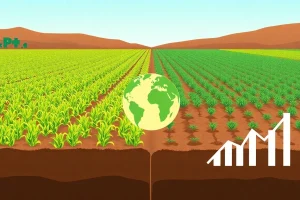
- Conventional farming typically produces 20-25% higher yields per acre than organic for most crops.
- On-farm biodiversity
- Organic farms support on average 30% more species than conventional farms.
- Greenhouse gas emissions per unit of product
- Organic systems often emit similar or slightly less CO2 per unit of food, but can emit more per unit of land due to lower yields.
- Synthetic pesticide use
- Conventional agriculture uses synthetic pesticides, while organic relies on natural substances and biological controls.
- Soil organic matter
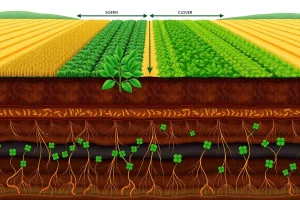
- Organic farming practices increase soil organic matter, improving water retention and carbon sequestration.
- Nitrogen pollution
- Conventional systems can cause nitrate leaching into groundwater, while organic systems use slower-release nutrients.
- Energy use
- Organic farming generally uses less energy per unit of land but sometimes more per unit of product.
- Water footprint
- Water efficiency varies; organic soils often retain water better, but lower yields can increase water footprint per unit of food.
Key Takeaways
- Organic farming generally supports higher on-farm biodiversity and soil health, while conventional farming achieves higher yields per acre, reducing pressure to convert natural habitats.
- Conventional agriculture relies on synthetic fertilizers and pesticides, which can lead to water pollution and greenhouse gas emissions, whereas organic systems use natural inputs but may require more land.
- Neither system is universally superior; the environmental impact depends on the specific metric (e.g., land use, climate change, water quality) and local context.
- Integrated approaches that combine the best practices of both systems may offer the most sustainable path forward for global food production.
What Is Conventional vs Organic Agriculture: Environmental Trade-Offs?
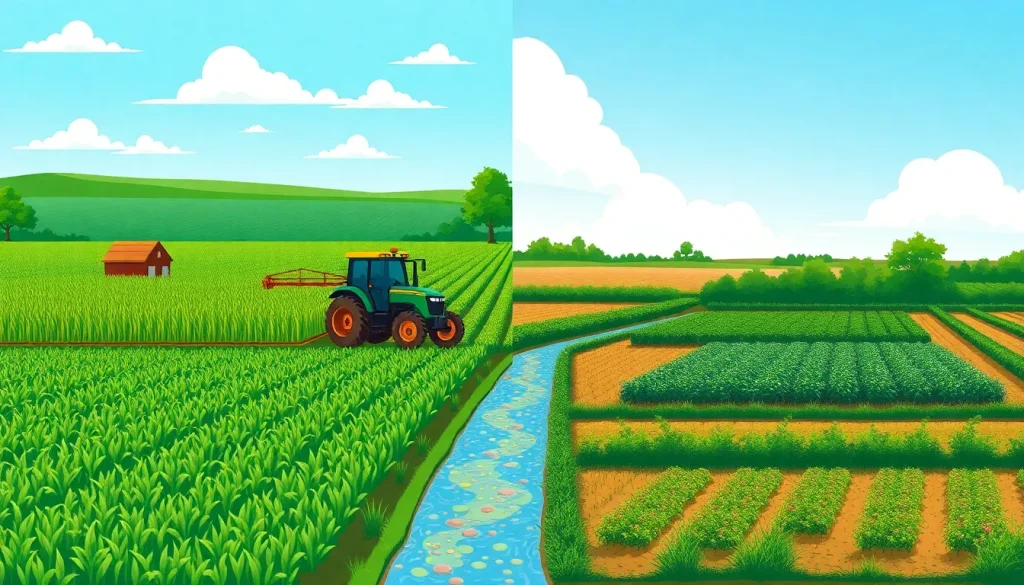
The comparison between conventional and organic agriculture involves evaluating the environmental costs and benefits of two distinct farming paradigms. Conventional agriculture, dominant since the mid-20th century, relies on synthetic fertilizers, pesticides, and high-yielding crop varieties to maximize production. Organic agriculture, by contrast, emphasizes ecological processes, biodiversity, and the avoidance of most synthetic inputs. The environmental trade-offs between these systems are not straightforward; they involve complex interactions among land use, greenhouse gas emissions, water quality, soil health, and biodiversity.
Understanding these trade-offs requires examining multiple environmental indicators simultaneously. For instance, while organic farming often reduces chemical runoff and supports greater on-farm biodiversity, its lower yields per acre can mean that more land is needed to produce the same amount of food, potentially leading to deforestation and habitat loss elsewhere. Conversely, conventional farming’s higher yields can spare land for conservation, but its reliance on synthetic inputs contributes to soil degradation, water pollution, and higher energy use. This article explores the key environmental dimensions of both systems, providing a balanced, evidence-based overview.
Overview
Agriculture occupies about 38% of the Earth’s ice-free land surface and is a major driver of environmental change, including biodiversity loss, freshwater depletion, and greenhouse gas emissions. The debate between conventional and organic farming is central to discussions about sustainable food production. Conventional agriculture, often called industrial or high-input farming, emerged from the Green Revolution and prioritizes efficiency and yield through technological inputs. Organic agriculture, codified in standards such as those of the International Federation of Organic Agriculture Movements (IFOAM), prohibits synthetic pesticides and fertilizers, genetically modified organisms (GMOs), and irradiation, instead relying on crop rotations, animal manures, and biological pest control.
Both systems have evolved over time, and neither is monolithic. Conventional farms vary from large-scale monocultures to smaller integrated operations, while organic practices range from intensive horticulture to extensive grazing. The environmental trade-offs are therefore not absolute but depend on management, crop type, and regional conditions. This article examines the evidence on key environmental indicators to provide a nuanced understanding of the choices involved.
How It Works
Conventional agriculture maximizes yields through several core practices. Synthetic nitrogen fertilizers, produced via the energy-intensive Haber-Bosch process, supply crops with readily available nutrients, enabling high productivity. Chemical pesticides—herbicides, insecticides, and fungicides—control pests and diseases. Monoculture, the cultivation of a single crop over large areas, simplifies management and allows mechanization. Genetically modified (GM) crops, where permitted, confer traits such as pest resistance or herbicide tolerance, further boosting efficiency.
Organic agriculture, in contrast, relies on ecological processes. Nutrient management uses compost, animal manure, green manure, and crop rotations, including nitrogen-fixing legumes. Pest control employs natural enemies, crop diversity, and approved substances like neem oil or Bacillus thuringiensis. Weed management depends on mechanical tillage, mulching, and competitive crop varieties. Organic standards also require maintenance of soil organic matter and prohibit synthetic inputs. These divergent practices lead to different environmental footprints across several dimensions.
Environmental and Human Impacts
The environmental impacts of conventional and organic farming can be assessed across multiple categories. In terms of land use, organic systems typically require 20–25% more land to produce the same amount of food due to lower yields. This land-use penalty can lead to habitat conversion if organic production expands significantly, potentially offsetting local biodiversity gains. However, when organic yields are optimized through best practices, the gap narrows for some crops.
Regarding greenhouse gas emissions, the picture is mixed. Per unit of land, organic farming often emits less nitrous oxide (a potent greenhouse gas) because it avoids synthetic nitrogen fertilizers. However, per unit of food produced, emissions can be similar or even higher for organic due to lower yields. Life-cycle analyses show that organic systems generally use less energy per unit of land but sometimes more per unit of product. Soil carbon sequestration is typically higher in organic systems, which can partially offset emissions.
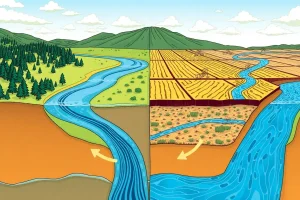
Water quality is a clear area of advantage for organic farming. The absence of synthetic pesticides and reduced nitrate leaching lower the risk of groundwater contamination and eutrophication of water bodies. Conventional agriculture is a leading source of nutrient runoff, causing algal blooms and dead zones. However, organic systems can also contribute to pollution if manure is mismanaged.
Biodiversity benefits are consistently higher on organic farms. Meta-analyses show that organic fields support about 30% more species on average, including pollinators, birds, and soil organisms. This is attributed to the lack of synthetic pesticides, more diverse crop rotations, and the presence of semi-natural habitats. However, the lower yields mean that if organic farming were adopted globally without dietary changes, the additional land required could threaten biodiversity at a landscape scale.
Soil health is generally superior under organic management. Higher organic matter content improves soil structure, water infiltration, and erosion resistance. Conventional tillage and monocultures can degrade soil over time, though conservation tillage and cover cropping are increasingly adopted in conventional systems to mitigate these effects.
Human health impacts are also relevant. Conventional farming exposes farmworkers and rural communities to synthetic pesticides, which have been linked to acute poisoning and chronic diseases. Organic farming reduces this exposure but may use natural pesticides that are not risk-free. Food safety risks, such as mycotoxin contamination, can be higher in organic crops due to reduced fungicide use, though evidence is mixed.
Benefits, Limitations and Trade-offs
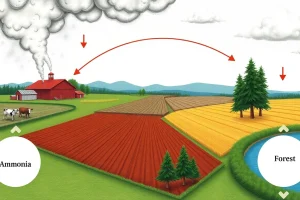
The core trade-off lies between land-use efficiency and local environmental quality. Conventional agriculture’s high yields spare land for conservation, a concept known as “land sparing.” If global food demand continues to rise, land sparing could be crucial for protecting forests and grasslands. Organic agriculture, by promoting on-farm biodiversity and reducing chemical inputs, aligns with a “land sharing” approach, where agriculture and wildlife coexist but more land is needed.
Other trade-offs include:
- Energy use vs. carbon sequestration: Organic farming uses less fossil energy but may not always have a lower carbon footprint per unit of food due to yield differences.
- Water pollution vs. water use: Organic systems reduce chemical runoff but can have a higher water footprint per unit of food because of lower yields, though improved soil structure can enhance water retention.
- Soil conservation vs. tillage: Organic weed control often relies on mechanical tillage, which can disrupt soil structure and release carbon, whereas conventional no-till systems reduce erosion but depend on herbicides.
- Nutrient cycling: Organic systems recycle nutrients locally but may face limitations in phosphorus and potassium, requiring external inputs that are not always sustainable.
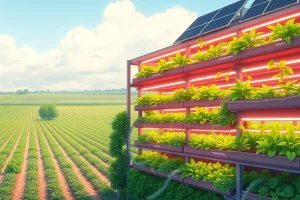
Neither system is inherently sustainable. The best choice depends on the specific environmental priority. For example, in regions with abundant land and water, organic methods may be preferable for protecting water quality and biodiversity. In areas where land is scarce and deforestation is a major concern, high-yield conventional farming might be more appropriate. Integrated approaches, such as precision agriculture, integrated pest management, and agroecology, seek to combine the strengths of both systems.
Common Misconceptions
Misconception 1: Organic farming is always better for the climate. While organic farming reduces synthetic nitrogen use and can sequester more soil carbon, its lower yields can result in higher greenhouse gas emissions per unit of food. The climate impact depends on the crop, region, and whether land-use change is considered.
Misconception 2: Conventional farming is inherently destructive to the environment. Conventional practices such as no-till farming, precision fertilizer application, and integrated pest management can significantly reduce environmental harm. Many conventional farmers adopt conservation practices that improve soil and water quality.
Misconception 3: Organic farming uses no pesticides. Organic standards permit a range of naturally derived pesticides, such as copper sulfate and pyrethrins, which can also have environmental and health impacts. However, their use is generally more restricted and less persistent than many synthetic alternatives.
Misconception 4: Organic yields are always much lower. The yield gap varies widely by crop, region, and management. For some crops like fruits and certain vegetables, organic yields can approach conventional levels. For cereals, the gap is often larger. Best practices and agroecological innovations can narrow the difference.
Misconception 5: One system can feed the world sustainably on its own. Global food security likely requires a mix of approaches tailored to local conditions. A blanket shift to either system would create new environmental pressures. Dietary changes, reduced food waste, and improved agricultural practices across all systems are essential.
FAQ
What is the main environmental trade-off between conventional and organic agriculture?
The primary trade-off is between land-use efficiency and local environmental quality. Conventional farming produces higher yields on less land, reducing pressure to convert natural habitats, but often causes more chemical pollution and soil degradation. Organic farming enhances on-farm biodiversity and reduces synthetic inputs, but requires more land to produce the same amount of food, which can lead to habitat loss elsewhere.
How does organic farming affect biodiversity?
Organic farming generally increases biodiversity at the field and farm scale. Studies show that organic fields have about 30% more species on average, including beneficial insects, birds, and soil microbes. This is due to the absence of synthetic pesticides, more diverse crop rotations, and the maintenance of hedgerows and other semi-natural habitats.
Why does organic farming require more land?
Organic farming typically has lower yields because it avoids synthetic fertilizers and pesticides, which can limit nutrient availability and pest control. Without these inputs, crops may grow more slowly or suffer greater losses. As a result, more land is needed to produce the same quantity of food, although the yield gap varies by crop and management practices.
References
- Seufert, V., Ramankutty, N., & Foley, J. A. (2012). Comparing the yields of organic and conventional agriculture. Nature, 485(7397), 229-232.
- Tuck, S. L., et al. (2014). Land-use intensity and the effects of organic farming on biodiversity: a hierarchical meta-analysis. Journal of Applied Ecology, 51(3), 746-755.
- Clark, M., & Tilman, D. (2017). Comparative analysis of environmental impacts of agricultural production systems, agricultural input efficiency, and food choice. Environmental Research Letters, 12(6), 064016.