In brief
At a glance
Quick Facts
- Fraction of anthropogenic CO2 absorbed by oceans
- About 25–30% since the Industrial Revolution
- Main chemical forms of inorganic carbon in seawater
- Bicarbonate (HCO3-), carbonate (CO3 2-), dissolved CO2
- pH change since pre-industrial times
- Decrease of ~0.1 units, representing ~30% increase in acidity
- Primary physical law governing gas dissolution
- Henry's Law
- Key biological process contributing to carbon storage
- Biological pump (photosynthesis and sinking organic matter)
- Solubility relationship with temperature
- CO2 is more soluble in cold water; warming reduces solubility
- Typical residence time of carbon in deep ocean
- Centuries to millennia
- Main human activities increasing atmospheric CO2
- Fossil fuel burning, deforestation, cement production
Key Takeaways
- The oceans absorb carbon dioxide primarily because CO2 dissolves in seawater and reacts chemically to form bicarbonate and carbonate ions, maintaining a concentration gradient that draws more CO2 from the air.
- This absorption is a critical natural carbon sink, removing roughly 25–30% of anthropogenic CO2 emissions from the atmosphere and significantly slowing global warming.
- The process is governed by well-established physical and chemical principles, including Henry’s Law and the carbonate buffer system, and varies with temperature, salinity, and biological activity.
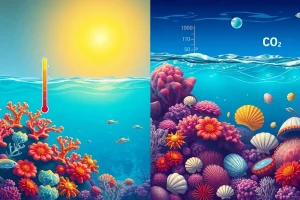
- While ocean CO2 uptake mitigates climate change, it also leads to ocean acidification, which threatens marine ecosystems, coral reefs, and shell-forming organisms.
What Is Why the Oceans Absorb Carbon Dioxide?
“Why the oceans absorb carbon dioxide” refers to the set of natural physical, chemical, and biological mechanisms that cause the world’s oceans to take up carbon dioxide (CO2) from the atmosphere. At its core, this is a consequence of the fundamental gas-exchange principle: when the partial pressure of CO2 in the surface ocean is lower than that in the overlying air, CO2 molecules diffuse from the atmosphere into the water. Once dissolved, CO2 undergoes a series of rapid chemical reactions that convert it into other forms of inorganic carbon, primarily bicarbonate ions, which effectively “lock” the carbon into the ocean and allow more CO2 to be absorbed.
This process is not a single event but a continuous, dynamic exchange that forms a critical part of the global carbon cycle. The oceans contain about 50 times more carbon than the atmosphere, and they naturally exchange CO2 with the air at the sea surface. The direction and rate of this exchange depend on the difference in CO2 partial pressure between the two reservoirs. Because human activities have raised atmospheric CO2 concentrations, the ocean has become a net absorber, taking in excess CO2 and thereby buffering the climate system. However, this absorption comes with significant consequences for seawater chemistry and marine life.
Overview
The ocean’s ability to absorb carbon dioxide is a cornerstone of Earth’s climate regulation. Covering more than 70% of the planet’s surface, the ocean acts as a vast reservoir that exchanges gases with the atmosphere continuously. The net movement of CO2 into the ocean is driven by the imbalance created by rising atmospheric CO2 levels from fossil fuel burning, deforestation, and cement production. Without this oceanic uptake, atmospheric CO2 concentrations would be substantially higher, and the greenhouse effect would be more intense.
The ocean’s carbon storage is not uniform; it varies with latitude, depth, and time. Cold, high-latitude waters absorb CO2 more readily because CO2 is more soluble in cold water. Deep ocean circulation then transports this carbon-rich water away from the surface, sequestering it for centuries to millennia. Biological processes, such as photosynthesis by phytoplankton and the sinking of organic particles, also contribute to carbon removal from the surface layer. Together, these mechanisms make the ocean the largest active carbon sink on Earth, but they are sensitive to climate change itself, creating complex feedback loops.
How It Works
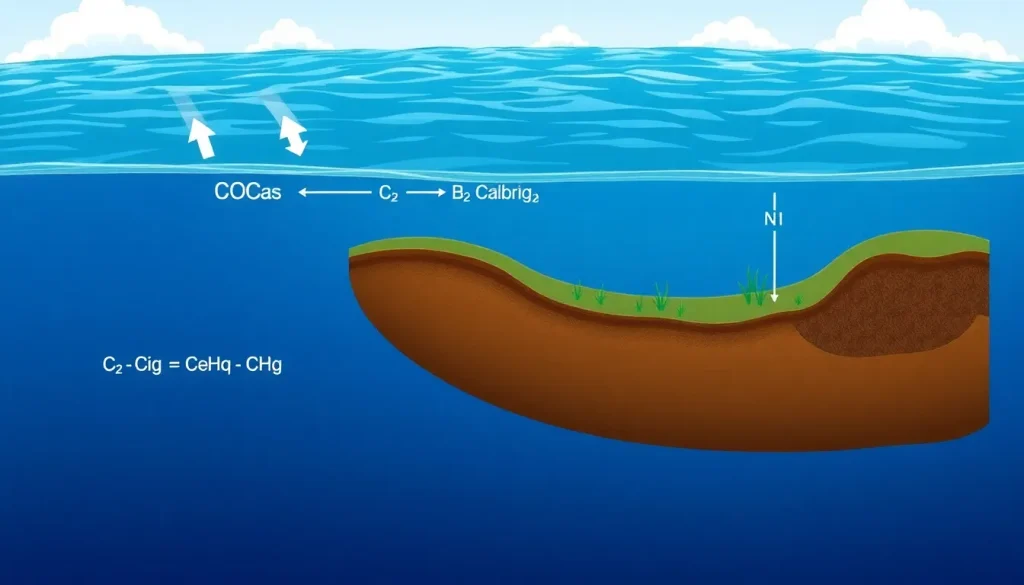
The absorption of CO2 by the ocean involves three interconnected processes: physical dissolution, chemical conversion, and biological uptake. The physical step is governed by Henry’s Law, which states that the amount of gas dissolved in a liquid is proportional to its partial pressure above the liquid. When atmospheric CO2 rises, the partial pressure gradient drives more CO2 into the surface ocean until a new equilibrium is approached. This exchange is enhanced by wind and waves, which increase the surface area and mixing.
Once dissolved, CO2 reacts with water (H2O) to form carbonic acid (H2CO3), a weak acid that quickly dissociates into bicarbonate (HCO3-) and hydrogen ions (H+). The bicarbonate can further dissociate into carbonate (CO3 2-) and another hydrogen ion. This series of reactions, known as the carbonate buffer system, removes dissolved CO2 from the surface water, allowing more atmospheric CO2 to be absorbed. The relative proportions of these carbon species depend on pH: in typical seawater, over 90% of the inorganic carbon exists as bicarbonate, about 9% as carbonate, and less than 1% as dissolved CO2. The hydrogen ions released during these reactions lower the ocean’s pH, a process called ocean acidification.
Biological uptake also plays a role. Phytoplankton, microscopic marine plants, use dissolved CO2 for photosynthesis, converting it into organic carbon. When these organisms die or are consumed, some of their carbon sinks to the deep ocean, a mechanism known as the biological pump. Additionally, some marine organisms use carbonate ions to build calcium carbonate shells and skeletons; when they die, these structures can sink and become part of the deep-sea sediment, effectively storing carbon for millions of years.
Importance and Impact
The ocean’s absorption of CO2 has profound importance for the global climate system. By taking up about 25–30% of anthropogenic CO2 emissions, the ocean has significantly slowed the rate of atmospheric warming. Without this service, the concentration of CO2 in the atmosphere would be much higher, and the resulting greenhouse effect would have caused more extreme temperature increases, sea level rise, and climate disruption. The ocean thus acts as a critical buffer, moderating the pace of climate change.
However, this buffering capacity comes at a cost. The chemical reactions that absorb CO2 also increase the acidity of seawater. Since the Industrial Revolution, the average pH of surface ocean waters has fallen by about 0.1 units, which corresponds to a roughly 30% increase in acidity. This change, known as ocean acidification, reduces the availability of carbonate ions, making it harder for calcifying organisms such as corals, mollusks, and some plankton to build and maintain their shells and skeletons. The impacts ripple through marine food webs, affecting fisheries, coral reef ecosystems, and the livelihoods of millions of people who depend on them.
Why It Matters
The ocean’s role as a carbon sink is a double-edged sword. On one hand, it has absorbed a significant fraction of human-caused CO2 emissions, preventing even more rapid climate change. On the other hand, the resulting ocean acidification poses a serious threat to marine biodiversity and ecosystem services. Understanding why the oceans absorb CO2 is essential for predicting future climate conditions, assessing the health of marine environments, and informing policy decisions on carbon emissions and ocean management.
Moreover, the ocean’s capacity to absorb CO2 is not infinite. As seawater becomes more acidic, its ability to take up additional CO2 diminishes because the buffer system becomes less effective. There is also concern that warming ocean temperatures may reduce CO2 solubility and slow down the biological pump, creating feedback loops that could accelerate atmospheric CO2 accumulation. These dynamics underscore the interconnectedness of the Earth’s climate and ocean systems and highlight the urgency of reducing greenhouse gas emissions to preserve the ocean’s regulatory function.
Environmental and Human Impacts
The absorption of CO2 by the ocean has direct and indirect consequences for marine life and human societies. Ocean acidification, the primary environmental impact, disrupts the ability of calcifying organisms to form shells and skeletons. This includes commercially important species such as oysters, clams, and shrimp, as well as foundational ecosystem engineers like corals. Coral reefs, which support immense biodiversity and provide coastal protection, are particularly vulnerable to both acidification and warming. Degradation of these ecosystems can lead to loss of fisheries, reduced tourism, and increased coastal erosion.
On the positive side, the ocean’s carbon uptake has slowed global warming, reducing the severity of heatwaves, droughts, and extreme weather events that would otherwise have occurred. This climate regulation service has enormous economic and social value, though it is often taken for granted. However, the combined effects of warming, acidification, and deoxygenation (caused by warming and nutrient runoff) are altering marine habitats and species distributions, with implications for food security and livelihoods, especially in coastal and island communities that rely heavily on marine resources.
Connections to Other Systems
The ocean’s absorption of CO2 is tightly linked to the global carbon cycle, which includes the atmosphere, terrestrial biosphere, and lithosphere. Carbon moves between these reservoirs through processes such as photosynthesis, respiration, weathering, and volcanic activity. The ocean is the largest active carbon reservoir, and its exchange with the atmosphere is a key control on atmospheric CO2 levels over timescales of centuries to millennia. Changes in ocean circulation, temperature, and chemistry can therefore have far-reaching effects on the entire climate system.
Additionally, the ocean’s carbon uptake is connected to the Earth’s energy balance. CO2 is a greenhouse gas, so its removal from the atmosphere reduces the amount of heat trapped. However, the ocean also absorbs a large portion of the excess heat from global warming, leading to thermal expansion and sea level rise. The interplay between carbon uptake, heat absorption, and ocean circulation creates complex feedback loops. For example, warming reduces the solubility of CO2 and can weaken the biological pump, potentially decreasing the ocean’s capacity to absorb carbon and amplifying climate change.
Data Limitations and Uncertainties
While the fundamental chemistry of ocean CO2 absorption is well understood, quantifying the exact amount of carbon taken up by the ocean and predicting future changes involves uncertainties. Direct measurements of air-sea CO2 fluxes are sparse in many regions, particularly in the Southern Ocean and remote tropical areas. Scientists rely on a combination of ship-based observations, autonomous floats, and satellite data to estimate global uptake, but these methods have inherent limitations in coverage and accuracy.
Future projections of ocean carbon uptake depend on complex Earth system models that simulate physical, chemical, and biological processes. Uncertainties arise from how these models represent ocean circulation, marine ecosystem responses, and feedback mechanisms. For instance, the response of the biological pump to warming and acidification is not fully understood, and the potential for abrupt changes in ocean circulation could significantly alter carbon uptake. Ongoing research aims to reduce these uncertainties, but they remain a challenge for precise climate predictions.
FAQ
What is the main reason the ocean absorbs carbon dioxide?
The ocean absorbs CO2 because of a difference in partial pressure between the atmosphere and surface water, combined with chemical reactions that convert dissolved CO2 into bicarbonate and carbonate ions, maintaining a gradient that draws more CO2 in.
How does ocean absorption of CO2 affect climate change?
It significantly slows climate change by removing about a quarter of human-caused CO2 emissions from the atmosphere, reducing the greenhouse effect and the rate of global warming.
Why is ocean acidification a problem?
Ocean acidification lowers seawater pH and reduces the availability of carbonate ions, making it difficult for corals, shellfish, and some plankton to build their shells and skeletons, threatening marine ecosystems and the services they provide.
References
- Intergovernmental Panel on Climate Change (IPCC) Special Report on the Ocean and Cryosphere in a Changing Climate
- National Oceanic and Atmospheric Administration (NOAA) Ocean Carbon and Acidification Data System
- Royal Society of Chemistry – Ocean Acidification and the Carbon Cycle