In brief
At a glance
Quick Facts
- Share of excess heat absorbed
- More than 90% of the extra energy from greenhouse gas emissions is stored in the ocean.
- Heat capacity comparison
- The ocean can hold about 1,000 times more heat than the atmosphere for the same temperature change.
- Primary heat source
- Solar radiation absorbed at the sea surface is the dominant mechanism of ocean heating.
- Deep ocean warming
- Heat has been detected down to depths of 2,000 meters and below, with the deep ocean continuing to warm.
- Thermal expansion contribution
- Ocean warming causes seawater to expand, contributing roughly one-third to one-half of observed sea-level rise.
- Mixed layer depth
- The surface mixed layer, where most heat is initially absorbed, ranges from about 10 to 200 meters deep depending on winds and season.
- Timescale of deep heat storage
- Heat absorbed by the deep ocean can remain there for centuries to millennia, delaying its climate impact.
- Argo float network
- A global array of nearly 4,000 profiling floats measures ocean temperature and salinity in the upper 2,000 meters.
Key Takeaways
- The ocean absorbs more than 90% of the excess heat trapped by greenhouse gases, making it the dominant heat sink in Earth’s climate system.
- Heat enters the ocean primarily through solar radiation at the surface, then is distributed downward by wind-driven mixing and large-scale thermohaline circulation.
- Ocean heat uptake slows atmospheric warming but causes thermal expansion of seawater, contributing significantly to global sea-level rise.
- Regional differences in heat absorption are driven by factors such as ocean currents, wind patterns, and the depth of the mixed layer, leading to uneven warming and marine heatwaves.
What Is How the Ocean Absorbs Heat From the Atmosphere?
Ocean heat absorption refers to the physical processes by which the ocean takes up thermal energy from the atmosphere and distributes it throughout the water column. The ocean is the largest heat reservoir in Earth’s climate system, with a heat capacity about 1,000 times greater than the atmosphere. This means that even a small increase in ocean temperature represents an enormous amount of stored energy. The ocean absorbs heat primarily at the sea surface through the absorption of solar radiation, as well as through sensible and latent heat exchange with the overlying air. Once heat enters the surface layer, it is mixed downward by wind-driven turbulence and large-scale ocean currents, eventually reaching the deep ocean over centuries to millennia.
This process is a critical component of Earth’s energy balance. The ocean’s ability to absorb and store heat moderates global temperatures, preventing the atmosphere from warming even more rapidly than it already has. However, the same heat uptake causes thermal expansion of seawater, which is a major driver of sea-level rise, and alters marine ecosystems. Understanding how the ocean absorbs heat is essential for predicting future climate change, sea-level rise, and the health of marine life.
How It Works
The ocean absorbs heat through a combination of radiative, convective, and conductive processes, followed by redistribution via ocean circulation. The primary steps are:
- Solar radiation absorption: The ocean surface absorbs incoming shortwave solar radiation. Because water is relatively transparent to visible light, sunlight penetrates the upper tens of meters, directly heating the surface layer. This is the dominant source of heat input.
- Sensible and latent heat exchange: The ocean also gains heat through sensible heat transfer when the air is warmer than the sea surface, and through latent heat release when water vapor condenses onto the surface. However, on a global average, the ocean loses more heat via evaporation than it gains via sensible heat, so the net effect is cooling; the primary heat gain is from solar radiation.
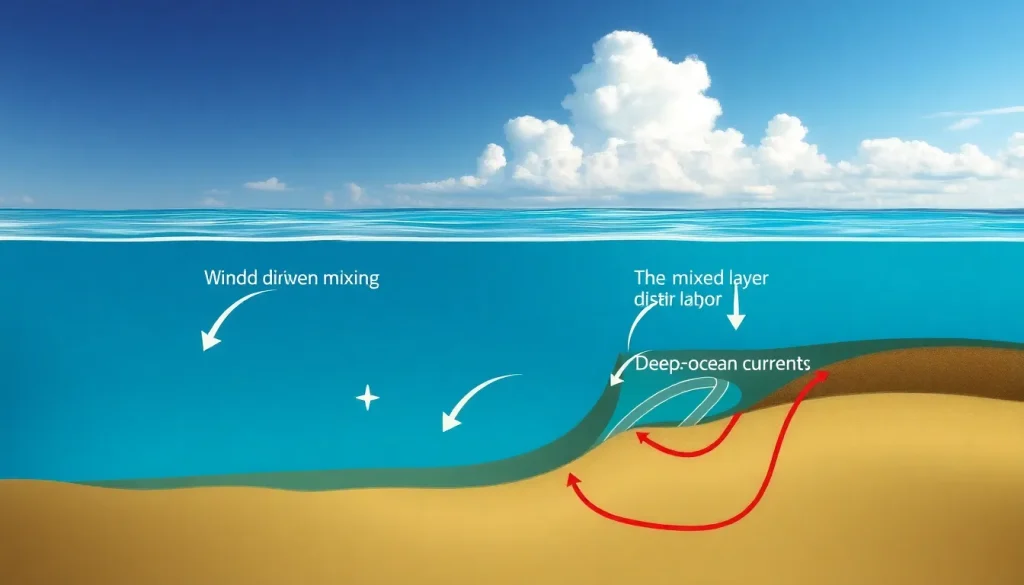
- Surface mixing: Wind-driven turbulence and waves mix the heated surface water downward, creating a well-mixed layer typically tens to hundreds of meters thick. This mixed layer distributes heat vertically and delays the warming of the deep ocean.
- Thermohaline circulation: Large-scale ocean currents driven by differences in water density (temperature and salinity) transport heat from the tropics toward the poles and from the surface to the deep ocean. This global conveyor belt sequesters heat in the deep ocean for centuries, playing a key role in long-term climate regulation.
- Penetration of shortwave radiation: In clear waters, a fraction of solar radiation penetrates below the mixed layer, directly heating the subsurface ocean. This process is especially important in regions with low biological productivity and minimal suspended particles.
The ocean’s high specific heat capacity means it can absorb large amounts of energy with relatively small temperature changes. This thermal inertia is why the ocean warms more slowly than the land but retains heat much longer, influencing climate on timescales from seasons to millennia.
Importance and Impact
The ocean’s absorption of heat has profound consequences for the global climate system and human societies. By taking up more than 90% of the excess energy from human-induced greenhouse gas emissions, the ocean has significantly slowed the rate of atmospheric warming. Without this heat uptake, surface air temperatures would be substantially higher, and the impacts of climate change would be far more severe. However, this heat storage is not without cost.
Thermal expansion of seawater due to ocean warming is a primary contributor to global sea-level rise, accounting for roughly one-third to one-half of the observed increase over the past century. Warmer oceans also fuel more intense tropical cyclones, disrupt marine ecosystems through coral bleaching and species migration, and reduce the ocean’s capacity to absorb carbon dioxide, exacerbating ocean acidification. The deep ocean’s slow heat uptake means that even if greenhouse gas emissions were to cease immediately, the ocean would continue to warm and sea levels would continue to rise for centuries, committing the planet to long-term change.
Regional Differences
Heat absorption by the ocean is not uniform across the globe. Several factors create pronounced regional variations:
- Latitude: Tropical oceans receive more solar radiation year-round and absorb more heat than polar regions. However, the tropics also lose more heat through evaporation, so net heat gain is highest in the subtropics.
- Ocean currents: Western boundary currents like the Gulf Stream and Kuroshio transport warm water poleward, leading to strong heat uptake in those regions. Conversely, upwelling zones along eastern boundaries bring cold deep water to the surface, absorbing heat from the atmosphere.
- Mixed layer depth: Regions with deep mixed layers, such as the Southern Ocean, can store more heat because the absorbed energy is distributed over a larger volume, resulting in slower surface warming but greater total heat uptake.
- Ice cover: Sea ice reflects solar radiation, reducing heat absorption. As ice melts, the exposed dark ocean surface absorbs more heat, creating a feedback loop that accelerates warming in the Arctic.
- Cloud cover and aerosols: Persistent cloud cover or high aerosol concentrations can reduce the amount of solar radiation reaching the sea surface, affecting local heat absorption rates.
Connections to Other Systems
Ocean heat absorption is tightly linked to other components of the Earth system. The ocean and atmosphere exchange heat, moisture, and momentum continuously, shaping weather patterns and climate variability. For example, El Niño and La Niña events are driven by changes in ocean heat distribution in the tropical Pacific, which in turn alter global weather patterns, including rainfall, droughts, and storm tracks.
The ocean’s heat content also influences the cryosphere. Warmer ocean waters melt marine-terminating glaciers and ice shelves from below, accelerating ice loss from Greenland and Antarctica and contributing to sea-level rise. Additionally, the ocean’s ability to absorb carbon dioxide is temperature-dependent: warmer waters hold less dissolved gas, so ocean warming reduces the ocean’s capacity to act as a carbon sink, leaving more CO₂ in the atmosphere and amplifying warming. These interconnections mean that changes in ocean heat uptake have cascading effects throughout the climate system.
Common Misconceptions
Data Limitations and Uncertainties
Measuring ocean heat content is challenging due to the vastness and depth of the ocean. Historical observations were sparse, particularly in the Southern Hemisphere and deep ocean, leading to uncertainties in long-term trends. Since the early 2000s, the Argo array of profiling floats has greatly improved coverage of the upper 2,000 meters, but the deep ocean below that remains poorly sampled. Satellite measurements of sea surface temperature provide global coverage but only for the top few millimeters.
Uncertainties also arise from the methods used to estimate heat content from temperature profiles, the treatment of data gaps, and the calibration of instruments. Despite these challenges, multiple independent analyses confirm that the ocean has warmed significantly over the past several decades, and the rate of warming has increased. Ongoing improvements in observing systems and data analysis are reducing uncertainties, but the deep ocean’s response to continued heat uptake remains a key area of research.
FAQ
What is ocean heat absorption?
Ocean heat absorption is the process by which the ocean takes up thermal energy from the atmosphere and sunlight, storing it in the water column. It is the primary way Earth’s climate system handles excess heat from greenhouse gas emissions.
How does the ocean absorb heat from the atmosphere?
Heat enters the ocean mainly through absorption of solar radiation at the surface. Wind and waves mix this heat downward, and large-scale ocean currents distribute it globally. Sensible and latent heat exchange also play a role, but solar radiation is the dominant source.
Why does ocean heat absorption matter?
It matters because the ocean’s heat uptake moderates atmospheric warming, but it also causes sea-level rise through thermal expansion, intensifies storms, and disrupts marine ecosystems. The stored heat will influence climate for centuries, making it a critical factor in long-term climate projections.
References
- IPCC Special Report on the Ocean and Cryosphere in a Changing Climate (SROCC)
- NOAA National Centers for Environmental Information: Ocean Heat Content
- NASA Earth Observatory: Ocean Heat Uptake and the Global Energy Budget