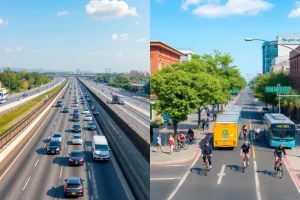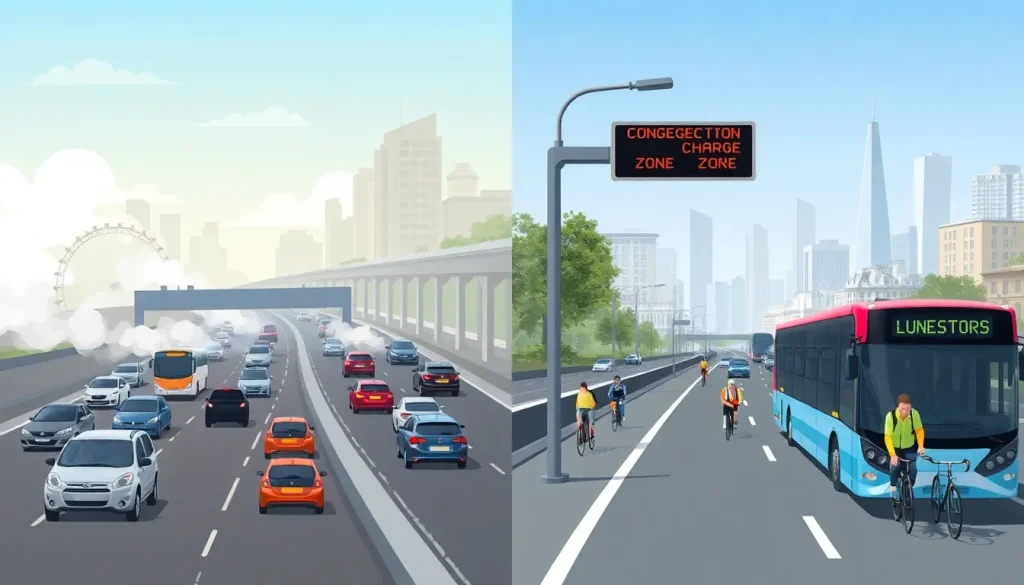
In brief
At a glance
Quick Facts
- Verdict
- Proven in specific urban contexts
- Problem addressed
- Traffic congestion and its externalities
- Evidence strength
- Moderate to strong
- Potential scale
- Urban/Regional
- Relative cost
- Moderate to high
- Time to impact
- Immediate after implementation
Quick verdict
Congestion pricing is a proven, though context-dependent, tool for managing urban traffic. When well-designed and accompanied by robust public transit alternatives and equitable revenue use, it can significantly reduce congestion, emissions, and travel times. However, its success hinges on political will, public acceptance, and careful mitigation of regressive impacts on lower-income drivers. It is not a universal fix but a powerful component of a broader sustainable mobility strategy.
Problem addressed
Traffic congestion imposes substantial costs on society: wasted time and fuel, increased greenhouse gas and local air pollutant emissions, noise, stress, and reduced economic productivity. In many metropolitan areas, demand for road space during peak hours far exceeds supply, leading to gridlock. Traditional responses—building more roads—often induce additional travel, a phenomenon known as induced demand, and are financially and environmentally unsustainable. Congestion pricing directly targets the root cause: the unpriced externalities of driving during peak times, where each additional vehicle slows down all others without bearing that cost.
How the solution works
Congestion pricing operates on the principle of internalizing the external costs of congestion. By imposing a fee for driving in a designated zone or on specific roads during high-demand periods, it makes drivers pay for the delay they impose on others. This price signal encourages behavioral changes: some trips are shifted to off-peak times, some are rerouted, some switch to public transit, walking, or cycling, and some are eliminated or combined. The result is a reduction in traffic volumes to a level where flow improves, often described as moving from hypercongestion to free-flow conditions. The fee can be fixed (a daily charge to enter a zone), variable by time of day, or dynamic based on real-time congestion levels. Revenue generated is typically reinvested in transportation infrastructure, particularly public transit, creating a virtuous cycle of improved alternatives.
Evidence strength
The evidence base for congestion pricing is moderate to strong, drawing from several multi-year, real-world implementations. London’s congestion charge, introduced in 2003, has been extensively monitored: traffic volumes in the charging zone initially dropped by about 15–30%, with bus ridership increasing. Stockholm’s 2006 trial and subsequent permanent scheme reduced traffic across the cordon by approximately 20%, with lasting effects. Singapore’s Electronic Road Pricing, in place since 1998, has kept traffic speeds stable despite rising car ownership. Milan’s Area C charge reduced traffic by around 30% and PM10 by 18%. These results are consistent with economic theory and transport modeling. However, evidence on long-term land-use impacts, business effects, and equity outcomes is more mixed and context-dependent. Some studies suggest that benefits erode over time without periodic fee adjustments. The evidence is largely from high-income, dense cities; applicability to lower-income or sprawling cities is less documented.
Potential scale
Congestion pricing is inherently an urban and regional solution. It is most applicable in cities with significant peak-period congestion and viable alternatives to single-occupancy vehicles. The potential scale is substantial: hundreds of large cities worldwide face severe congestion and could benefit. If widely adopted, the cumulative reduction in vehicle kilometers traveled could meaningfully contribute to climate goals and improve urban air quality. However, scaling is limited by political feasibility, institutional capacity, and the need for tailored design. It is not a global solution in the sense of a single technology deployable everywhere; each scheme requires local adaptation.
Cost considerations
Implementation costs are moderate to high, primarily for technology infrastructure (cameras, sensors, billing systems, enforcement) and public communication campaigns. London’s initial setup cost was around £160 million, with annual operating costs of about £90 million. Stockholm’s system cost approximately SEK 1.9 billion to establish. However, these costs are often recouped through revenue: London’s scheme generates net revenues of over £200 million per year, which are legally reinvested in transport. Compared to the cost of building new road capacity—often billions of dollars per mile in urban areas—congestion pricing is highly cost-effective. The main economic burden falls on drivers who pay the charge, but time savings for all road users (including buses and freight) and reduced fuel consumption can offset these costs for many.
Implementation time
Planning, political approval, and system deployment typically take 3–10 years. London’s scheme took about 3 years from announcement to launch; Stockholm’s trial required several years of planning and a referendum. Once operational, traffic reductions appear almost immediately—within days or weeks—as drivers adjust. Full behavioral and economic effects may take months to stabilize. The long lead time is often due to public consultation, legal frameworks, and technology procurement, not the physical installation of equipment.
Environmental benefits
By reducing vehicle miles traveled and smoothing traffic flow, congestion pricing lowers tailpipe emissions. London’s zone saw a 16% reduction in CO2 and significant drops in nitrogen oxides (NOx) and particulate matter (PM10) within the charging area. Stockholm reported a 10–14% decrease in emissions of CO2, NOx, and PM. Milan’s Area C led to a 18% reduction in PM10 and similar drops in NOx. These improvements translate into public health benefits, including fewer respiratory and cardiovascular illnesses. However, the magnitude depends on the fee level, coverage, and the share of older, more polluting vehicles. Some schemes exempt or discount low-emission vehicles, which can dilute air quality gains if not carefully designed.
Social and economic co-benefits
Beyond congestion relief, well-designed pricing schemes yield multiple co-benefits. Time savings for all road users—including buses, which become more reliable—can be substantial. London’s bus ridership increased by 38% in the first year, partly due to faster, more predictable journeys. Revenue is often earmarked for public transit, cycling, and pedestrian infrastructure, improving mobility options for non-drivers. Road safety may improve: London saw a reduction in accidents within the zone. More efficient freight movement reduces business costs. Reduced noise and better air quality enhance urban livability and property values. These co-benefits can build public support over time, as seen in Stockholm, where opinion shifted from majority opposition to majority approval after the trial.
Risks and unintended consequences
Congestion pricing carries several risks. Equity is a central concern: flat charges are regressive, disproportionately affecting lower-income drivers who may have less schedule flexibility and fewer alternatives. Without mitigation, the charge can be perceived as a tax on the poor. Traffic diversion to untolled roads can increase congestion and emissions in surrounding neighborhoods, creating new hotspots. Businesses inside the charging zone may fear loss of customers, though evidence is mixed—some studies show neutral or positive effects due to improved accessibility. Privacy concerns arise from license plate recognition or GPS-based tracking. There is also a risk of public backlash leading to scheme repeal or political gridlock, as seen in some proposed schemes. Finally, if fees are not adjusted for inflation or growing demand, effectiveness can erode over time.
Where it works best
Congestion pricing is most effective in dense urban cores with high baseline congestion, strong public transit networks, and clear political leadership. Cities with a culture of data-driven policy and public engagement are better positioned. Success factors include: a cordon or zone design that minimizes boundary effects, variable pricing that targets peak hours, substantial revenue reinvestment in transit and active transport, exemptions or discounts for residents, low-income groups, and essential services, and a trial period to demonstrate benefits. Stockholm’s referendum after a trial is a model of building legitimacy. London’s scheme benefited from a mayor with a strong mandate and a clear transport strategy.
Where it may not work
Congestion pricing is less suitable in areas with low congestion, limited transit alternatives, or where the fee is too low to change behavior. In sprawling, car-dependent cities, a cordon charge may simply shift trips without reducing overall driving, or may be politically impossible. Places with weak institutional capacity or corruption may struggle with enforcement and revenue management. If the charge is perceived as purely revenue-raising without visible improvements, public support will erode. Schemes that exempt too many vehicles (e.g., low-emission, residents) can undermine traffic reduction goals. Finally, in regions with extreme income inequality, the equity impacts may be too severe to overcome without substantial compensatory measures.
Comparison with alternatives
Alternatives to congestion pricing include road expansion, fuel taxes, parking pricing, and promoting telecommuting. Road expansion often induces additional demand and is costly and environmentally damaging. Fuel taxes are blunt instruments: they do not target congestion specifically and are less effective in reducing peak-hour travel. Parking pricing can manage demand in specific areas but does not address through-traffic. Telecommuting and flexible work hours reduce peak demand but are not universally applicable. Congestion pricing directly targets the externality of congestion at its source, can be dynamically adjusted, and generates dedicated revenue. It is often most effective when combined with these other measures in a comprehensive mobility strategy.
Case studies
London (2003–present): A daily charge for driving in central London. Traffic volumes fell by 15–30%, bus use rose, and congestion initially dropped by 30%. Net revenues of over £200 million per year are invested in transport. Public acceptance remains moderate, and the scheme has been expanded and adjusted over time.
Stockholm (2006 trial, permanent 2007): A cordon-based variable charge. Traffic across the cordon decreased by about 20%, with lasting effects. Public support grew from below 40% to over 70% after the trial. Emissions fell 10–14%. Revenue is used for road and transit improvements.
Singapore (1975, electronic since 1998): The pioneer of congestion pricing. Electronic Road Pricing (ERP) uses variable rates to maintain optimal speeds. Traffic speeds have remained stable despite rising car ownership. The system is integrated with high vehicle ownership taxes and excellent public transit.
Milan (2008, Area C since 2012): A pollution and congestion charge. Traffic reduced by about 30%, PM10 by 18%, and accidents fell. Revenue supports sustainable mobility projects.
New York City (planned): After decades of debate, a congestion pricing plan for Manhattan’s central business district was approved in 2019 but has faced legal and political delays. If implemented, it would be the first in the US, with projected traffic reductions of 15–20% and revenue for the subway system.
Final assessment
Congestion pricing is a powerful, evidence-backed tool for managing urban traffic, reducing emissions, and funding sustainable transport. Its effectiveness is well-documented in cities that have implemented it with careful design, public engagement, and equitable revenue use. However, it is not a panacea: equity concerns, political resistance, and the need for complementary investments in transit and active mobility are real constraints. The most successful schemes treat pricing as part of a broader strategy to reshape urban mobility, not as an isolated fee. For cities with severe congestion, strong transit alternatives, and the political will to address equity, congestion pricing offers a proven path to more efficient, cleaner, and livable urban environments.
FAQ
Does congestion pricing actually reduce traffic?
Yes, in cities where it has been implemented, traffic volumes typically drop by 15–30% within the charging zone. For example, London saw a 15–30% reduction, Stockholm about 20%, and Milan around 30%. These reductions are sustained as long as the charge remains in place and is periodically adjusted for inflation or growing demand.
Is congestion pricing fair to low-income drivers?
Congestion pricing can be regressive if it imposes a flat fee that takes a larger share of income from lower-income drivers. However, many schemes include discounts, exemptions, or revenue recycling into public transit and low-income assistance programs to mitigate this. The overall fairness depends on how the revenue is used and whether viable alternatives exist. In Stockholm, for instance, lower-income groups benefited from improved bus services funded by the charge.
How is the revenue from congestion pricing used?
Revenue is typically earmarked for transportation improvements. In London, net revenue (over £200 million per year) is legally required to be reinvested in transport, primarily public transit, roads, and active travel. Stockholm uses revenue for road and transit projects. This reinvestment is critical for public acceptance and for providing alternatives to driving.
References
- Transport for London, Congestion Charging Impacts Monitoring reports (various years).
- Eliasson, J. (2008). Lessons from the Stockholm congestion charging trial. Transport Policy, 15(6), 395-404.
- Santos, G. (2005). Urban congestion charging: a comparison between London and Singapore. Transport Reviews, 25(5), 511-534.
- Daniels, P. (2003). The Stockholm congestion charging trial: what happened and what did we learn? European Transport Conference.
- Börjesson, M., et al. (2012). The Stockholm congestion charges—5 years on. Effects, acceptability and lessons. Transport Policy, 20, 1-12.