In brief
At a glance
Quick Facts
- Definition of Green Water
- Precipitation stored in soil and used by plants through evapotranspiration.
- Definition of Blue Water
- Liquid water in rivers, lakes, reservoirs, and aquifers.
- Origin of the Terms
- Coined by hydrologist Malin Falkenmark in the 1990s.
- Global Green Water Share
- About 65% of all precipitation becomes green water.
- Global Blue Water Share
- About 35% of precipitation becomes blue water, but only a fraction is accessible.
- Importance for Agriculture
- Rainfed agriculture relies entirely on green water; it produces most of the world's food.
- Water Footprint Connection
- The concept of green, blue, and grey water footprints was developed by Arjen Hoekstra.
Key Takeaways
- Green water is precipitation stored in soil and used by plants; blue water is liquid water in rivers, lakes, and aquifers.
- Green water is the primary source of water for rainfed agriculture, which produces most of the world’s food.
- Blue water is the focus of traditional water management, but green water is often overlooked despite its critical role.
- Understanding the green-blue water framework is essential for sustainable water resource management and climate adaptation.
What Is Green Water and Blue Water?
Green water and blue water are terms used in hydrology to distinguish between two fundamental types of water resources. Green water refers to the precipitation that infiltrates the soil and is stored in the root zone, eventually returning to the atmosphere through evapotranspiration (the combined process of evaporation from soil and transpiration from plants). Blue water, on the other hand, is the liquid water found in rivers, lakes, reservoirs, and aquifers—the water that can be directly extracted for human use, such as irrigation, industry, and domestic supply.
The distinction was first introduced by Swedish hydrologist Malin Falkenmark in the 1990s to highlight the often-ignored role of soil moisture in the global water cycle and food production. While blue water has historically been the focus of water management and policy, green water constitutes the majority of water used in agriculture, particularly in rainfed systems. Recognizing both types is crucial for addressing water scarcity, ecosystem health, and climate change adaptation.
How Green Water and Blue Water Function in the Water Cycle
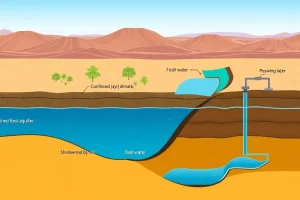
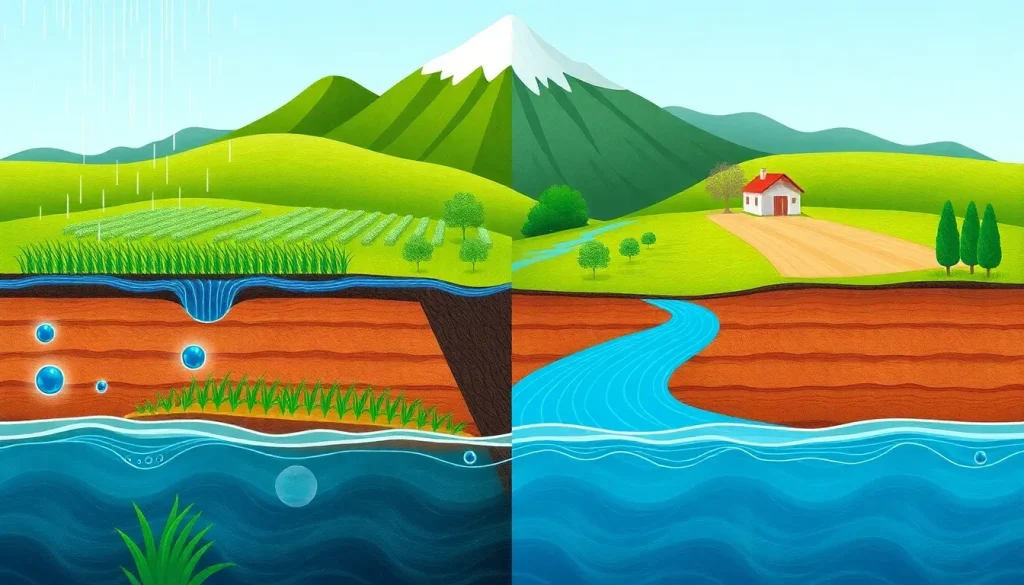
Precipitation is the starting point for both green and blue water. When rain falls on land, it partitions into several pathways. Some water runs off directly into streams and rivers (surface runoff), some infiltrates into the ground to recharge aquifers (groundwater), and some is intercepted by vegetation or stored in the soil. The water that enters the soil and is later taken up by plant roots or evaporates from the soil surface is considered green water. The water that flows into rivers, lakes, and aquifers is blue water. Globally, about 65% of precipitation becomes green water, while 35% becomes blue water, though this ratio varies significantly by region and climate.
Green water is essentially the “invisible” water that sustains terrestrial ecosystems and rainfed agriculture. It is not directly accessible for human withdrawal but is the primary water source for forests, grasslands, and most croplands. Blue water, in contrast, is the “visible” water that can be extracted, stored, and transported for human use. The two are interconnected: green water can become blue water through groundwater discharge into streams, and blue water can be converted to green water when used for irrigation and then evapotranspired by crops.
Importance and Impact
The green-blue water framework has profound implications for water management and food security. Globally, rainfed agriculture—which relies entirely on green water—accounts for about 80% of cultivated land and produces 60–70% of the world’s food. In many regions, especially in sub-Saharan Africa and parts of Asia, green water is the only source of water for crop production. Ignoring green water in water resource assessments leads to an incomplete picture of water availability and can result in policies that overemphasize irrigation (blue water) at the expense of soil and water conservation practices that enhance green water productivity.
Blue water, while more visible and manageable, is under increasing pressure from population growth, industrialization, and climate change. Over-extraction of groundwater and rivers has led to depletion of aquifers, reduced streamflows, and ecosystem degradation. The green-blue water concept encourages integrated water resource management that considers the entire water cycle, promoting practices such as rainwater harvesting, soil moisture conservation, and efficient irrigation to optimize the use of both water types.
Regional Differences in Green and Blue Water Availability
The distribution of green and blue water varies significantly across the globe due to climate, soil, and vegetation patterns. In humid tropical regions, abundant rainfall generates large amounts of both green and blue water, supporting dense vegetation and high river flows. In arid and semi-arid regions, precipitation is low and highly variable, resulting in limited green water and intermittent blue water. Here, soil moisture conservation is critical for any vegetation or rainfed crops.
In temperate zones, seasonal variations influence the partitioning: during wet seasons, excess green water may recharge groundwater and streams, while dry seasons see reliance on stored blue water. In monsoon climates, intense rainfall can cause high runoff, reducing the proportion that becomes green water. Understanding these regional differences helps tailor water management strategies—for example, promoting water harvesting in drylands or managing floodwaters in humid areas to enhance green water storage.
Connections to Other Systems
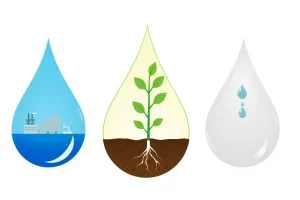
The green-blue water concept is closely linked to the water footprint, a tool developed by Arjen Hoekstra that measures the total volume of freshwater used to produce goods and services. The water footprint distinguishes between green, blue, and grey water (polluted water). This allows consumers and businesses to understand the hidden water use in products like food, clothing, and energy. For instance, the water footprint of a crop includes the green water consumed by the plant and the blue water used for irrigation.
Additionally, green and blue water are integral to ecosystem services. Green water supports primary productivity, carbon sequestration, and biodiversity in terrestrial ecosystems. Blue water sustains aquatic habitats, fisheries, and provides water for human settlements. Climate change alters the balance between green and blue water by shifting precipitation patterns, increasing evaporation, and intensifying droughts and floods, making the framework essential for climate adaptation planning.
Benefits, Limitations and Trade-offs
The green-blue water framework offers several benefits for water management. It provides a more complete picture of water resources, highlighting the importance of soil moisture and rainfed agriculture. This can lead to better policies that support smallholder farmers and ecosystem conservation. It also helps in assessing the water footprint of products and identifying opportunities for water savings along supply chains.
However, the framework has limitations. Green water is difficult to measure and monitor compared to blue water, as it involves soil moisture dynamics and evapotranspiration rates that vary spatially and temporally. This data scarcity can hinder its integration into policy. Additionally, there are trade-offs: increasing green water use for crops may reduce blue water availability downstream, affecting other users and ecosystems. Balancing the allocation between green and blue water requires careful management and consideration of local conditions.
Common Misconceptions
FAQ
What is green water?
Green water is the precipitation that infiltrates the soil and is stored in the root zone, later used by plants or evaporated. It is the main water source for rainfed agriculture and natural ecosystems.
What is blue water?
Blue water is the liquid water in rivers, lakes, reservoirs, and aquifers. It can be extracted for human uses like drinking, irrigation, and industry.
Why does the green-blue water distinction matter?
It matters because traditional water management often overlooks green water, which is critical for food production and ecosystem health. Recognizing both types enables more holistic and sustainable water resource planning.
References
- Falkenmark, M. (1995). Coping with water scarcity under rapid population growth. Conference of SADC Ministers, Pretoria.
- Hoekstra, A. Y., & Hung, P. Q. (2002). Virtual water trade: A quantification of virtual water flows between nations in relation to international crop trade. Value of Water Research Report Series No. 11, UNESCO-IHE.
- Water Footprint Network. (n.d.). What is a water footprint? Retrieved from https://waterfootprint.org/en/water-footprint/what-is-water-footprint/