In brief
At a glance
Quick Facts
- Definition
- Critical thresholds where the boreal forest ecosystem may abruptly shift to a non-forest state.
- Key Drivers
- Climate warming, increased wildfires, permafrost thaw, insect outbreaks, and land-use change.
- Carbon Storage
- The boreal forest stores over 30% of the world's terrestrial carbon, mostly in soils and permafrost.
- Warming Rate
- Boreal regions are warming at roughly twice the global average rate due to Arctic amplification.
- Potential Tipping Point
- A shift from coniferous forest to grassland or steppe, releasing large amounts of carbon.
- Fire Feedback
- More frequent fires release carbon and expose permafrost, creating a self-reinforcing warming loop.
- Regional Hotspots
- Western Canada and Alaska have seen the most dramatic warming and fire increases.
- Uncertainties
- Exact thresholds and reversibility are uncertain due to complex interactions and data gaps.
Key Takeaways
- Boreal forest tipping points are critical thresholds where the ecosystem may abruptly shift to a different state, such as from forest to grassland, due to interacting stressors like climate warming, fire, and pests.
- These tipping points could trigger large-scale carbon release from soils and permafrost, amplifying global climate change.
- The boreal forest spans vast regions of Canada, Alaska, Scandinavia, and Russia, and its stability is crucial for global carbon storage, biodiversity, and Indigenous livelihoods.
- While evidence suggests that some boreal regions are approaching tipping points, significant uncertainties remain about the exact thresholds and the reversibility of changes.
What Is Boreal Forest Tipping Points Explained?
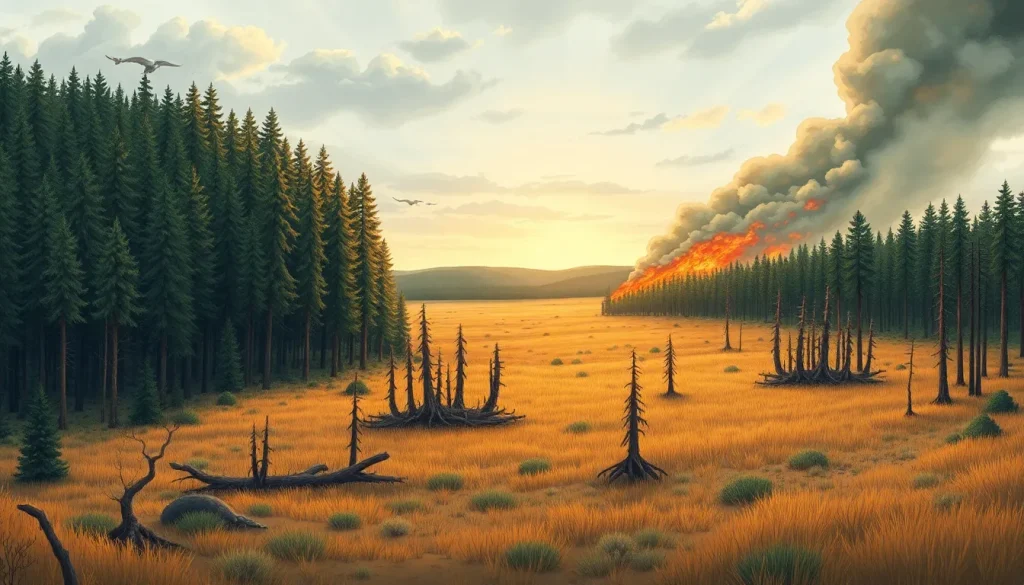
Boreal forest tipping points refer to critical thresholds in the structure and function of the boreal biome—the world’s largest terrestrial biome, encircling the Northern Hemisphere just south of the Arctic Circle. When these thresholds are crossed, the ecosystem may undergo a rapid, self-reinforcing transformation to a fundamentally different state, such as a shift from dense coniferous forest to open woodland, grassland, or even a steppe-like landscape. The concept of tipping points is central to understanding the boreal forest’s vulnerability to climate change and other disturbances, because once a tipping point is passed, the change can be difficult or impossible to reverse on human timescales.
The boreal forest is not a uniform system; it consists of a mosaic of tree species, soils, permafrost, and wetlands that have evolved under cold, often harsh conditions. Tipping points in this biome are typically associated with the loss of resilience—the ability of the ecosystem to absorb disturbances and maintain its fundamental character. When resilience is eroded by factors such as rising temperatures, increased fire frequency, insect outbreaks, or permafrost thaw, the forest may cross a threshold into an alternative stable state. Understanding these tipping points is essential for predicting the future of the boreal forest and its role in the global climate system.
How It Works
The boreal forest ecosystem is maintained by a delicate balance of climate, soil, and disturbance regimes. Tipping points occur when positive feedback loops overwhelm the system’s capacity to recover. For example, warming temperatures can lead to more frequent and severe wildfires. Fires release carbon stored in trees and soil, which adds to atmospheric greenhouse gases, causing further warming—a classic positive feedback. Additionally, fires can remove the protective organic layer on the forest floor, exposing permafrost to thaw. Thawing permafrost releases methane and carbon dioxide, potent greenhouse gases, which accelerate warming even more. This self-reinforcing cycle can push the forest past a threshold where tree regeneration fails, and the landscape transitions to a non-forested state.

Another mechanism involves insect outbreaks. Warmer winters allow bark beetles and other pests to survive and expand their range, leading to widespread tree mortality. Dead trees become fuel for fires, and the loss of canopy cover alters the microclimate, making the area drier and less suitable for forest regrowth. In some regions, the combination of fire, insects, and drought can shift the ecosystem from a carbon sink to a carbon source, further amplifying climate change. These feedback loops are the engine of tipping point dynamics, and they can operate at local to regional scales.
Main Causes or Drivers
The primary driver of boreal forest tipping points is climate change, particularly the rapid warming observed at high northern latitudes. The Arctic and boreal regions are warming at roughly twice the global average rate, a phenomenon known as Arctic amplification. This warming leads to a cascade of effects: increased drought stress on trees, more frequent and intense wildfires, permafrost degradation, and insect outbreaks. Each of these stressors can independently weaken the forest, but their interactions are what push the system toward a tipping point.
Land-use change, such as logging, mining, and infrastructure development, also contributes by fragmenting the forest and altering local hydrology. In some areas, industrial activities have removed large tracts of mature forest, reducing the ecosystem’s ability to buffer against climate impacts. Additionally, changes in snow cover and albedo (the reflectivity of the land surface) play a role. As forests are replaced by grasslands or shrubs, the surface becomes darker in winter, absorbing more solar radiation and further warming the region. These drivers are often interconnected, making the boreal forest a complex system with multiple potential tipping points.
What the Evidence Shows
Scientific research has identified several indicators that the boreal forest may be approaching tipping points in certain regions. Satellite data show that tree growth has declined in parts of the southern boreal zone due to drought stress, while tree mortality has increased. In interior Alaska and western Canada, large-scale diebacks of aspen and spruce have been documented, linked to hot, dry conditions and insect attacks. Fire records indicate that the frequency and severity of wildfires in the boreal forest have increased, with some areas experiencing fire return intervals that are too short for trees to regenerate.
Paleoecological studies, which examine past ecosystem changes preserved in lake sediments and peat, reveal that the boreal forest has undergone dramatic shifts in response to past climate changes. For instance, during the warm period of the early Holocene, the treeline advanced northward, and in some regions, forest was replaced by tundra or steppe when conditions became too dry. These historical precedents suggest that the boreal forest is capable of rapid, non-linear change. However, current rates of warming are unprecedented, and the combination of climate change with human land use may create novel conditions with no direct analog in the past.
Importance and Impact
The boreal forest plays a critical role in the global climate system. It stores vast amounts of carbon—estimated at over 30% of the world’s terrestrial carbon—in its trees, soils, and permafrost. If tipping points are crossed and large areas of forest are lost or degraded, this carbon could be released into the atmosphere, significantly accelerating global warming. The boreal forest also influences regional and global climate through its effects on albedo and water cycles. The dark canopy of coniferous trees absorbs solar radiation, but snow-covered forests reflect more light; a shift to a non-forested state could alter this balance in complex ways.
Beyond climate, the boreal forest is home to unique biodiversity, including species adapted to cold environments such as caribou, lynx, and billions of migratory birds. Indigenous peoples have lived in and relied on the boreal forest for millennia, depending on its resources for food, medicine, and cultural practices. Tipping points that transform the forest would have profound consequences for these communities, disrupting traditional ways of life and economic activities like hunting, fishing, and forestry. The loss of ecosystem services, such as water purification and flood regulation, would also affect downstream populations.
Regional Differences
The boreal forest is not a monolith; its vulnerability to tipping points varies by region due to differences in climate, species composition, permafrost extent, and disturbance history. In North America, the boreal forest spans from Alaska to Newfoundland, with a gradient from cold, continuous permafrost in the north to warmer, discontinuous permafrost in the south. The western boreal, particularly in Canada and Alaska, has experienced some of the most dramatic warming and fire increases, making it a hotspot for potential tipping points. In contrast, the eastern Canadian boreal is generally wetter and less fire-prone, but it faces threats from insect outbreaks like the spruce budworm.
In Eurasia, the vast Russian taiga covers Siberia and extends into Scandinavia. Siberia’s boreal forest is underlain by extensive permafrost, which contains enormous carbon stores. Thawing permafrost in this region is a major concern, as it could release methane from previously frozen organic matter. The Scandinavian boreal forest, while also warming, has a milder climate and a long history of intensive forest management, which may buffer some impacts but also reduce natural resilience. Regional differences in governance, fire management, and conservation efforts further influence the likelihood and consequences of tipping points.
Data Limitations and Uncertainties
Despite growing evidence, significant uncertainties remain in predicting boreal forest tipping points. One major challenge is the complexity of the system: multiple interacting drivers, feedback loops, and threshold behaviors are difficult to capture in models. Climate models project continued warming, but the precise regional changes in precipitation, fire weather, and permafrost dynamics are uncertain. Ecological models struggle to simulate the adaptive capacity of tree species and the potential for migration or genetic adaptation.
Observational data are sparse in many remote boreal regions, particularly in Siberia, limiting our ability to detect early warning signals of tipping points. Long-term monitoring networks are essential but often underfunded. Additionally, the concept of tipping points itself is debated; some scientists argue that ecosystem changes may be more gradual or that alternative stable states are not always clearly defined. These uncertainties underscore the need for precautionary management and further research to better understand the risks and to develop strategies for maintaining boreal forest resilience.
FAQ
What are boreal forest tipping points?
They are critical thresholds where the boreal forest ecosystem may abruptly shift to a different state, such as from forest to grassland, due to factors like warming, fires, and permafrost thaw.
How do boreal forest tipping points work?
They are driven by positive feedback loops: for example, warming causes more fires, which release carbon and thaw permafrost, leading to more warming and further forest loss, potentially crossing a threshold where recovery is impossible.
Why do boreal forest tipping points matter?
They matter because the boreal forest stores vast amounts of carbon; crossing a tipping point could release that carbon, accelerating global climate change, and would also threaten biodiversity and Indigenous livelihoods.
References
- Intergovernmental Panel on Climate Change (IPCC) Special Report on Climate Change and Land
- NASA Earth Observatory: Boreal Forest
- National Geographic: Boreal Forest