In brief
At a glance
Quick Facts
- Status
- Six of nine boundaries transgressed as of 2023
- Control variable
- Multiple, process-specific indicators (e.g., CO2 concentration, extinction rate, nitrogen flow)
- Proposed boundary
- Holocene-range limits; e.g., 350 ppm CO2, <10 E/MSY extinction rate
- Current value
- CO2 ~417 ppm (2022); extinction rate >100 E/MSY; N fixation ~190 Tg N/yr
- Pre-industrial baseline
- Holocene average conditions (last 10,000 years)
Current status
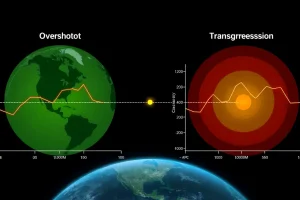
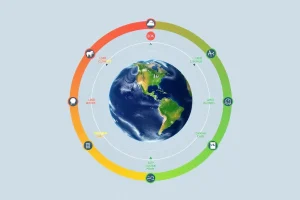
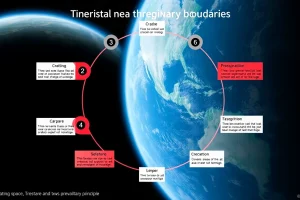
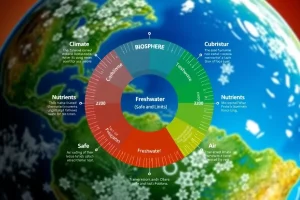
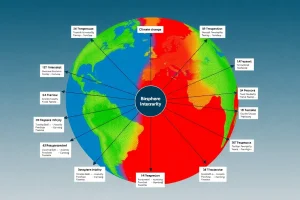
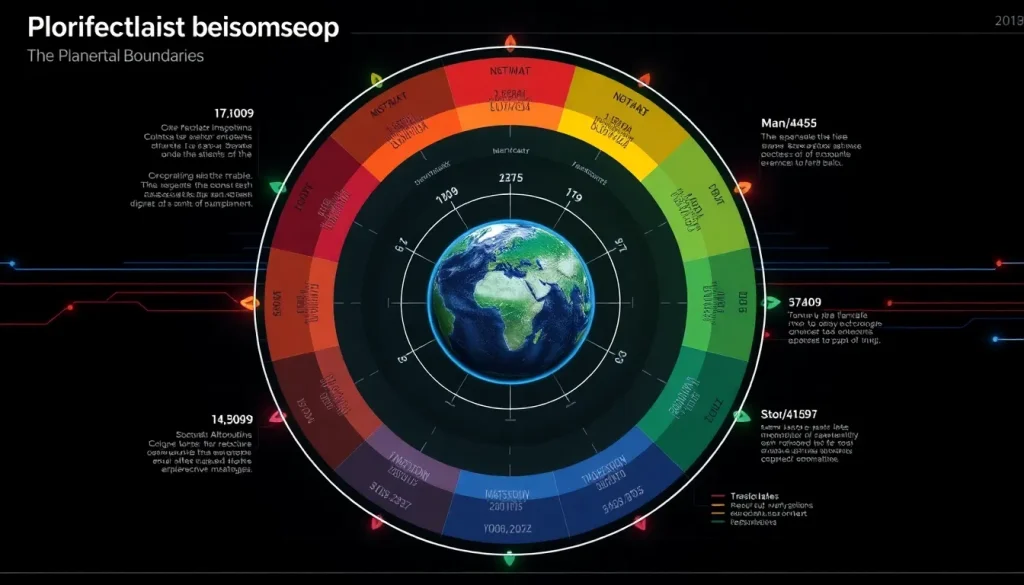
As of the latest comprehensive assessment in 2023, six of the nine planetary boundaries are considered transgressed: climate change, biosphere integrity (genetic diversity and functional integrity), land-system change, freshwater change, biogeochemical flows (nitrogen and phosphorus), and novel entities (including plastics and synthetic chemicals). The remaining three—stratospheric ozone depletion, atmospheric aerosol loading, and ocean acidification—are currently within their safe operating zones, though ocean acidification is approaching its boundary. The overall framework indicates that Earth has moved beyond the Holocene-like conditions that prevailed for the past 10,000 years, entering a less stable and less predictable state due to human pressures.
Control variable
Each planetary boundary is associated with one or more control variables—measurable quantities that track the state of the underlying Earth-system process. For example, climate change is tracked by atmospheric CO2 concentration (ppm) and total radiative forcing (W/m2); biosphere integrity by genetic diversity (extinction rate) and functional integrity (e.g., Human Appropriated Net Primary Production, or HANPP); and freshwater change by human consumption of blue water and green water (km3/yr) and their deviations from pre-industrial conditions. Control variables are selected based on their ability to capture the core dynamics of the process, their sensitivity to human perturbation, and the availability of reliable data. In some cases, multiple variables are used to reflect different dimensions of a boundary (e.g., both nitrogen and phosphorus flows for biogeochemical cycles).
Proposed boundary or threshold
The proposed safe boundary for each control variable is typically set at a value that maintains the Earth system within the Holocene-like range of variability, which is considered the safe operating space for humanity. For boundaries with clear global thresholds (e.g., climate change, stratospheric ozone depletion), the boundary is placed at a level that avoids crossing a known tipping point. For example, the climate change boundary is set at 350 ppm CO2 and a radiative forcing of +1.0 W/m2 relative to pre-industrial levels. For boundaries without a well-defined global threshold, the boundary is often defined using a precautionary approach, such as keeping the control variable within the Holocene range or limiting the percentage of global land area affected. In the 2023 update, many boundaries were refined to include sub-global thresholds (e.g., for freshwater change, the boundary is defined as the percentage of global land area where deviations exceed regional safe limits).
Current measured value
The current values of key control variables, as of the 2023 assessment, are: atmospheric CO2 concentration ~417 ppm (2022) vs. boundary 350 ppm; genetic diversity (extinction rate) >100 extinctions per million species-years (E/MSY) vs. boundary <10 E/MSY; functional integrity (measured by HANPP) ~30% of net primary production vs. boundary <10% (preliminary); land-system change (global forest area remaining) ~60% vs. boundary 75%; freshwater change (blue water consumption) ~2,600 km3/yr vs. boundary 4,000 km3/yr (but regional transgressions widespread); biogeochemical flows: phosphorus flow to ocean ~22 Tg P/yr vs. boundary 11 Tg P/yr, industrial nitrogen fixation ~190 Tg N/yr vs. boundary 62 Tg N/yr; novel entities: boundary transgressed due to widespread release of synthetic chemicals and plastics; stratospheric ozone depletion: within safe zone; atmospheric aerosol loading: within safe zone (regional); ocean acidification: current saturation state (Ωarag) ~2.8 vs. boundary 2.75 (approaching).
How the boundary is calculated
The measurement of planetary boundaries involves a multi-step process. First, scientists identify the key Earth-system processes that regulate the stability of the planet. For each process, they select one or more control variables that can be quantified using observational data or model outputs. The safe boundary value is then determined by analyzing the Holocene variability of that variable (the range over the past ~10,000 years) and, where possible, identifying critical thresholds or tipping points beyond which the system may shift into a new state. For global-scale boundaries like climate change, Earth-system models of intermediate complexity are used to simulate the response of the climate to different forcing levels. For sub-global boundaries, such as freshwater change or land-system change, the global boundary is often an aggregation of regional assessments: the percentage of global land area where the control variable exceeds a locally defined safe limit. Data sources include ice-core records, satellite observations, global monitoring networks, and process-based models. The methodology has evolved from the original 2009 framework, with the 2015 and 2023 updates incorporating more spatially explicit and process-based approaches.
Historical trend
The concept of planetary boundaries was first proposed in 2009 by Rockström et al., who identified nine boundaries and suggested that three (climate change, biodiversity loss, and nitrogen cycle) had already been transgressed. In the 2015 update by Steffen et al., the framework was refined: the biodiversity boundary was replaced by biosphere integrity (genetic and functional), land-system change was redefined, and the phosphorus and nitrogen cycles were merged into biogeochemical flows. At that time, four boundaries were assessed as transgressed (climate change, biosphere integrity, land-system change, and biogeochemical flows). The 2023 assessment by Richardson et al. introduced the novel entities boundary and provided the first quantification for freshwater change and atmospheric aerosol loading. It concluded that six boundaries are now transgressed, with ocean acidification approaching its limit. This trend reflects both improved scientific understanding and increasing human pressures on the Earth system.
What is driving the change
The primary driver of transgression across multiple planetary boundaries is human activity, particularly since the Industrial Revolution. Key drivers include: fossil fuel combustion and land-use change (climate change, ocean acidification, biosphere integrity, land-system change); industrial agriculture and fertilizer use (biogeochemical flows, freshwater change, biosphere integrity); production and release of synthetic chemicals and plastics (novel entities); and deforestation and habitat conversion (land-system change, biosphere integrity). These drivers are interconnected and often amplify one another through feedback loops. For example, deforestation contributes to climate change, biodiversity loss, and freshwater cycle disruption simultaneously.
What crossing the boundary means
Crossing a planetary boundary does not imply an immediate catastrophe but rather a shift from a safe operating space to a zone of increasing risk. The Earth system may exhibit non-linear responses, including tipping points where a small additional perturbation triggers a large, often irreversible change. For instance, continued climate change could trigger the collapse of the Greenland ice sheet or the Amazon rainforest dieback. Transgression of the biosphere integrity boundary undermines the resilience of ecosystems, reducing their capacity to provide essential services such as carbon sequestration, water purification, and pollination. Exceeding the biogeochemical flows boundary leads to eutrophication, dead zones in coastal waters, and disruption of global nutrient cycles. The novel entities boundary is considered transgressed because the rate of introduction of new substances far exceeds society’s ability to assess and manage their risks, leading to unknown long-term effects on Earth-system functioning.
Regional variations
Several planetary boundaries are inherently global (e.g., climate change, stratospheric ozone depletion, ocean acidification), but others exhibit significant regional heterogeneity. Freshwater change is assessed using regional boundaries for surface water and groundwater, with the global boundary transgressed if a sufficient fraction of the world’s land area exceeds local safe limits. Similarly, land-system change is measured by the extent of forest cover remaining in key biomes (tropical, temperate, boreal), with the global boundary based on aggregate forest area. Biogeochemical flows have strong regional patterns, with nitrogen and phosphorus pollution concentrated in agricultural regions. The biosphere integrity boundary is assessed globally, but biodiversity loss and ecosystem degradation are highly uneven. The framework acknowledges that some boundaries must be managed at both global and regional scales to be effective.
Interaction with other boundaries
Planetary boundaries are not independent; they interact in complex ways. For example, climate change exacerbates biodiversity loss, alters freshwater availability, and accelerates ocean acidification. Land-system change contributes to climate change, biodiversity loss, and freshwater cycle disruption. Biogeochemical flows (excess nitrogen and phosphorus) degrade water quality and contribute to biodiversity loss. The transgression of one boundary can push others further into the risk zone, creating cascading effects. The 2015 and 2023 assessments emphasize that the boundaries are interconnected and that a systems approach is necessary to avoid unintended consequences of addressing one boundary in isolation.
Impacts on people and ecosystems
Transgressing planetary boundaries directly threatens human well-being and ecosystem integrity. Climate change increases the frequency and intensity of extreme weather events, sea-level rise, and food insecurity. Biodiversity loss reduces ecosystem resilience and the provision of services such as pollination, pest control, and nutrient cycling. Freshwater scarcity affects drinking water supplies, agriculture, and energy production. Pollution from novel entities and excess nutrients harms human health and aquatic life. The combined effect of multiple boundary transgressions can amplify risks, particularly for vulnerable populations and developing countries. Maintaining the Earth system within the safe operating space is considered a prerequisite for sustainable development.
Possible pathways back toward the safe zone
Returning to the safe operating space requires transformative changes across multiple sectors. Key strategies include: rapid decarbonization of the global economy to reduce greenhouse gas emissions; sustainable land management, reforestation, and protection of intact ecosystems; circular economy approaches to reduce nutrient pollution and synthetic chemical release; improved water management and efficiency; and international cooperation to set binding targets. The planetary boundaries framework is intended to guide policy by providing science-based targets. For example, the climate boundary aligns with the Paris Agreement goal of limiting warming to well below 2°C. Achieving these targets demands systemic shifts in energy, food, and economic systems.
Scientific uncertainty
Significant uncertainties remain in the planetary boundaries framework. For some boundaries, the precise position of the threshold is unknown or debated (e.g., the exact CO2 level that avoids dangerous climate change). For others, the control variable is a proxy that may not fully capture the system’s complexity (e.g., extinction rate as a measure of biosphere integrity). The interaction between boundaries is poorly quantified, and the time lags between transgression and observable impacts are uncertain. The 2023 assessment acknowledges that some boundaries are based on expert judgment and precautionary principles rather than hard thresholds. Ongoing research aims to reduce these uncertainties through improved Earth-system modeling, paleoclimate data, and long-term monitoring.
Criticism and alternative frameworks
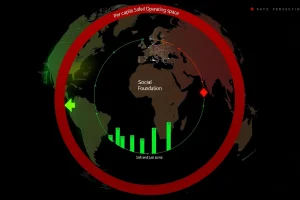
The planetary boundaries framework has been criticized on several grounds. Some scientists argue that the global boundaries oversimplify complex, regionally heterogeneous processes and that a focus on global limits may distract from local environmental management. Others question the choice of control variables and the scientific basis for specific boundary values. The concept of a single safe operating space has been challenged by those who emphasize the need for context-specific sustainability targets. Alternative frameworks include the “doughnut economics” model by Kate Raworth, which combines planetary boundaries with social foundations, and the “safe and just Earth system boundaries” approach, which incorporates justice considerations. Despite criticisms, the planetary boundaries framework remains influential in Earth-system science and policy, providing a high-level synthesis of the state of the planet.
FAQ
What is a planetary boundary?
A planetary boundary is a scientifically defined limit for a key Earth-system process that, if transgressed, risks destabilizing the planet's environment and undermining the safe operating space for humanity. The framework identifies nine such boundaries.
How are control variables chosen?
Control variables are selected based on their ability to represent the core dynamics of an Earth-system process, their sensitivity to human pressures, and the availability of reliable observational or model data. They are intended to be measurable and policy-relevant.
Why are some boundaries already transgressed?
Human activities such as fossil fuel burning, deforestation, and industrial agriculture have pushed several Earth-system processes beyond their Holocene ranges. The transgression indicates that the risk of destabilizing the Earth system is increasing, though it does not mean immediate catastrophe.
References
- Rockström, J., Steffen, W., Noone, K., et al. (2009). A safe operating space for humanity. Nature, 461, 472–475.
- Steffen, W., Richardson, K., Rockström, J., et al. (2015). Planetary boundaries: Guiding human development on a changing planet. Science, 347(6223), 1259855.
- Richardson, K., Steffen, W., Lucht, W., et al. (2023). Earth beyond six of nine planetary boundaries. Science Advances, 9(37), eadh2458.
- Lenton, T. M., Rockström, J., Gaffney, O., et al. (2019). Climate tipping points — too risky to bet against. Nature, 575, 592–595.
- Persson, L., Carney Almroth, B. M., Collins, C. D., et al. (2022). Outside the safe operating space of the planetary boundary for novel entities. Environmental Science & Technology, 56(3), 1510–1521.