In brief
At a glance
Quick Facts
- Status
- Six of nine planetary boundaries are transgressed (2023); carrying capacity estimates vary widely and are not globally agreed.
- Control variable
- Planetary boundaries: Earth-system process variables (e.g., atmospheric CO₂ concentration). Carrying capacity: population size or resource consumption.
- Proposed boundary
- Planetary boundaries: safe operating space defined for each process (e.g., 350 ppm CO₂). Carrying capacity: maximum sustainable population, no single global value.
- Current value
- Six boundaries transgressed (2023). Human carrying capacity estimates range from 0.5 to 1,000 billion.
- Pre-industrial baseline
- Holocene epoch (last 11,700 years) for planetary boundaries; pre-industrial human population ~1 billion for carrying capacity context.
Current status
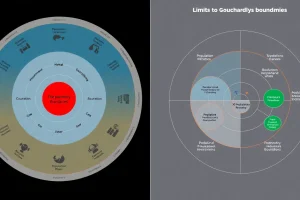
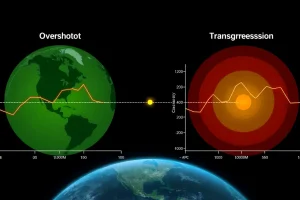
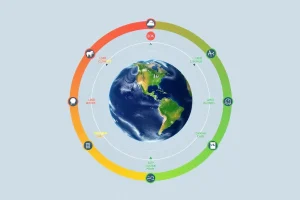
The planetary boundaries framework, first proposed in 2009 and updated in 2015 and 2023, identifies nine Earth-system processes that regulate the stability and resilience of the planet. As of the 2023 assessment, six of these nine boundaries are transgressed: climate change, biosphere integrity (genetic diversity and functional integrity), land-system change, freshwater change, biogeochemical flows (nitrogen and phosphorus), and novel entities (including synthetic chemicals and plastics). The remaining three—stratospheric ozone depletion, atmospheric aerosol loading, and ocean acidification—are currently within the safe operating space, though ocean acidification is approaching its boundary. In contrast, the concept of carrying capacity, which originated in ecology and was later applied to human populations, does not have a single global status. Estimates of Earth’s human carrying capacity range from fewer than 1 billion to more than 1 trillion, depending on assumptions about technology, consumption patterns, and the definition of a sustainable standard of living. The planetary boundaries framework thus provides a more structured and empirically grounded assessment of global environmental limits, while carrying capacity remains a contested and often locally defined metric.
Control variable
In the planetary boundaries framework, each boundary is associated with a specific control variable—a measurable quantity that reflects the state of an Earth-system process. For example, the climate change boundary uses atmospheric CO₂ concentration (in parts per million) and radiative forcing (in watts per square meter) as control variables. The biosphere integrity boundary uses genetic diversity (extinction rate) and functional integrity (e.g., the Biodiversity Intactness Index). These variables are chosen because they are sensitive to human perturbation and have known or suspected thresholds beyond which the Earth system may shift to a different state. In contrast, carrying capacity typically uses population size or density as the primary variable, often expressed as the maximum number of individuals of a species that an environment can support without degradation. For human carrying capacity, the variable is often total human population or per capita resource consumption, sometimes aggregated into metrics like the ecological footprint. The key difference is that planetary boundaries focus on the state of Earth-system processes, while carrying capacity focuses on the number of organisms relative to resources.
Proposed boundary or threshold
Planetary boundaries propose a safe operating space defined by a boundary value for each control variable. This boundary is set at a level that aims to avoid crossing critical thresholds and maintain Holocene-like conditions. For instance, the climate change boundary is proposed at 350 ppm CO₂, with a zone of increasing risk between 350 and 450 ppm. The framework distinguishes between a safe boundary and a high-risk zone, acknowledging uncertainty. Carrying capacity, on the other hand, proposes a maximum sustainable population size, often without a clear distinction between safe and dangerous levels. For human populations, carrying capacity is not a fixed number but depends on per capita resource use, technology, and social organization. Some estimates suggest a sustainable global population of 1.5–3 billion at a modest standard of living, while others argue that with technological advances, Earth could support 10 billion or more. The planetary boundaries framework does not prescribe a population limit but instead defines limits for the pressures that human activities exert on the Earth system.

Current measured value
For planetary boundaries, the current measured values of control variables indicate widespread transgression. Atmospheric CO₂ concentration is approximately 420 ppm (2023), well above the 350 ppm boundary. The rate of species extinction is estimated to be tens to hundreds of times higher than the background rate, placing the genetic diversity boundary in the high-risk zone. Nitrogen and phosphorus flows to the biosphere and oceans have more than doubled relative to pre-industrial levels, exceeding their respective boundaries. In contrast, there is no single current measured value for global human carrying capacity. Estimates vary enormously: ecological footprint analyses suggest that humanity is already in overshoot, using the equivalent of 1.7 Earths (Global Footprint Network, 2023). However, this is a measure of resource demand, not a carrying capacity per se. The wide range of carrying capacity estimates reflects fundamental disagreements about the substitutability of natural capital and the potential for technological innovation.
How the boundary is calculated
Planetary boundaries are calculated using a combination of Earth-system models, paleoclimatic data, and expert elicitation. For each boundary, scientists identify a critical threshold or tipping point based on observed responses in the geological record or model simulations. The boundary is then set at a safe distance from that threshold, often using the precautionary principle. For example, the climate boundary is informed by the relationship between CO₂ concentration and global temperature in past climates, such as the Pliocene. The novel entities boundary is assessed using a weight-of-evidence approach due to the complexity of chemical pollution. Carrying capacity is typically calculated using resource budgets: the total available supply of food, water, energy, or land is divided by per capita demand. More sophisticated approaches use systems dynamics models (e.g., World3 model used in The Limits to Growth) or integrated assessment models. However, these calculations are highly sensitive to assumptions about future technology, consumption patterns, and environmental feedbacks, making them less robust than the planetary boundaries approach for defining global limits.
Historical trend
The planetary boundaries framework shows a clear historical trend: most boundaries were well within the safe operating space during the Holocene (the last 11,700 years) but have been increasingly transgressed since the Industrial Revolution, with acceleration after the 1950s (the Great Acceleration). For example, atmospheric CO₂ has risen from ~280 ppm pre-industrial to over 420 ppm today. The concept of carrying capacity has a longer intellectual history, dating back to Thomas Malthus’s 1798 essay on population growth and food supply. In the 20th century, the idea was revived by ecologists and applied to human populations, notably in the 1972 report The Limits to Growth. The planetary boundaries framework, introduced in 2009, represents a shift from a population-centric view to an Earth-system-centric view, emphasizing that the key issue is not just how many people but how they consume and produce.
What is driving the change
Human activities are the primary drivers pushing planetary boundaries toward or past their safe limits. These include fossil fuel combustion, deforestation, intensive agriculture, industrial production, and the release of synthetic chemicals. The underlying drivers are population growth, economic growth, and consumption patterns, often summarized by the IPAT equation (Impact = Population × Affluence × Technology). Carrying capacity is also driven by these factors, but the planetary boundaries framework highlights that different boundaries are driven by different combinations of pressures. For instance, climate change is mainly driven by CO₂ emissions from energy and land use, while biogeochemical flows are driven by fertilizer use. The framework thus provides a more nuanced understanding of how specific human activities affect different Earth-system processes, rather than attributing all impacts to population size alone.
What crossing the boundary means
Crossing a planetary boundary does not imply an immediate catastrophe but rather that the Earth system moves into a zone of increasing risk, where the likelihood of triggering non-linear, abrupt, or irreversible changes rises significantly. These changes include tipping points such as the collapse of the Greenland ice sheet, dieback of the Amazon rainforest, or disruption of ocean circulation patterns. Such events could fundamentally alter the Earth system and undermine human well-being. Exceeding carrying capacity, in classical terms, leads to resource depletion, population decline, and ecosystem degradation. However, the planetary boundaries framework emphasizes that the consequences are not just local or gradual but can involve global-scale feedbacks that threaten the stability of the entire Earth system, potentially making the planet less habitable for future generations.
Regional variations
Several planetary boundaries have strong regional dimensions. Freshwater use, land-system change, and biogeochemical flows are assessed at both global and sub-global scales because their impacts depend on spatial patterns. For example, the freshwater boundary is transgressed in many river basins even if the global aggregate is within limits. The framework acknowledges that some boundaries must be defined regionally to capture the risk of local tipping points. Carrying capacity is inherently regional or local, as it depends on the specific resources and environmental conditions of an area. A region with abundant water and fertile soil can support a higher population density than an arid region. The planetary boundaries framework attempts to aggregate regional transgressions to a global level, but this aggregation remains a methodological challenge and a source of uncertainty.
Interaction with other boundaries
Planetary boundaries are not independent; they interact in complex ways. For instance, climate change exacerbates biosphere loss through habitat shifts and extreme events, while land-system change contributes to climate change via deforestation and also reduces biosphere integrity. Nitrogen and phosphorus flows contribute to freshwater eutrophication and ocean acidification. These interactions can create positive feedback loops that amplify the overall risk. Carrying capacity models often treat resources (food, water, energy) separately or assume simple additive effects, but the planetary boundaries framework explicitly recognizes that transgressing one boundary can increase the likelihood of transgressing others, potentially pushing the Earth system toward a planetary threshold.
Impacts on people and ecosystems
Transgressing planetary boundaries has profound consequences for human societies and ecosystems. Climate change leads to more frequent extreme weather events, sea-level rise, and disruptions to food production. Biosphere integrity loss undermines pollination, pest control, and other ecosystem services. Freshwater scarcity affects drinking water supplies and agriculture. These impacts disproportionately affect vulnerable populations and can exacerbate poverty, migration, and conflict. Exceeding carrying capacity can result in famine, resource wars, and societal collapse, as documented in historical cases. The planetary boundaries framework provides a more comprehensive risk assessment by linking multiple environmental pressures to the stability of the Earth system as a whole, highlighting that the well-being of current and future generations depends on staying within a safe operating space.
Possible pathways back toward the safe zone
Returning to the safe operating space requires transformative changes in human systems. For climate change, this means rapid decarbonization of the global economy, transitioning to renewable energy, and enhancing carbon sinks. For biosphere integrity, it requires protecting and restoring natural habitats, sustainable agriculture, and reducing pollution. For biogeochemical flows, it involves improving nutrient use efficiency and reducing fertilizer runoff. These actions must be coupled with changes in consumption patterns, including dietary shifts and circular economy principles. While carrying capacity–based approaches often emphasize population stabilization or reduction, the planetary boundaries framework suggests that both population and per capita consumption must be addressed, but within the context of specific environmental limits. Policy options include carbon pricing, protected area expansion, and international agreements like the Paris Agreement and the Kunming-Montreal Global Biodiversity Framework.
Scientific uncertainty
Both concepts involve significant scientific uncertainty. For planetary boundaries, key uncertainties include the exact position of thresholds, the interactions among boundaries, and the regional heterogeneity of some processes. The framework addresses this by defining a zone of increasing risk rather than a hard cliff. For novel entities and atmospheric aerosol loading, the boundaries are particularly uncertain due to limited data and complex effects. Carrying capacity estimates are even more uncertain because they depend on assumptions about future technology, resource substitutability, and human preferences. Critics argue that carrying capacity is not a useful concept for human populations because human ingenuity can expand limits. The planetary boundaries framework acknowledges uncertainty but provides a more structured and precautionary approach to defining a safe operating space based on Earth-system science.
Criticism and alternative frameworks
The planetary boundaries framework has faced criticism for its arbitrary boundary placement, the difficulty of defining global thresholds for some processes, and the challenge of aggregating regional boundaries. Some scientists argue that the framework oversimplifies complex systems and may lead to policy complacency if boundaries are not transgressed. Alternative or complementary frameworks include the ecological footprint, which measures human demand on nature; the doughnut economics model, which combines planetary boundaries with social foundations; and the safe and just boundaries concept, which incorporates equity considerations. Carrying capacity has been criticized for being overly deterministic, ignoring technological change, and failing to account for the dynamic nature of human-environment interactions. The planetary boundaries framework is seen by many as an evolution beyond carrying capacity, providing a more nuanced and scientifically grounded basis for global sustainability governance.
FAQ
What is the main difference between planetary boundaries and carrying capacity?
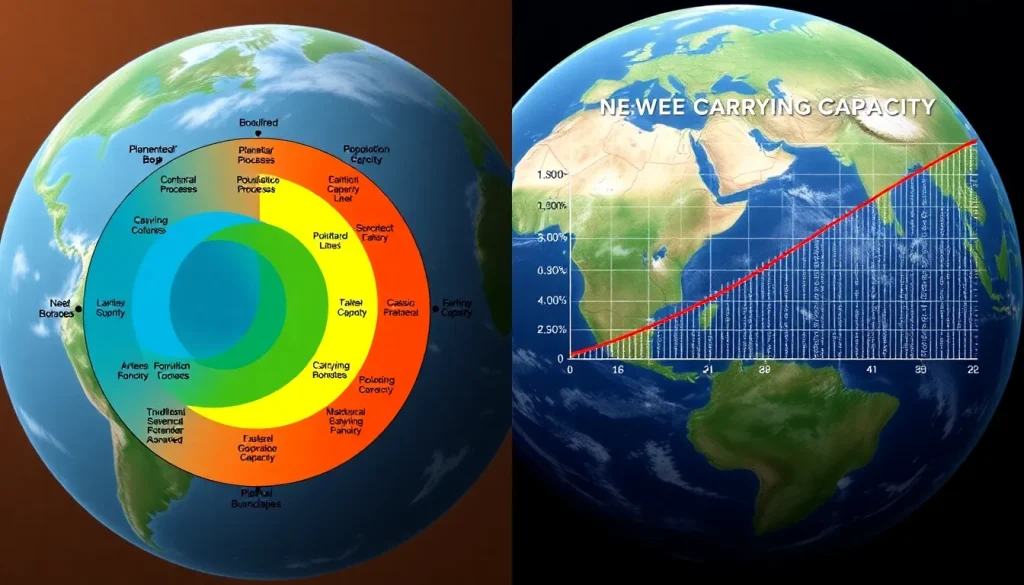
Planetary boundaries define limits for specific Earth-system processes (e.g., climate change, biodiversity loss) to maintain a stable planet, using control variables like CO₂ concentration. Carrying capacity is the maximum population an environment can support based on resource availability. The planetary boundaries framework is more comprehensive, accounting for non-linear thresholds and global systemic risks, while carrying capacity is a simpler, population-focused concept.
Can carrying capacity be applied globally to humans?
Applying carrying capacity globally to humans is highly contested because human carrying capacity depends on technology, consumption patterns, and trade, which can expand local limits. Estimates range from under 1 billion to over 1 trillion, making it an unreliable policy target. The planetary boundaries framework avoids this by focusing on the environmental pressures that human activities generate, rather than on population numbers alone.
How do planetary boundaries relate to the doughnut economics model?
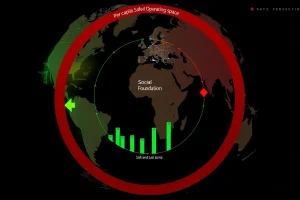
The doughnut economics model, developed by Kate Raworth, combines the planetary boundaries framework (the ecological ceiling) with social foundations (the social floor) to create a safe and just space for humanity. It uses the same nine boundaries but adds dimensions of human well-being, such as food, health, and education, to ensure that sustainability does not come at the expense of social equity.
References
- Rockström, J., et al. (2009). A safe operating space for humanity. Nature, 461, 472–475.
- Steffen, W., et al. (2015). Planetary boundaries: Guiding human development on a changing planet. Science, 347(6223), 1259855.
- Richardson, K., et al. (2023). Earth beyond six of nine planetary boundaries. Science Advances, 9(37), eadh2458.
- Ehrlich, P. R., & Holdren, J. P. (1971). Impact of population growth. Science, 171(3977), 1212–1217.
- Daily, G. C., & Ehrlich, P. R. (1992). Population, sustainability, and Earth's carrying capacity. BioScience, 42(10), 761–771.