In brief
At a glance
Quick Facts
- Status
- Six of nine planetary boundaries transgressed (2023); no country meets all social thresholds within all planetary boundaries
- Control variable
- Multiple: e.g., CO₂ concentration, extinction rate, nitrogen fixation (PB); social indicators and ecological footprints (Doughnut)
- Proposed boundary
- PB: 350 ppm CO₂, 10 E/MSY, 62 Tg N/year; Doughnut: social foundation thresholds + ecological ceiling (same as PB)
- Current value
- CO₂ ~417 ppm (2022); extinction rate >100 E/MSY; global material footprint ~2-3x sustainable level
- Pre-industrial baseline
- Holocene epoch (~11,700 years ago) for PB; Doughnut uses same ecological baselines plus social deprivation baselines
Current status
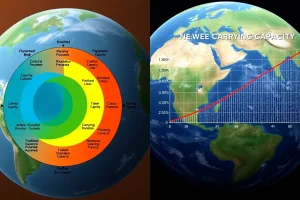
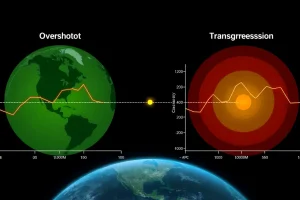
The planetary boundaries framework, first published in 2009 and updated in 2015 and 2023, identifies nine Earth-system processes that regulate the stability and resilience of the planet. As of the 2023 assessment, six of the nine boundaries are transgressed: climate change, biosphere integrity (genetic diversity and functional diversity), land-system change, freshwater change, biogeochemical flows (nitrogen and phosphorus), and novel entities (including plastics and synthetic chemicals). Three boundaries—stratospheric ozone depletion, atmospheric aerosol loading, and ocean acidification—remain within the safe operating space, though ocean acidification is approaching its boundary. The framework does not prescribe a single global status but quantifies the degree of transgression for each process.
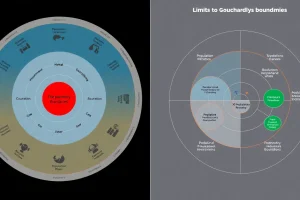
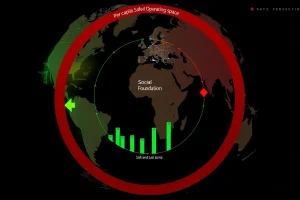
Doughnut Economics, introduced by Kate Raworth in 2012 and expanded in her 2017 book, combines the concept of planetary boundaries (the ecological ceiling) with a set of social foundations (the social floor) derived from the Sustainable Development Goals. The doughnut framework assesses whether humanity is meeting the basic needs of all people within the means of the planet. Current assessments indicate that no country meets all social thresholds while staying within all planetary boundaries simultaneously. Globally, the ecological ceiling is overshot for climate change, biodiversity loss, land-use change, and nitrogen and phosphorus loading, while social shortfalls persist in areas such as food security, health, education, and gender equality.
Control variable
In the planetary boundaries framework, each boundary is defined by one or more control variables—measurable indicators that capture the state of a critical Earth-system process. For example, the climate change boundary uses atmospheric CO₂ concentration (parts per million) and radiative forcing (watts per square metre); the biosphere integrity boundary uses genetic diversity (extinction rate) and functional diversity (Biodiversity Intactness Index). These control variables are chosen for their ability to reflect the risk of triggering non-linear, abrupt, or irreversible environmental change at a global or regional scale.

Doughnut Economics does not use a single control variable. Instead, it defines a set of social foundation indicators (e.g., food security, health, education, income, gender equality, housing, social equity, political voice, peace and justice) and ecological ceiling indicators (aligned with the planetary boundaries). The framework thus operates with multiple variables across two dimensions, measuring both human deprivation and planetary pressure. The “doughnut” itself is the space between the social foundation and the ecological ceiling, where humanity can thrive.
Proposed boundary or threshold
The planetary boundaries framework proposes quantitative boundaries for each Earth-system process at a global or sub-global scale. For example, the climate change boundary is set at 350 ppm CO₂ (with a zone of increasing risk up to 450 ppm) and radiative forcing of +1.0 W/m² (with a danger zone up to +1.5 W/m²). The biosphere integrity boundary for genetic diversity is an extinction rate of less than 10 extinctions per million species-years (E/MSY), with a high-risk zone above 100 E/MSY. For functional diversity, the boundary is set at 90% Biodiversity Intactness Index (BII) for biomes, with a danger threshold of 30% BII. Other boundaries have similar quantitative or semi-quantitative limits.
Doughnut Economics defines the ecological ceiling using the same planetary boundaries, but it also sets a social foundation consisting of twelve social priorities (e.g., sufficient food, clean water, decent sanitation, energy access, healthcare, education, housing, income, gender equality, social equity, political voice, peace and justice). The doughnut’s inner boundary is the social foundation, below which lies critical human deprivation. The outer boundary is the ecological ceiling, beyond which lies unacceptable environmental degradation. The safe and just space for humanity lies between these two boundaries.
Current measured value
For the planetary boundaries, the 2023 update by Richardson et al. reports that the control variable for climate change (atmospheric CO₂ concentration) is approximately 417 ppm (2022 annual mean), exceeding the proposed boundary of 350 ppm. The genetic diversity component of biosphere integrity is assessed at an extinction rate of over 100 E/MSY, far beyond the boundary of 10 E/MSY. Functional diversity (Biodiversity Intactness Index) is estimated at 84% globally, below the 90% boundary. Biogeochemical flows of nitrogen and phosphorus are severely transgressed, with industrial fixation of nitrogen approximately 150 Tg N/year against a boundary of 62 Tg N/year, and phosphorus flow from freshwater to ocean about 22 Tg P/year against a boundary of 11 Tg P/year. Land-system change is assessed at 62% of original forest cover remaining, below the boundary of 75%. Freshwater change is transgressed for both blue water (consumptive use) and green water (soil moisture). Novel entities are assessed qualitatively as transgressed due to the release of synthetic chemicals and plastics beyond the planet’s capacity to assess and manage them.
For the Doughnut framework, global assessments (e.g., O’Neill et al. 2018, “A good life for all within planetary boundaries”) show that no country currently meets all social thresholds while staying within all planetary boundaries. High-income countries generally meet social thresholds but overshoot multiple planetary boundaries, while low-income countries often stay within boundaries but fail to meet social thresholds. For example, the global material footprint exceeds the sustainable level by a factor of about 2–3, and CO₂ emissions are roughly double the level consistent with the 1.5°C target. At the same time, over 800 million people lack access to sufficient food, and billions lack access to safely managed sanitation or clean cooking fuels.
How the boundary is calculated
Planetary boundaries are calculated using Earth-system models, paleo-climatic data, and expert elicitation. For each process, scientists identify a control variable and a Holocene baseline (the relatively stable epoch of the last 11,700 years). The boundary is set at a distance from the baseline that avoids tipping points or non-linear responses, often using a precautionary principle. For example, the climate boundary of 350 ppm CO₂ is based on paleo-climatic evidence that this level maintained the ice sheets and avoided dangerous sea-level rise. The biosphere integrity boundary uses extinction rates from the fossil record and current species-area relationships. The nitrogen boundary is derived from the amount of reactive nitrogen that can be safely absorbed by ecosystems without causing widespread eutrophication. The methodology has evolved from expert judgment (2009) to more quantitative, spatially explicit assessments (2015, 2023).
Doughnut Economics calculates the social foundation using internationally agreed minimum standards (e.g., Sustainable Development Goals, human rights frameworks). The ecological ceiling is directly adopted from the planetary boundaries framework, with some modifications: Raworth uses nine planetary boundaries but groups them into seven ecological ceiling categories (climate change, ocean acidification, chemical pollution, nitrogen and phosphorus loading, freshwater withdrawals, land conversion, biodiversity loss, air pollution, and ozone layer depletion). The doughnut is a visual and conceptual tool, not a single quantitative model. Assessments of whether countries operate within the doughnut rely on aggregating country-level data for each social and ecological dimension, often using consumption-based environmental footprints to allocate responsibility.
Historical trend
The planetary boundaries framework was first proposed in 2009 by Rockström et al., identifying nine boundaries. At that time, three boundaries were already transgressed: climate change, biodiversity loss, and nitrogen cycle. The 2015 update by Steffen et al. added a regional boundary for freshwater use and redefined land-system change, finding that four boundaries were transgressed (climate change, biosphere integrity, land-system change, and biogeochemical flows). The 2023 update by Richardson et al. introduced a two-tier approach for several boundaries and concluded that six boundaries are now transgressed, with novel entities and freshwater change added to the list. The trend shows a progressive increase in the number of transgressed boundaries and the magnitude of overshoot.
Doughnut Economics emerged in 2012 as a discussion paper and was popularized in Raworth’s 2017 book. The concept built on the planetary boundaries and the SDGs, but its historical trend is not a time series of a single variable. Instead, the doughnut has been applied at global, national, and city levels (e.g., Amsterdam’s City Doughnut). Assessments show that since the mid-20th century, humanity has moved from mostly within the doughnut to a situation where high-income countries overshoot the ecological ceiling while many low-income countries fall short of the social foundation. The global trend is one of simultaneous ecological overshoot and persistent social deficits.
What is driving the change
The transgression of planetary boundaries is driven primarily by human activities: fossil fuel combustion and land-use change (climate change, land-system change), industrial agriculture and fertilizer use (biogeochemical flows, freshwater change), habitat destruction and overexploitation (biosphere integrity), and the proliferation of synthetic chemicals and plastics (novel entities). Underlying drivers include population growth, economic growth models based on resource extraction, consumption patterns, and technological choices.
In the doughnut framework, the same drivers push humanity beyond the ecological ceiling, while social shortfalls are driven by poverty, inequality, lack of access to resources and services, and governance failures. The framework highlights that economic systems focused on GDP growth often exacerbate both ecological overshoot and social inequality, as the benefits of growth are unevenly distributed and the environmental costs are externalized.
What crossing the boundary means
Crossing a planetary boundary increases the risk of triggering non-linear, abrupt, or irreversible changes in Earth-system functioning. For example, transgressing the climate boundary raises the likelihood of ice-sheet collapse, permafrost thaw, and shifts in ocean circulation. Transgressing the biosphere integrity boundary can lead to ecosystem collapse, reduced resilience, and loss of critical ecosystem services. Crossing the biogeochemical flows boundary causes widespread eutrophication, dead zones, and disruption of aquatic ecosystems. The framework emphasizes that boundaries are interconnected, so transgression of one can amplify others.
In Doughnut Economics, crossing the ecological ceiling means entering a state of environmental degradation that undermines the life-support systems on which human well-being depends. Falling below the social foundation means that people are deprived of essential needs, leading to human suffering, social instability, and reduced capacity to cope with environmental change. The doughnut’s central message is that both overshoot and shortfall are unacceptable and often reinforce each other: environmental degradation disproportionately harms the poor, while poverty can drive unsustainable resource use.
Regional variations
Several planetary boundaries operate at sub-global scales. For example, freshwater change is assessed at the river-basin scale, and land-system change is evaluated for major forest biomes (Amazon, Congo, boreal). Biogeochemical flows have strong regional patterns, with nitrogen and phosphorus pollution concentrated in agricultural regions. The framework acknowledges that boundaries can be transgressed regionally even if the global aggregate is within limits. The 2023 update introduced spatially explicit boundaries for green water and functional diversity.
Doughnut Economics explicitly addresses regional and national variations. The ecological ceiling is global, but consumption-based footprints allow assessment of each country’s contribution to planetary pressure. The social foundation is universal, but its achievement varies widely by country. The doughnut has been downscaled to cities (e.g., Amsterdam, Brussels) and nations, revealing that high-income countries typically need to reduce their environmental footprint by factors of 2–5 while ensuring social thresholds are met for all residents. Low-income countries often need to increase resource use to meet social needs, but must do so in ways that avoid replicating the unsustainable pathways of wealthy nations.
Interaction with other boundaries
The planetary boundaries framework emphasizes that the nine boundaries are interconnected. For example, climate change exacerbates biodiversity loss, ocean acidification, and freshwater availability. Land-system change affects climate, biodiversity, and freshwater cycles. Biogeochemical flows contribute to climate change (nitrous oxide) and biodiversity loss. The 2023 update highlights that transgressing multiple boundaries simultaneously can lead to compounding effects and reduce the safe operating space for other boundaries.
Doughnut Economics integrates the interactions between social and ecological dimensions. The framework shows that achieving social goals (e.g., food security, energy access) can increase pressure on planetary boundaries if done unsustainably. Conversely, environmental degradation can undermine social achievements. The doughnut encourages a holistic approach that seeks synergies—for example, regenerative agriculture can improve food security while restoring biosphere integrity and reducing nitrogen pollution. The framework also highlights trade-offs: providing universal energy access may increase climate pressure unless based on renewable sources.
Impacts on people and ecosystems
Transgressing planetary boundaries has direct and indirect impacts on human societies and ecosystems. Climate change leads to more frequent extreme weather events, sea-level rise, and food insecurity. Biodiversity loss reduces pollination, pest control, and water purification. Freshwater overuse causes water scarcity and ecosystem degradation. Biogeochemical pollution creates dead zones in coastal waters, harming fisheries. Novel entities pose risks to human health and wildlife. These impacts disproportionately affect vulnerable populations and can exacerbate poverty and conflict.
Doughnut Economics frames these impacts as a dual crisis: ecological overshoot threatens the life-support systems, while social shortfalls mean that billions of people lack the resources to cope with environmental change. The framework argues that addressing both simultaneously is essential for human well-being and justice. For example, restoring ecosystems can provide jobs and improve health, while ensuring access to clean energy can reduce air pollution and climate emissions.
Possible pathways back toward the safe zone
The planetary boundaries framework suggests that returning to the safe operating space requires transformative changes in energy, food, and economic systems. Specific pathways include rapid decarbonization, reforestation and ecosystem restoration, sustainable agriculture, circular economy models, and reduced consumption of material resources. The framework does not prescribe policy instruments but provides a scientific basis for target-setting.
Doughnut Economics proposes a shift from GDP growth to a regenerative and distributive economy. Pathways include: embedding economic activity within planetary boundaries through circular design, renewable energy, and regenerative resource use; meeting social needs through universal basic services, fair distribution of income and wealth, and inclusive governance; and redesigning financial systems to serve long-term well-being. The doughnut has been used by cities to develop action plans (e.g., Amsterdam’s circular economy strategy) and by businesses to align with social and ecological goals.
Scientific uncertainty
The planetary boundaries framework acknowledges significant uncertainties in boundary positions, control variable measurements, and the dynamics of Earth-system interactions. Key uncertainties include: the exact threshold for triggering tipping points (e.g., ice-sheet collapse, Amazon dieback); the spatial heterogeneity of boundaries; the interaction effects between multiple transgressed boundaries; and the time lags between pressure and response. The 2023 update introduced a “zone of increasing risk” to reflect these uncertainties and moved from a single hard boundary to a range. The assessment of novel entities remains qualitative due to the vast number of synthetic chemicals and lack of comprehensive monitoring.
Doughnut Economics faces uncertainties related to the quantification of social thresholds, the allocation of planetary boundaries to nations (e.g., fair shares of the global carbon budget), and the feasibility of decoupling well-being from resource use. The framework is more conceptual than quantitative, and its application at national and city levels requires assumptions about downscaling global boundaries. Critics note that the doughnut does not provide a clear mechanism for resolving trade-offs between social and ecological goals.
Criticism and alternative frameworks
The planetary boundaries framework has been criticized for its global, top-down approach that may not capture regional realities, for the arbitrary selection of boundaries, and for the difficulty of quantifying some boundaries (e.g., novel entities). Some scientists argue that the framework oversimplifies complex Earth-system dynamics and that the concept of a “safe operating space” may imply a static equilibrium that does not exist. Alternative frameworks include the “safe and just operating space” concept, which integrates social dimensions more explicitly, and the “Earth system justice” approach, which emphasizes equity and responsibility.
Doughnut Economics has been criticized for its lack of a rigorous quantitative model, for relying on the planetary boundaries which themselves have uncertainties, and for being difficult to operationalize in policy. Some economists argue that the doughnut’s rejection of GDP growth is unrealistic and that green growth is possible. Others note that the framework does not adequately address power dynamics, political economy, or the role of corporations. Alternative frameworks include the “wellbeing economy” approach, “degrowth,” and “prosperity without growth” models, which share similar goals but differ in emphasis and strategy.
FAQ
What is the main difference between planetary boundaries and doughnut economics?
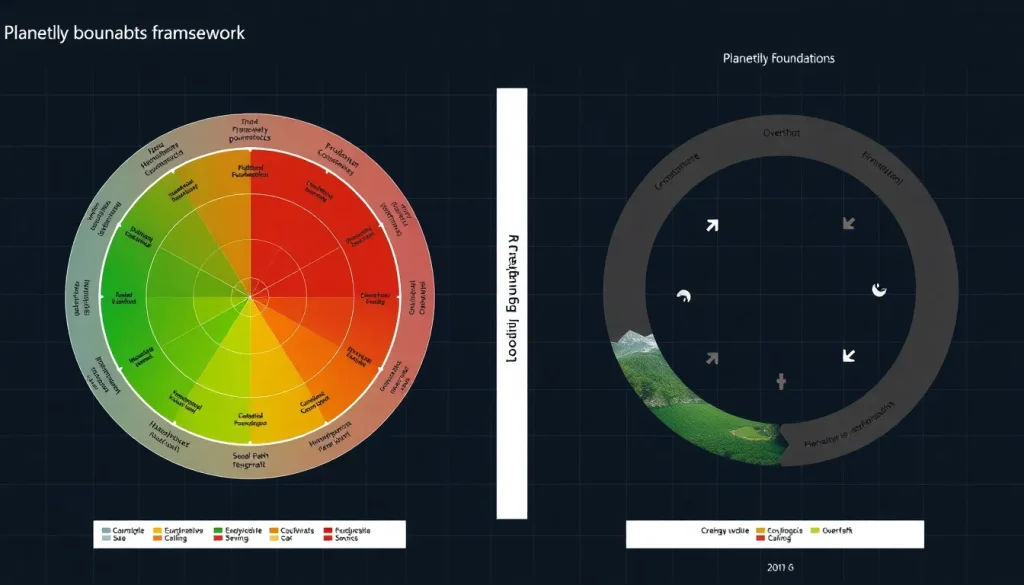
The planetary boundaries framework focuses solely on the biophysical limits of Earth-system processes, defining a safe operating space for humanity. Doughnut Economics adds a social foundation, creating a safe and just space that ensures all people have access to life’s essentials while staying within planetary boundaries. The doughnut thus integrates social and ecological dimensions into a single visual and conceptual model.
How many planetary boundaries are currently transgressed?
According to the 2023 update by Richardson et al., six of the nine planetary boundaries are transgressed: climate change, biosphere integrity (genetic and functional diversity), land-system change, freshwater change, biogeochemical flows (nitrogen and phosphorus), and novel entities. Three boundaries remain within the safe operating space: stratospheric ozone depletion, atmospheric aerosol loading, and ocean acidification (though ocean acidification is approaching its boundary).
Can a country be within the doughnut?
As of current assessments, no country operates fully within the doughnut—meeting all social thresholds while staying within all planetary boundaries. High-income countries typically meet social thresholds but overshoot multiple ecological boundaries, while low-income countries often stay within ecological limits but fail to meet social needs. The doughnut is thus a goal to strive for, not a current reality for any nation.
References
- Rockström, J., Steffen, W., Noone, K., et al. (2009). A safe operating space for humanity. Nature, 461, 472–475.
- Steffen, W., Richardson, K., Rockström, J., et al. (2015). Planetary boundaries: Guiding human development on a changing planet. Science, 347(6223), 1259855.
- Richardson, K., Steffen, W., Lucht, W., et al. (2023). Earth beyond six of nine planetary boundaries. Science Advances, 9(37), eadh2458.
- Raworth, K. (2017). Doughnut Economics: Seven Ways to Think Like a 21st-Century Economist. Random House.
- O’Neill, D. W., Fanning, A. L., Lamb, W. F., & Steinberger, J. K. (2018). A good life for all within planetary boundaries. Nature Sustainability, 1, 88–95.