In brief
At a glance
Quick Facts
- Definition
- Precipitation recycling is the contribution of local evaporation to precipitation in the same region.
- Key Metric
- The recycling ratio measures the fraction of precipitation originating from local evaporation versus moisture transported from elsewhere.
- Global Average
- On average, about 10–20% of continental precipitation is recycled, but this varies widely by region.
- High Recycling Regions
- The Amazon basin, central Africa, and the Eurasian interior have recycling ratios exceeding 50% during certain seasons.
- Influencing Factors
- Land cover, soil moisture, and atmospheric circulation patterns strongly influence recycling rates.
- Climate Impact
- Deforestation can reduce recycling, leading to decreased rainfall and increased drought risk in downwind areas.
- Measurement Methods
- Scientists use isotopic analysis, atmospheric models, and water vapor tracking to estimate recycling ratios.
Key Takeaways
- Precipitation recycling is the process where water that evaporates from a land area returns as precipitation to the same region, rather than being transported away by winds.
- It is a critical link between land surface conditions—such as soil moisture and vegetation—and local rainfall patterns.
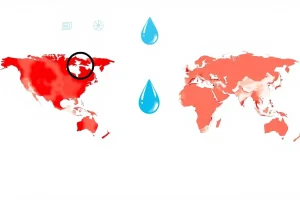
- Recycling ratios vary widely across the globe, from less than 5% in coastal zones to over 50% in large continental interiors like the Amazon basin.
- Understanding precipitation recycling is essential for predicting the impacts of deforestation, climate change, and land-use changes on regional water availability and drought risk.
What Is Precipitation Recycling?
Precipitation recycling is the process by which water that evaporates from a given land area subsequently falls as precipitation within the same area. In other words, it is the fraction of rainfall that originates from local evaporation rather than from moisture transported into the region by atmospheric winds. This concept is a fundamental part of the hydrological cycle and is sometimes referred to as moisture recycling or local precipitation recycling.
The idea is rooted in the observation that not all rain that falls over a continent comes directly from the ocean. A portion of it comes from water that has evaporated from the land surface—from soil, lakes, rivers, and vegetation (through transpiration). This locally sourced moisture can be lifted, condensed, and returned to the same land area as precipitation. The recycling ratio, typically expressed as a percentage, quantifies the contribution of this local evaporation to total precipitation. A high recycling ratio indicates that a region depends heavily on its own evaporative sources for rainfall, while a low ratio means that most of its precipitation is derived from moisture advected from elsewhere, often from oceans.
How It Works
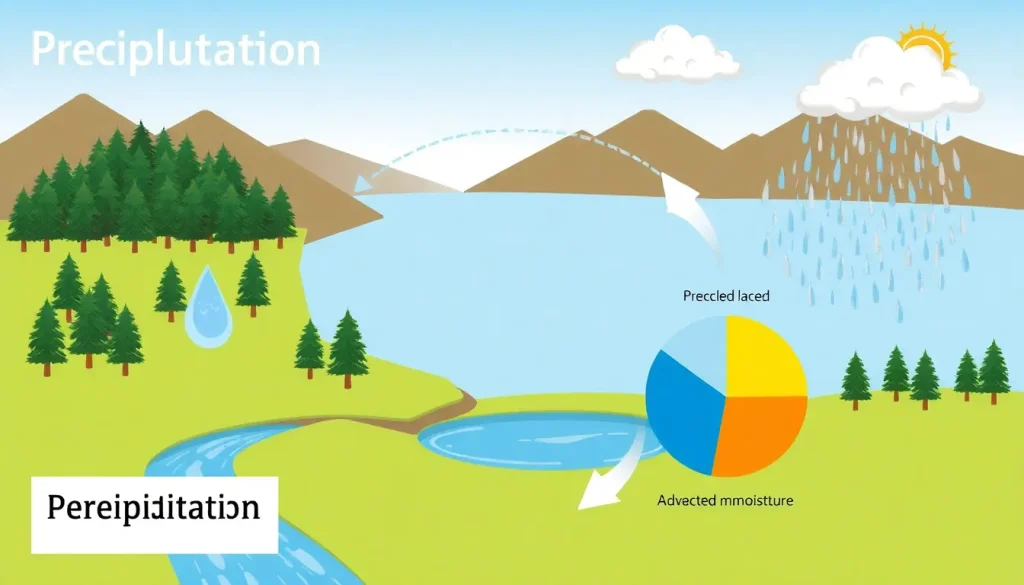
The physical mechanism of precipitation recycling involves several steps. First, solar energy drives evaporation from wet surfaces and transpiration from plants, collectively known as evapotranspiration. This process adds water vapor to the atmospheric boundary layer. Some of this moisture is mixed upward by turbulence and convection, forming clouds. When conditions are right, the water vapor condenses and falls as precipitation. If the air mass remains over the same region, a portion of that precipitation will have originated from the local evapotranspiration.

However, the atmosphere is in constant motion. Winds transport moisture horizontally—a process called advection. Therefore, the total precipitation over an area is a mixture of two sources: advected moisture (from outside the region) and recycled moisture (from local evaporation). The recycling ratio depends on the balance between these two sources. It is influenced by factors such as the size of the region, the rate of evapotranspiration, the speed and direction of winds, and the atmospheric moisture content. Larger regions tend to have higher recycling ratios because air masses spend more time over them, allowing more opportunity for local moisture to be entrained and precipitated.
Scientists estimate precipitation recycling using a variety of methods. One common approach is the bulk recycling model, which uses atmospheric water balance equations. Another method involves tracking water vapor using numerical weather prediction models or analyzing stable isotopes of water (e.g., oxygen-18 and deuterium) in precipitation, which carry signatures of their evaporative source. These techniques help distinguish between oceanic and terrestrial moisture sources.
Importance and Impact
Precipitation recycling is a crucial concept for understanding regional water resources and climate dynamics. In many continental interiors, a significant portion of rainfall is recycled, meaning that the land surface plays an active role in sustaining its own precipitation. This has profound implications for agriculture, ecosystems, and water management. For example, in the Amazon rainforest, estimates suggest that 25–50% of rainfall is recycled, making the forest a key regulator of its own climate. If large areas of forest are cleared, evapotranspiration decreases, which can reduce recycling and lead to less rainfall, potentially triggering a feedback loop of drying and further forest loss.
Recycling also influences the severity and persistence of droughts. During a drought, soil moisture is depleted, reducing evapotranspiration. This can lower the recycling ratio, further decreasing precipitation and intensifying the drought. Conversely, wet periods can enhance recycling, helping to maintain rainfall. Understanding these feedbacks is essential for predicting the impacts of climate change and land-use change on water availability. It also informs strategies for managing water resources, such as the role of irrigation in augmenting local rainfall or the consequences of large-scale deforestation.
Regional Differences
Precipitation recycling ratios vary dramatically across the globe, primarily due to differences in geography, climate, and land cover. Coastal regions typically have low recycling ratios (often below 10%) because they receive abundant moisture directly from the ocean. In contrast, continental interiors far from oceanic moisture sources tend to have higher recycling ratios. For instance, the central United States, the Eurasian steppe, and the Sahel region of Africa all exhibit moderate to high recycling, especially during the growing season when evapotranspiration is high.
The Amazon basin is one of the most studied regions for precipitation recycling, with ratios often exceeding 50% during the wet season. The Congo Basin in Africa and the boreal forests of Siberia also show substantial recycling. In arid and semi-arid regions, recycling can be highly variable and sensitive to land surface conditions. Seasonal patterns are also important: in many mid-latitude regions, recycling is higher in summer when evapotranspiration peaks and lower in winter when the land surface is dormant or snow-covered. These regional differences highlight the need for localized assessments when evaluating the impacts of land-use change on water resources.
Connections to Other Systems
Precipitation recycling is intimately linked to several other Earth system processes. It is a key component of land-atmosphere interactions, where changes in land cover (e.g., deforestation, afforestation, urbanization) alter surface albedo, roughness, and evapotranspiration rates, which in turn affect local and regional climate. For example, replacing forest with cropland typically reduces evapotranspiration, lowering the recycling ratio and potentially decreasing downwind precipitation.
Recycling also connects to the global water cycle and atmospheric circulation patterns. Large-scale phenomena such as El Niño–Southern Oscillation (ENSO) can shift moisture transport pathways, altering recycling ratios in distant regions. Climate change is expected to modify recycling by increasing atmospheric water vapor capacity (according to the Clausius–Clapeyron relation) and changing wind patterns. However, the net effect is complex: while higher temperatures may increase evaporation, they can also lead to more intense convection and moisture export. Additionally, irrigation practices can artificially enhance local recycling, creating “oasis effects” in arid regions. Understanding these connections helps scientists model future climate scenarios and assess the resilience of water supplies.
Data Limitations and Uncertainties
Despite its importance, precipitation recycling remains challenging to quantify accurately. Direct measurement of the recycling ratio is not possible; it must be inferred from models or indirect observations. Atmospheric reanalysis products, which combine observations with weather models, provide estimates of moisture fluxes, but they are subject to uncertainties in evapotranspiration, wind fields, and precipitation data. Isotopic methods offer valuable insights but require extensive sampling networks and are influenced by fractionation processes that can complicate interpretation.
Another limitation is the scale dependence of recycling estimates. The recycling ratio is highly sensitive to the size of the region considered: a larger area will naturally capture more of its own evaporated moisture. Therefore, comparisons between studies must account for differences in spatial domain. Furthermore, most models simplify complex processes such as cloud microphysics and convective transport, which can introduce biases. Ongoing research aims to improve these estimates through higher-resolution modeling, better satellite observations of water vapor and soil moisture, and expanded isotopic monitoring networks. Acknowledging these uncertainties is essential for robust decision-making in water resource management and climate adaptation.
FAQ
What is precipitation recycling?
Precipitation recycling is the process where water that evaporates from a land area returns as precipitation to the same area, rather than being transported away by winds.
How does precipitation recycling work?
It works through evaporation from soil, plants, and water bodies, which adds moisture to the atmosphere. Some of this moisture condenses and falls as rain within the same region, while the rest is advected elsewhere.
Why does precipitation recycling matter?
It matters because it sustains rainfall in continental interiors, influences regional climate, and is sensitive to land-use changes like deforestation, which can reduce local rainfall and exacerbate droughts.
References
- Brubaker, K. L., Entekhabi, D., & Eagleson, P. S. (1993). Estimation of continental precipitation recycling. Journal of Climate, 6(6), 1077-1089.
- Trenberth, K. E. (1999). Atmospheric moisture recycling: Role of advection and local evaporation. Journal of Climate, 12(5), 1368-1381.
- Eltahir, E. A. B., & Bras, R. L. (1994). Precipitation recycling in the Amazon basin. Quarterly Journal of the Royal Meteorological Society, 120(518), 861-880.