In brief
At a glance
Quick Facts
- Definition of a tipping point
- A critical threshold at which a small perturbation can qualitatively alter the state or development of a system.
- Number of identified climate tipping elements
- Scientists have identified at least 15 major tipping elements in the Earth system.
- Example of a positive feedback loop
- Arctic sea ice loss reduces albedo, causing more heat absorption, which melts more ice.
- Cascading tipping points
- The collapse of the Greenland Ice Sheet could slow the AMOC, affecting monsoon systems and the Amazon rainforest.
- Irreversibility
- Many tipping points, once crossed, lead to irreversible changes on human timescales.
- Temperature thresholds
- Some tipping points may be triggered at warming levels as low as 1.5°C above pre-industrial levels.
- Policy relevance
- Interacting tipping points increase the urgency of limiting global warming to well below 2°C.
- Economic impact
- Cascading tipping points could lead to trillions of dollars in damages from sea-level rise, extreme weather, and ecosystem collapse.
Key Takeaways
- Tipping points in the Earth system are critical thresholds where a small change can trigger a large, often irreversible shift in a subsystem.
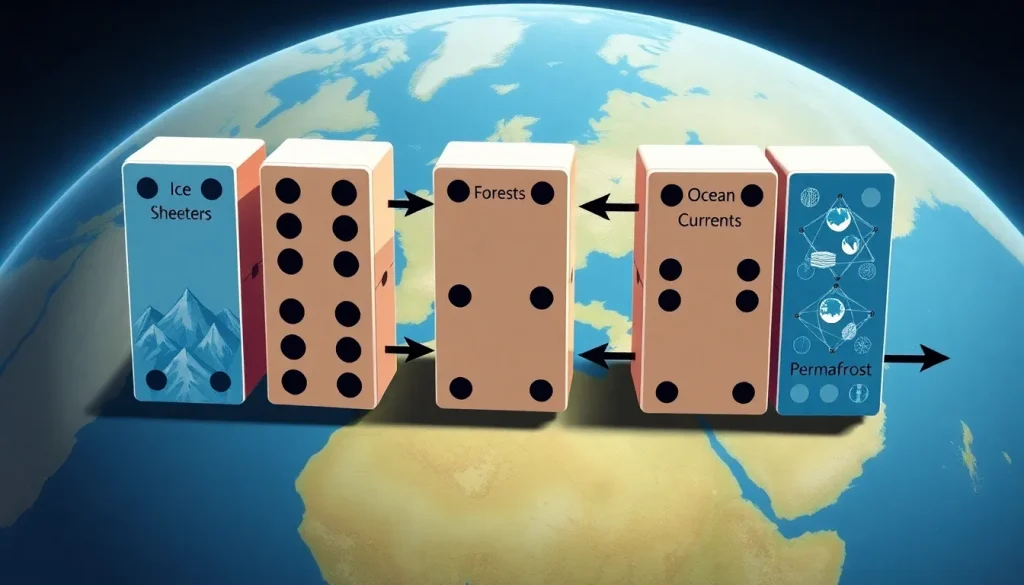
- Multiple tipping points can interact and reinforce one another through feedback loops, increasing the risk of cascading effects.
- Such interactions can lower the threshold for triggering individual tipping points, making the whole system more sensitive to perturbations.
- Understanding these interactions is crucial for assessing the full risks of climate change and for setting safe planetary boundaries.
What Is Why Multiple Tipping Points Could Reinforce One Another?
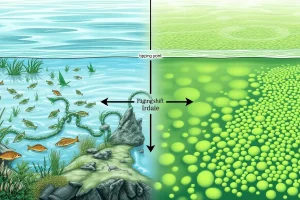
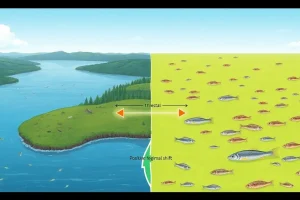
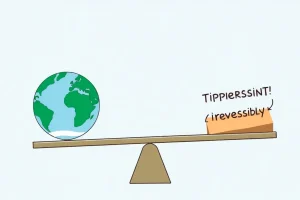
The concept that multiple tipping points could reinforce one another refers to the phenomenon where crossing a critical threshold in one part of the Earth system increases the likelihood of crossing thresholds in other parts, creating a domino effect that amplifies the overall impact of climate change. A tipping point is a point of no return: once passed, a system shifts into a new state, often abruptly and irreversibly on human timescales. When these tipping points are connected through physical, biological, or chemical processes, the destabilization of one can push others toward their own thresholds, leading to a cascade of changes that can fundamentally alter the planet’s climate, ecosystems, and habitability.
This idea is central to the study of Earth system dynamics and climate risk assessment. It moves beyond the traditional view of isolated tipping elements—such as the Greenland Ice Sheet or the Amazon rainforest—and recognizes that the Earth operates as a single, interconnected system. The interactions between tipping points can create positive feedback loops that accelerate warming and environmental degradation, making the climate more sensitive to human-induced greenhouse gas emissions than previously thought. As a result, the risk of triggering a cascade of tipping points is now considered one of the most serious threats posed by climate change, with implications for global policy, adaptation, and the long-term stability of the planet.
How It Works
The reinforcement of multiple tipping points occurs primarily through feedback mechanisms—processes that amplify or dampen an initial change. In the context of climate tipping points, positive feedback loops are the main drivers of interaction. When one tipping element is pushed past its threshold, it can release or alter flows of energy, water, or carbon that affect other parts of the system. For example, the loss of Arctic sea ice reduces the Earth’s albedo (reflectivity), causing more solar radiation to be absorbed by the ocean, which in turn warms the region further. This additional warming can accelerate the thawing of permafrost, releasing large amounts of methane and carbon dioxide—potent greenhouse gases—that further enhance global warming. The enhanced warming then increases the risk of other tipping points, such as the dieback of the Amazon rainforest or the destabilization of the West Antarctic Ice Sheet.

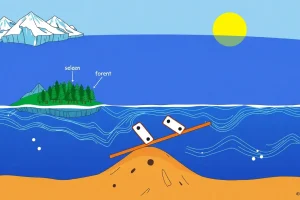
Another key mechanism is the disruption of large-scale circulation patterns. The Atlantic Meridional Overturning Circulation (AMOC), a major ocean current system that transports heat around the globe, can be weakened by an influx of freshwater from melting ice sheets. A slowdown or collapse of the AMOC would alter regional climates, potentially shifting tropical rainfall belts and intensifying droughts in the Amazon, which could push that rainforest past its tipping point. Similarly, changes in the Indian monsoon or the West African monsoon can be triggered by remote tipping events, affecting water availability and food security for billions of people. These teleconnections—climate linkages over vast distances—mean that a tipping point in one region can have far-reaching consequences, setting off a chain reaction that is difficult to predict or control.
Examples
Several well-documented tipping elements illustrate how interactions can occur. The Greenland Ice Sheet, for instance, is losing mass at an accelerating rate. If it passes a critical threshold, its meltwater could contribute to a significant slowdown of the AMOC. A weakened AMOC would reduce heat transport to the North Atlantic, causing cooling in Europe but also shifting tropical rain belts southward, which could dry out the Amazon basin. The Amazon, in turn, is a major carbon sink; its dieback would release vast quantities of CO₂, further warming the planet and accelerating ice loss in both Greenland and Antarctica. This chain of events demonstrates how ice sheets, ocean circulation, and terrestrial ecosystems are linked in a web of potential cascades.
Another example involves permafrost and boreal forests. Warming in the Arctic is causing permafrost to thaw, releasing methane and CO₂. This not only amplifies global warming but also increases the frequency and intensity of wildfires in boreal forests. These fires release additional carbon and black carbon (soot) that can settle on ice sheets, reducing their albedo and accelerating melting. The loss of boreal forest also reduces the land’s ability to sequester carbon, creating a self-reinforcing cycle. Coral reefs, too, are a tipping element: ocean warming and acidification can cause widespread coral bleaching and mortality. The collapse of reef ecosystems disrupts marine food webs and reduces the protection of coastlines from storm surges, which can have knock-on effects for human communities and further stress other marine tipping points, such as the loss of kelp forests or the destabilization of methane hydrates on the seafloor.
Connections to Other Systems
The interactions among climate tipping points do not occur in isolation; they are deeply connected to ecological, social, and economic systems. For example, the collapse of the West Antarctic Ice Sheet would contribute to several meters of sea-level rise over centuries, displacing hundreds of millions of people from coastal cities and low-lying island nations. This displacement can trigger geopolitical instability, resource conflicts, and mass migration, which in turn can strain governance and economic systems, potentially hindering the global response to climate change. Similarly, the dieback of the Amazon would not only release carbon but also disrupt regional rainfall patterns that support agriculture across South America, threatening food production and livelihoods.
Ecosystem services—such as pollination, water purification, and fisheries—are also at risk. The loss of coral reefs and the disruption of ocean circulation can lead to the collapse of fish stocks, affecting food security for billions. Changes in monsoon patterns can cause both devastating floods and prolonged droughts, impacting water availability and hydropower generation. These cascading impacts highlight that tipping point interactions are not just a geophysical phenomenon; they have profound consequences for human well-being and the stability of societies. Recognizing these connections is essential for developing holistic risk assessments and adaptation strategies that account for the full spectrum of potential outcomes.
Importance and Impact
Understanding why multiple tipping points could reinforce one another is critical for climate policy and risk management. The existence of tipping cascades implies that the Earth system may have a point of no return—a global threshold beyond which self-amplifying changes could propel the planet into a much warmer, less stable state, often referred to as a “Hothouse Earth” scenario. This would make the impacts of climate change far more severe and unpredictable than current models project, potentially exceeding the limits of human adaptation. The risk of such cascades strengthens the case for ambitious mitigation targets, such as limiting global warming to 1.5°C or well below 2°C above pre-industrial levels, as enshrined in the Paris Agreement.
The economic and social costs of triggering multiple tipping points are difficult to quantify but are likely to be enormous. Sea-level rise alone from ice sheet collapse could cost trillions of dollars in lost infrastructure and displacement. Agricultural disruptions, water scarcity, and increased extreme weather events would compound these costs. Moreover, the irreversible nature of many tipping points means that once crossed, the changes cannot be undone on any practical timescale, locking future generations into a more hostile world. This underscores the importance of precautionary action and the need to integrate tipping point risks into climate models, economic assessments, and long-term planning.
Common Misconceptions
One common misconception is that tipping points are independent events that occur in isolation. In reality, the Earth system is highly interconnected, and a change in one component can propagate through the system in unexpected ways. Another misconception is that tipping points only become relevant at very high levels of warming. While some tipping elements have higher thresholds, others—such as the loss of Arctic summer sea ice or the degradation of coral reefs—may be triggered at warming levels as low as 1.5°C to 2°C. Additionally, the idea that tipping points are always abrupt and dramatic is misleading; some transitions may unfold over decades or centuries, but once initiated, they are effectively irreversible on human timescales.
There is also a tendency to assume that we can simply reverse a tipping point if we reduce emissions or remove carbon from the atmosphere. However, many tipping points exhibit hysteresis, meaning that the path to recovery requires a much larger reversal of the forcing than the one that caused the initial shift. For example, even if global temperatures were lowered, the Greenland Ice Sheet might not regrow because the ice-albedo feedback and the shape of the ice sheet itself create a new stable state. This irreversibility makes prevention far more effective than cure, reinforcing the urgency of early and decisive action to avoid crossing these thresholds in the first place.
Data Limitations and Uncertainties
Despite growing scientific understanding, significant uncertainties remain about the exact thresholds, timing, and interactions of tipping points. Climate models are still limited in their ability to simulate the complex, non-linear processes that govern tipping elements, such as ice sheet dynamics, permafrost carbon release, and ecosystem responses. The interactions between tipping points are even more challenging to model because they involve multiple spatial and temporal scales and feedbacks that are not fully captured in current Earth system models. As a result, projections of tipping cascades are often based on expert elicitation, simplified models, or paleoclimate evidence rather than on fully coupled simulations.
Paleoclimate records provide valuable insights into past tipping point behavior, showing that the Earth system has undergone abrupt shifts in the past, such as during the end of the last ice age. However, the current rate of warming is unprecedented, and the combination of stressors—including land-use change, pollution, and biodiversity loss—adds layers of complexity that have no direct analog in the past. This means that while the risk of interacting tipping points is considered high, the precise sequence and magnitude of potential cascades remain uncertain. Ongoing research, improved observations, and higher-resolution models are essential to reduce these uncertainties and provide more robust guidance for decision-makers.
FAQ
What is a climate tipping point?
A climate tipping point is a critical threshold in a component of the Earth system—such as an ice sheet, ecosystem, or ocean current—beyond which a small additional perturbation can trigger a large, often irreversible change in its state.
How can tipping points reinforce each other?
Tipping points can reinforce each other through positive feedback loops and teleconnections. For example, melting Arctic sea ice warms the region, which thaws permafrost and releases greenhouse gases, further warming the planet and increasing the risk of other tipping points like Amazon dieback or ice sheet collapse.
Why does the interaction of tipping points matter?
The interaction of tipping points matters because it can lead to cascading, self-amplifying changes that make climate change more severe and unpredictable. This increases the risk of crossing a global threshold into a 'Hothouse Earth' state, with profound and irreversible impacts on ecosystems, economies, and societies.
References
- Lenton, T. M., et al. (2008). Tipping elements in the Earth's climate system. Proceedings of the National Academy of Sciences, 105(6), 1786–1793.
- Steffen, W., et al. (2018). Trajectories of the Earth System in the Anthropocene. Proceedings of the National Academy of Sciences, 115(33), 8252–8259.
- IPCC (2021). Climate Change 2021: The Physical Science Basis. Contribution of Working Group I to the Sixth Assessment Report of the Intergovernmental Panel on Climate Change. Cambridge University Press.