In brief
At a glance
Quick Facts
- Core Principle
- Mass balance: inputs = outputs + net stock change
- Key Equation
- Inputs = Outputs + ΔStock
- Common Units
- Mass (e.g., tonnes, kilograms)
- Typical System Boundaries
- National economy, urban area, industrial sector, specific substance
- Primary Applications
- Resource efficiency, waste management, environmental policy, circular economy
- Related Disciplines
- Industrial ecology, environmental accounting, systems analysis
- First Major Use
- Early applications in the 1970s for regional metabolism studies
- Global Standard
- Eurostat's Economy-Wide Material Flow Accounts (EW-MFA) framework
Key Takeaways
- Material Flow Analysis (MFA) is a systematic method for quantifying the flows and stocks of materials within a defined system, based on the principle of mass conservation.
- It provides a comprehensive picture of how materials enter, move through, and exit a system, enabling the identification of inefficiencies, waste, and opportunities for resource optimization.
- MFA is a foundational tool for environmental management, supporting the transition to a circular economy and informing policies on resource efficiency and waste reduction.
- While powerful, MFA relies on data availability and quality, and its static nature may not capture dynamic changes without repeated assessments or modeling extensions.
What Is Material Flow Analysis?
Material Flow Analysis (MFA) is a systematic method for quantifying the flows and stocks of materials within a system defined in space and time. It is rooted in the principle of mass conservation, meaning that the total mass entering a system must equal the total mass leaving the system plus any net accumulation (or depletion) of stocks within it. MFA provides a comprehensive accounting of how materials—such as metals, plastics, biomass, or chemicals—move through a specific system, whether that is a single industrial process, a factory, a city, a region, or an entire national economy.
MFA belongs to the broader field of industrial ecology and is closely related to environmental accounting. It serves as a diagnostic tool to understand the metabolism of socioeconomic systems, analogous to the study of nutrient flows in natural ecosystems. By tracking materials from extraction or import through processing, consumption, and final disposal or recycling, MFA reveals the structure and scale of material use. This information is essential for identifying inefficiencies, assessing environmental pressures, and designing strategies for sustainable resource management. MFA can be applied to bulk materials (such as total material throughput of a nation), specific substances (like lead or phosphorus), or individual products (such as electronic devices).
Overview
Material Flow Analysis is a core method in industrial ecology and environmental accounting. It provides a quantitative framework for understanding the “metabolism” of a system—how it consumes resources and generates waste. The approach is based on the law of conservation of mass: within any defined system, the total mass of inputs must equal the total mass of outputs plus any change in stock. This simple balance equation underpins all MFA studies, ensuring consistency and completeness.
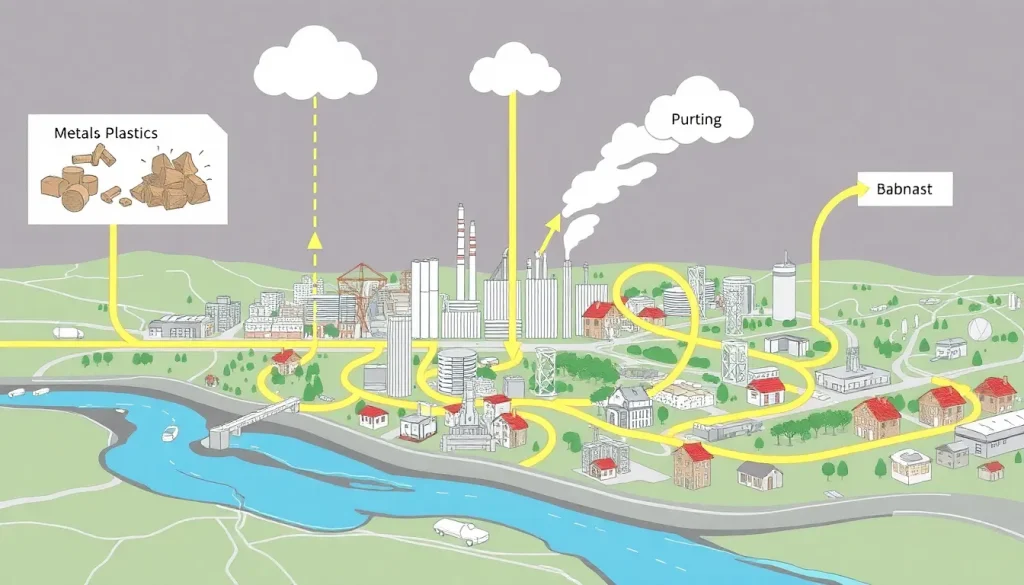
MFA can be conducted at various scales and for different purposes. Economy-wide MFA (EW-MFA) tracks the total material throughput of a national or regional economy, including biomass, fossil fuels, metals, and non-metallic minerals. Substance flow analysis (SFA) focuses on a specific chemical element or compound, such as nitrogen, phosphorus, or mercury, to understand its pathways and potential environmental or health impacts. Product-level MFA examines the life cycle of a particular good, from raw material extraction to end-of-life management. Regardless of the scale, MFA provides a systematic way to visualize and quantify material flows, often using Sankey diagrams to represent the magnitude of flows between processes. The method is widely used by governments, international organizations, and researchers to monitor resource use, set targets, and evaluate policy effectiveness.
How It Works
Conducting a Material Flow Analysis involves several key steps, each requiring careful definition and data collection. The process is iterative and may be refined as new information becomes available.
- System definition: The analyst defines the spatial and temporal boundaries of the system, the materials to be tracked, and the processes or compartments within the system. For example, a study might examine the flow of aluminum in the United States for a given year, with processes including mining, refining, manufacturing, use, and recycling. Clear system boundaries are essential to avoid double counting or omissions.
- Data collection and estimation: Data on material inputs, outputs, and stocks are gathered from various sources, such as industry statistics, trade databases, environmental reports, and scientific literature. When direct data are unavailable, estimates are made using mass balance, expert judgment, or proxy data. The quality of the MFA depends heavily on the reliability of these data.
- Mass balance calculation: Using the conservation of mass, the analyst ensures that for each process and the system as a whole, inputs equal outputs plus stock changes. This step often reveals data gaps or inconsistencies that require further investigation. The basic equation is: Inputs = Outputs + ΔStock.
- Modeling and visualization: The quantified flows and stocks are typically represented in a flow chart or Sankey diagram, where the width of arrows is proportional to the mass of material. Software tools such as STAN (Substance Flow Analysis) are commonly used to build and balance the model.
- Interpretation and analysis: The results are analyzed to identify key flows, losses, accumulation points, and inefficiencies. Indicators such as recycling rates, material intensity, and resource productivity can be derived to support decision-making. Sensitivity analysis may be performed to assess the influence of uncertain data.
Importance and Impact
Material Flow Analysis is a critical tool for addressing the environmental challenges associated with material consumption. By revealing the full picture of resource use, MFA helps policymakers, businesses, and researchers understand the scale of material throughput and its link to environmental degradation, including greenhouse gas emissions, land use change, and pollution. It provides the evidence base needed to design effective resource efficiency strategies and monitor progress toward sustainability goals.
MFA is particularly important for the circular economy transition. It identifies where materials are lost as waste, where recycling loops can be closed, and where dematerialization or substitution can reduce environmental impacts. For example, an MFA of plastics can show the low recycling rates and high leakage into the environment, motivating policies to improve collection and recycling infrastructure. At the national level, economy-wide MFA indicators, such as domestic material consumption (DMC), are used to track resource productivity and decouple economic growth from material use. International bodies like the United Nations Environment Programme and the Organisation for Economic Co-operation and Development rely on MFA to produce global resource outlooks and inform sustainable development policies.
Examples
Material Flow Analysis has been applied to a wide range of systems and materials, yielding valuable insights for policy and management.
- National economy-wide MFA: Many countries and international organizations compile regular economy-wide material flow accounts. These accounts show that global material extraction has grown significantly, with construction minerals, biomass, and fossil fuels dominating. Such analyses highlight the uneven distribution of resource consumption and the need for absolute reductions in material use in high-income countries.
- Urban metabolism: Cities like Vienna, London, and Beijing have been studied using MFA to understand their resource dependencies and waste generation. For instance, an MFA of a city’s food system can reveal the nitrogen and phosphorus flows, helping to design urban agriculture and waste-to-resource strategies.
- Phosphorus flow analysis: Phosphorus is a critical nutrient for agriculture but a pollutant in water bodies. MFA studies have traced phosphorus flows from mining to fertilizer application, food consumption, and wastewater treatment, identifying opportunities for recovery and reuse to reduce both scarcity and eutrophication.
- Steel recycling: MFA of steel in the automotive or construction sectors quantifies the recycling rates and the accumulation of steel in in-use stocks. This information helps forecast future scrap availability and design for disassembly and recycling.
- Electronic waste: MFA of precious metals in electronic devices reveals the significant losses of gold, silver, and palladium due to low collection and recycling rates, highlighting the economic and environmental benefits of improved e-waste management.
Benefits, Limitations and Trade-offs
MFA offers several distinct benefits. It provides a holistic, quantitative overview of material flows, making it possible to identify hidden losses and inefficiencies that would be missed by looking at individual processes in isolation. The mass balance approach ensures internal consistency and can reveal data gaps or errors. MFA results are easily communicated through visualizations like Sankey diagrams, facilitating stakeholder engagement. Moreover, MFA can be linked to environmental impact assessments, such as life cycle assessment (LCA), to evaluate the environmental consequences of material flows.
However, MFA also has limitations. It is data-intensive, and the quality of the analysis depends heavily on the availability and accuracy of input data. In many cases, data are incomplete, outdated, or inconsistent, requiring assumptions that introduce uncertainty. Traditional MFA is static, providing a snapshot for a specific time period, which may not capture dynamic changes or future trends. Extensions like dynamic MFA can address this but add complexity. There is also a trade-off between system detail and feasibility: highly disaggregated models require more data and effort, while overly aggregated models may miss important nuances. Finally, MFA focuses on mass flows and does not directly assess environmental impacts; it must be combined with other methods to evaluate toxicity, carbon footprint, or other effects.
Data Limitations and Uncertainties
The reliability of an MFA depends critically on the quality of the underlying data. Common challenges include a lack of consistent data across different regions or time periods, confidential business information that is not publicly available, and the difficulty of measuring diffuse flows such as corrosion, wear, or littering. In many developing countries, formal data collection systems are weak, making comprehensive MFA difficult. Even in data-rich environments, discrepancies between different data sources can lead to conflicting results.
To address these issues, analysts use uncertainty analysis techniques, such as sensitivity analysis or Monte Carlo simulation, to quantify the range of possible results. Data reconciliation methods can help adjust measured values to satisfy mass balance constraints. Despite these tools, MFA results should be interpreted with an understanding of their limitations. Transparent documentation of data sources, assumptions, and uncertainty ranges is essential for credibility and for guiding future data collection efforts. As MFA becomes more integrated into policy-making, improving data infrastructure and standardization remains a priority.
FAQ
What is Material Flow Analysis?
Material Flow Analysis (MFA) is a systematic method for quantifying the flows and stocks of materials within a defined system, based on the principle of mass conservation. It tracks materials from extraction or import through processing, consumption, and disposal, providing a comprehensive picture of resource use.
How does Material Flow Analysis work?
MFA works by defining a system boundary, collecting data on material inputs and outputs, and applying mass balance equations to ensure that total inputs equal total outputs plus any change in stock. The results are often visualized using Sankey diagrams to show the magnitude of flows.
Why does Material Flow Analysis matter?
MFA matters because it reveals inefficiencies, waste, and environmental pressures in material use. It supports the transition to a circular economy, informs resource efficiency policies, and helps monitor progress toward sustainability goals.
References
- Brunner, P.H. and Rechberger, H. (2016). Handbook of Material Flow Analysis. CRC Press.
- Eurostat. Economy-wide material flow accounts handbook.
- UNEP. Global Material Flows and Resource Productivity.